
I sincerely hope that people have been preparing for this day, not just consuming headlines.
This was the warning.

Saudi ships mobbed and set alight in attack by Houthis
From Hal Turner
Red Sea: Saudi Tanker Vessel Hit By Houthi Missile - Burning
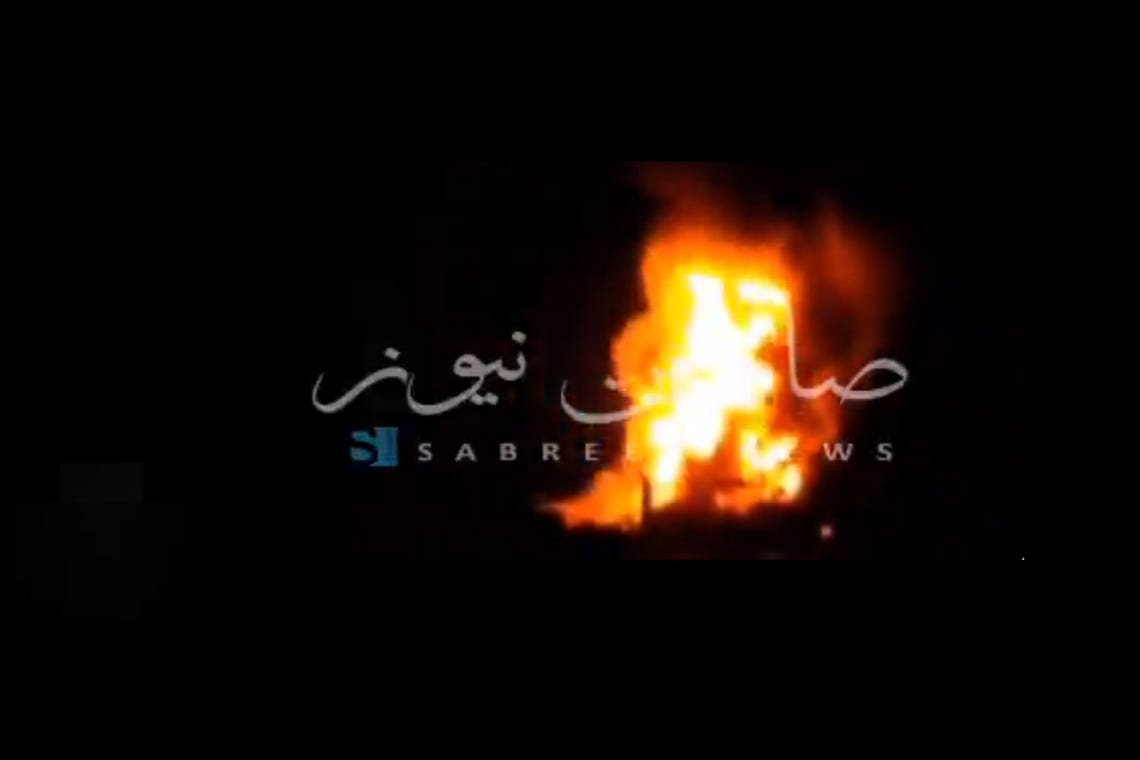
The Houthis in Yemen have fired a missile at, and scored a direct hit upon, a Saudi Arabian Tanker Vessel in the Red Sea.
The Houthis in Yemen declared a Blockade on all ships trying to enter or leave Saudi Arabia ports, saying they would fire upon such ships. Today, the Houthis made good on that threat.
The tanker vessel, name as yet unknown, is burning in the Red Sea as of 6:02 PM eastern US time on Wednesday, July 22, 2026.
UPDATE 6:32 PM EDT --
A Statement by the Yemeni Armed Forces regarding the execution of a special military operation that targeted two Saudi oil tankers, one of which bears the name “ENCELIA” and the other “LAYLA,” for their violation of the blockade decision issued by the Armed Forces.
The Yemen Army says they used a number of ballistic and cruise missiles, as well as drones to strike the two ships.
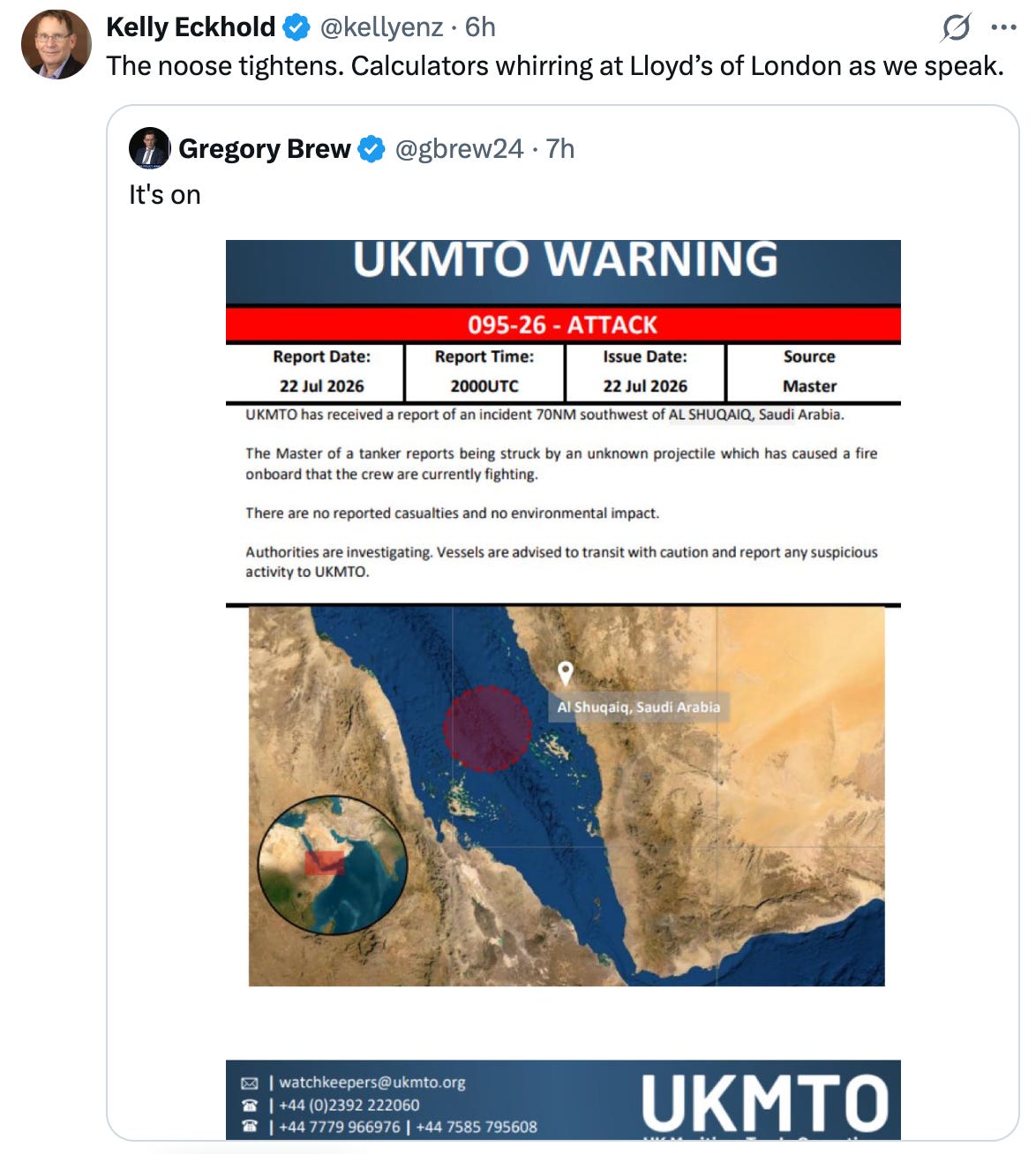
Is someone waking out of their slumber.?
This is NZ economist, Kelly Eckhold.
From Pepe Escobar and Larry Johnson at Transition Protocol
SECURITY BRIEFING — SPECIAL MID-WEEK EDITION · FOR ALL SUBSCRIBERS
Wednesday, July 22, 2026 · The Strategic Rupture in West Asia
Jul 23, 2026
A gift for all subscribers, free and paid alike — our complete Security Briefing, unlocked for everyone this week
Why you are receiving this. The weekly Security Briefing is normally reserved for paid subscribers. Not this one. What is unfolding this week between Washington, Tehran, Islamabad, Beijing, and the Red Sea will reach every reader of this letter — at the pump, in the markets, and in the security architecture of the world your family lives in. When the story is this consequential, our judgment is simple: everyone who trusts us with their attention should have our full picture. This edition is our gift to all subscribers, free and paid alike.
Disclosure standard. Every item carries a confidence label consistent with our on-air standard: [CONFIRMED] — established in the public record; [SOURCED] — Transition Protocol reporting from sources with direct access, corroborated across contacts or consistent with the public record’s direction of travel; [SINGLE-SOURCE] — attributed intelligence from one highly placed source, unverified. Read each item at its labeled weight — that discipline is why this briefing exists.
Bottom Line Up Front
Sunday’s briefing closed on a knife’s edge: Pakistani officials privately believed a deal was reachable by Friday, while our most sensitive sourcing said the Supreme Leader’s office had already said no — and we wrote that one of those two things would prove wrong within the week. The week did not wait for Friday. Beijing’s informal Monday deadline passed not in silence but in fire: an eleventh consecutive night of American strikes, Iranian salvos against Jordan, Kuwait, and Bahrain, and — per our sourcing — an off-ramp that Islamabad successfully delivered and Washington rejected on the spot. The Houthis declared a maritime blockade of Saudi Arabia on Monday, putting the second of the world’s two great oil chokepoints under pressure at once, and Brent crossed $94. And our most sensitive reporting now puts a number on the horizon: Tehran’s inner circle is preparing for a final showdown within ten days. This edition lays out what is confirmed, what our sources report, and precisely how much weight to give each.
The Board as It Stands [CONFIRMED]
The public record, before the exclusive reporting — because our sourced material only matters against it. The United States has now flown eleven consecutive nights of strikes against Iranian military targets, and senior officials are publicly talking down the prospect of near-term negotiations. Iran’s July 17 ballistic-missile and drone attack on Muwaffaq Salti Air Base in Jordan killed American service members — CENTCOM confirmed two killed and one missing, later recovering remains now being identified — and this morning the fallen were honored at a dignified transfer at Dover Air Force Base. Mainstream coverage is now openly asking how four Iranian attacks in five days penetrated U.S. missile defenses; the Secretary of State’s own words: “a missile got through.”
The economic tape has followed the ordnance. Brent crude touched $94 today — up more than twenty percent in a month — West Texas Intermediate sits near $87, and U.S. pump prices are back above four dollars. On Monday, Ansarallah — the Houthis, in the wire services’ shorthand — declared a maritime blockade of Saudi Arabia at the Bab el-Mandeb, directly threatening the Yanbu corridor that had become the kingdom’s last reliable export outlet, with roughly three-quarters of Saudi crude moving through it this month. And on the same day, Iranian Interior Minister Eskandar Momeni arrived in Islamabad at the head of a high-level delegation, on a visit officially framed around border security, trade, and agriculture. Iran’s parliament national-security committee has declared the June MoU “no longer valid.” Everything below this line is what the public record does not yet show.
The Deadline Passed in Fire [SOURCED]
Sunday’s briefing reported Beijing’s informal Monday deadline for de-escalation, transmitted through Ishaq Dar after Shanghai. That deadline has now expired — and the answer was escalation on every axis. Our reporting adds the uncomfortable nuance: Beijing is driving the diplomacy and is in no particular hurry for it to succeed on Washington’s timetable. China’s interest in reopening Hormuz is real; so is its interest in watching American precision-missile inventories drain and American bases empty. Both things are true at once, and Pakistani officials navigating between them know it. Islamabad’s instruction set from Beijing — get both sides to the table — remains in force; what has changed is that the party refusing the table, per our sourcing this week, was not Tehran.
The Off-Ramp, Delivered and Dead [SOURCED]
This is the week’s central development, and it inverts the story most of the press is telling. Our sources — confirmed and reconfirmed — report that President Trump has been calling Field Marshal Asim Munir day after day, pressing for an exit “that is not equivalent to my humiliation,” in the words relayed to us. (That is a source’s account of private communications, not a public statement; treat it accordingly.) Pakistan delivered. Tehran, through the Islamabad channel, offered a conditional pause — duration flexible, one day or ten — contingent on a single, non-negotiable term: the United States returns to the June MoU and begins fulfilling it from minute one. Implementation, not renegotiation. Per our sourcing, Washington rejected the offer immediately.
Why it matters. The rejection is invisible in the public record, but its shadow is not: on the very day oil crossed $94, U.S. officials publicly dismissed the prospect of new talks. Iran’s negotiators, per our reporting, anticipated the rejection — the offer was made in part to establish, before Beijing and the Gulf capitals, which party killed the last off-ramp. That record now exists, and every government in the channel knows it. Sunday’s single-source report that the Supreme Leader’s office had rejected the revived framework should be read alongside this: both accounts can be true — a leadership with no faith in American commitments, still permitting Islamabad one final demonstration of who says no.
Momeni’s Extended Mission [SOURCED]
Interior Minister Momeni’s visit — flagged in Sunday’s watch list under “unusual travel” — has extended beyond Islamabad to Lahore, with meetings including Prime Minister Shehbaz Sharif and Field Marshal Munir. The official agenda is diplomatic cover. The substantive mission, per our reporting, is verification: Momeni is not merely carrying Tehran’s terms — his Interior portfolio places him inside Iran’s security and intelligence architecture, and he is assessing first-hand whether Pakistan’s channel to Washington is real, durable, and worth Tehran’s continued investment. Our understanding is that he is satisfied with what he has found, and will return to Tehran within days to report to the leadership. His report — not any public statement — is the next true decision point in the diplomacy.
The Ten-Billion-Dollar Ask [SOURCED]
Pakistan is converting geopolitical access into financial protection. Our reporting: Finance Minister Muhammad Aurangzeb has formally requested a rare $10 billion U.S. exchange-stabilization facility — a direct Treasury backstop, potentially maturing over five years — delivered personally to Treasury Secretary Scott Bessent. This is not an IMF extension; Washington has historically granted such facilities only to a handful of strategically indispensable states. Islamabad’s theory of the case is explicit: it has kept the only credible mediation channel alive, and it expects to be compensated at Treasury level for it.
Why it matters. Watch the facility as a barometer. Approval would signal Washington still values — and intends to keep using — the Islamabad channel. Refusal, or slow-walking, would tell Islamabad its leverage is depreciating, with consequences for how hard Pakistan works the next round. It also cuts the other way: a Pakistan visibly susceptible to American financial pressure is a Pakistan that Tehran, in Larry Johnson’s phrase from today’s episode, handles “like a cobra” — useful, but gripped firmly.
The Arsenal Ledger [SOURCED]
The material foundation of the entire crisis is now visible: the United States is expending precision munitions — PAC-3 and THAAD interceptors, HARM, Tomahawk, JASSM, PrSM — faster than they can be replaced, with rebuild timelines our analysis puts at four to six years per category. The chokehold on the rebuild is not budgetary but material: the guidance systems run on rare-earth elements that China effectively monopolizes. Meanwhile Iran’s early-war destruction of billion-dollar radar and satellite-communication nodes in Bahrain and Qatar has compressed American warning time on incoming missiles to one or two minutes — which is the technical explanation behind this week’s confirmed defensive failures. Overnight, reports indicate U.S. personnel have been withdrawn from Muwaffaq Salti and King Faisal air bases — the base struck on July 17 now emptied within the week. Our assessment, stated plainly on today’s show: this is no longer repositioning. It is expulsion, base by base.
The Second Chokepoint [CONFIRMED] / [SOURCED]
The blockade itself is confirmed and public: Ansarallah declared a maritime embargo on Saudi shipping Monday, framed in its own statements as “a siege for a siege” — reciprocity for the eleven-year blockade of Yemen. Loaded tankers are accumulating off Yanbu. The Suez alternative adds roughly forty days to Asian deliveries. Our reporting adds two layers the public record lacks. First [SOURCED]: the blockade’s design contains a deliberate exemption — tankers carrying Saudi crude to China are permitted through the Bab el-Mandeb. Every other destination waits. Read that exemption carefully; it tells you whose energy security this blockade is engineered to protect, and it is the single most revealing detail of the week. Second [SINGLE-SOURCE]: a direct conversation between Pepe Escobar and a well-placed Yemeni contact two days ago yielded a first-time account of the timing — that Yemeni intelligence, working with Iranian counterparts, uncovered indications of a planned large-scale American operation against the wider Axis of Resistance, and that the blockade was a preemptive complication introduced against it. That account has no independent confirmation and should be weighed strictly as attributed intelligence.
Why it matters. Riyadh’s position is a strategic bind with no military exit: striking Yemen invites the destruction of the Yanbu terminal itself — the kingdom’s last distribution point — while inaction concedes a chokehold. Our Islamabad reporting indicates the Saudis are already negotiating through Pakistan, and that Pakistan has declined, categorically, to fight Yemen on Riyadh’s behalf: mediation, not war. The defense pact has found its limit, exactly where our Monday reporting said it would.
Ten Days [SINGLE-SOURCE]
This is the most sensitive and least verified element of this edition. It comes from reporting with direct access to the leadership’s thinking, has no independent confirmation, and must be read strictly as attributed intelligence — not established fact. Per that reporting: the mood inside Leader Mojtaba Khamenei’s inner circle has hardened into preparation for what it describes as a final showdown, expected — in the exact phrase relayed to us — within the next ten days if Washington does not return to the MoU. The posture is not preemption but absorption: take the anticipated American-Israeli assault, preserve retaliatory capacity, then deliver a counterstrike — described to us as “crushing” — against bases, regional infrastructure, and maritime traffic, employing missile systems Iran has not yet shown the West. A confirmed strike on Iran’s fortified enrichment complex is the stated red line that would trigger the maximum response. The leadership’s strategic objective is explicit and larger than survival: to use this confrontation to end the American military presence in West Asia.
How to weigh it. The defiant posture is consistent with observable behavior — Tehran has escalated, not paused, since the revived terms were delivered, exactly as Sunday’s single-source rejection report anticipated. The ten-day figure and the unseen-weapons claim are intention intelligence: the hardest category to verify and the easiest to overstate, and a number this specific can also serve signaling purposes precisely because channels like ours exist. We publish it because our source relayed it as heard; we label it because you deserve to know its weight. If it begins to firm up — evacuation orders, unusual IAEA disruptions, base-emptying acceleration, Gulf airspace closures — subscribers will hear it from us first. Until then: a reported posture and a reported clock, not a prediction.
What to Watch This Week
Friday — Islamabad’s original target. Sunday’s briefing carried Pakistani optimism for a deal by Friday. After this week’s rejection, silence through Friday confirms the channel is stalled; any Qatari or Pakistani statement suggests it survived.
Momeni’s report to Tehran. The Interior Minister returns within days. The leadership’s next move follows his verification report, not any public signal.
The ten-day window. Through roughly the first of August. Watch for the flagged escalation vectors: strikes on the fortified nuclear file, debut of previously unseen missile systems, Gulf airspace or evacuation notices.
Bab el-Mandeb enforcement. The first physical test of the blockade — either an interdicted Saudi cargo or, equally telling, a China-bound VLCC transiting unmolested. Tracking data will show it before any statement does.
The $10 billion facility. Any Treasury signal on Pakistan’s exchange-stabilization request — the cleanest barometer of how much Washington still values the channel.
The SPR red line. Mid-August, per our reporting — roughly three weeks out. Diesel and jet-fuel spreads will show the strain first.
Israel basing friction. Whether relocated U.S. air assets concentrate in Israel over its objections — and any Iranian targeting statement that follows.
WATCH TODAY — THE FULL BRIEFING, ON CAMERA
Everything in this briefing — the rejected off-ramp, the ten-day horizon, the arsenal ledger, the second chokepoint, and what Pakistan does next — is discussed in full on today’s episode of Transition Protocol: “The Strategic Rupture,” with Zulfiqar Ali, Pepe Escobar, and Larry Johnson together at one table. It releases today, Wednesday, July 22, on our YouTube channel — and if events break sooner, we go live. Watching, sharing, and subscribing on YouTube is the single most effective way to support this reporting.
Sourcing Note
The Munir channel remains the only mediation track with simultaneous credibility in Washington and Tehran — which is why Transition Protocol continues to track this story ahead of legacy media. Our sources are senior officers and officials operating inside an active crisis; we report only what they authorize, we do not dilute intelligence they have cleared, and we do not state as fact what cannot be independently verified. This week the public record caught up with our reporting again — on the Bab el-Mandeb, flagged in Sunday’s watch list days before the blockade was declared, and on the diplomatic urgency behind Momeni’s travel. When it catches up next, you will know you read it here first.
— The Transition Protocol Team
Next regular weekly briefing (paid subscribers): Sunday, July 26, 2026. Special editions will issue sooner if events warrant.