
I fully expect a comment to say I am “scaremongering”.
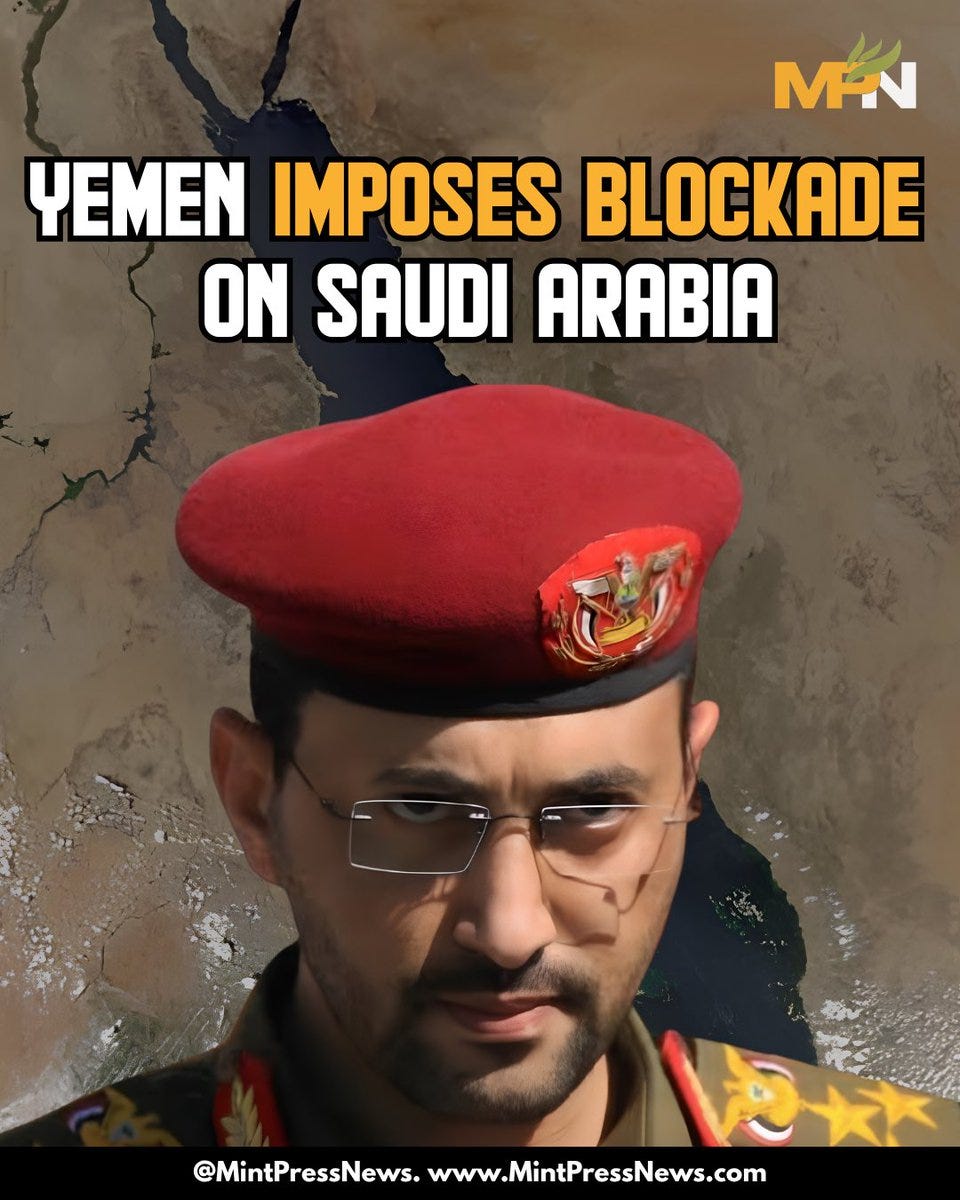
I woke to the following
Yemen’s Houthis announce Naval Blockade on Saudi Arabia from the Red Sea
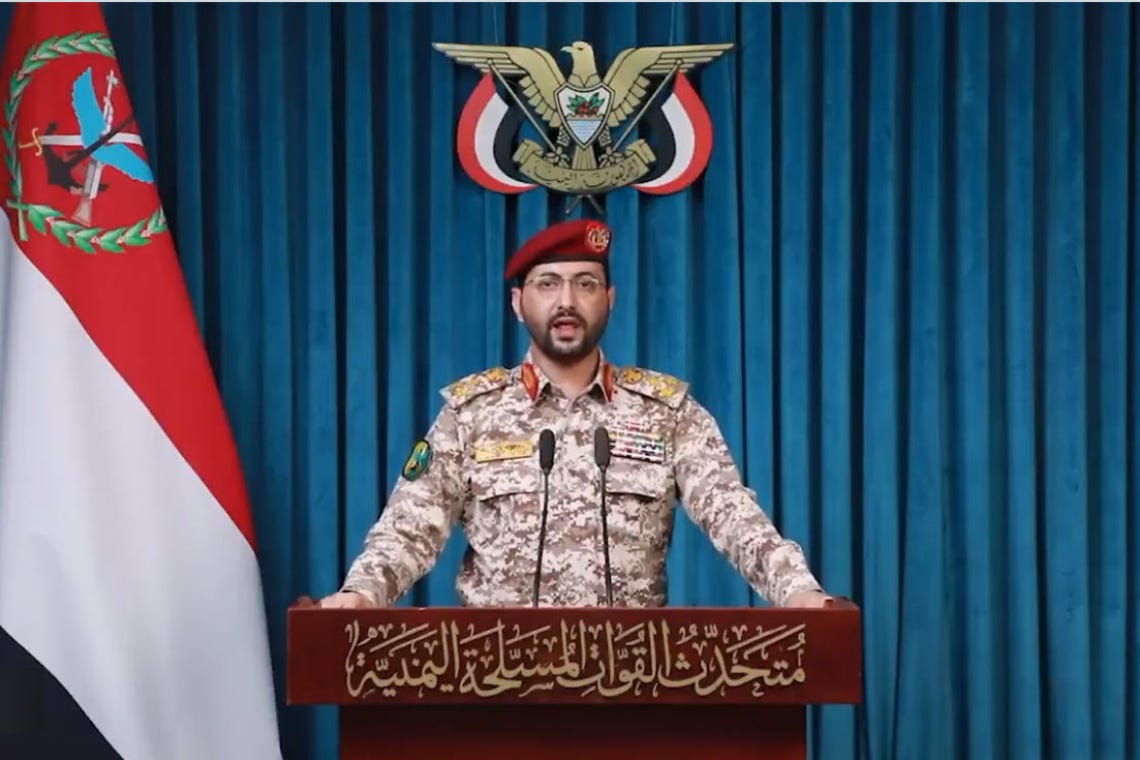
Yemen’s Houthis have announced a Naval Blockade on Saudi Arabia from the Red Sea.
This move essentially cuts-off Saudi oil exports through the Bab al-Mandeb Strait.
Saudi Arabia has been using its “East-West Pipeline” to send crude oil out via the Red Sea since Iran closed the Strait of Hormuz, preventing oil from leaving the Persian Gulf.
The East-West Pipeline has been carrying between 5 and 7 Million Barrels of Oil, per day. That helped alleviate the loss of twenty million barrels a day from the Persian Gulf.
Now, the world’s oil shortage situation is going to get very much worse, very much faster.
The Houthis also warned that any further Saudi escalation would be met with a “comprehensive and decisive” response
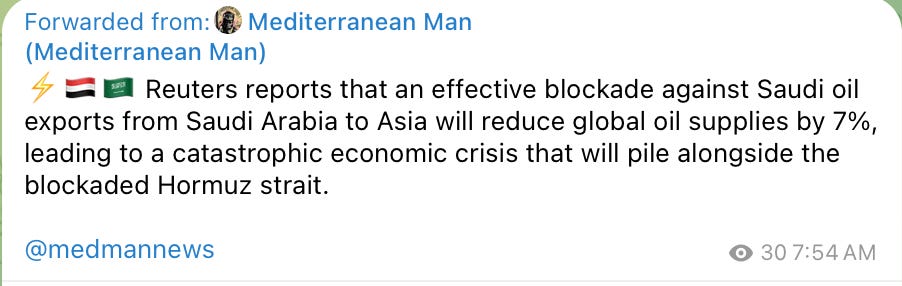
No one can claim there was no warning.
Dr. Marandi Warns “Provoking Yemen Is NOT A Good Idea”
Since recording this interview on Saturday, Yemen has announced a naval blockade against Saudi Arabia, threatening Saudi oil exports through the Bab al-Mandab Strait, a move that could disrupt the route Saudi Arabia uses to bypass the Strait of Hormuz via its East-West pipeline.
From al-Jazeera.
‘An eye for an eye’: Yemen’s Houthis announce maritime blockade of Saudi Arabia
Yemen's Ansar Allah group, commonly referred to as the Houthis. have declared a naval blockade against Saudi Arabia, set to take effect immediately. The Iran-backed group says the move is in response to a recent attack on Sanaa Airport, based on the equation of "an eye for an eye".
The group also warned that any further escalation by Saudi Arabia would be met with a broader response.
Approximately 12 to 15 percent of global trade passes through the Red Sea via Bab al-Mandeb, with 8 to 10 million barrels of crude oil passing through daily—4 million of those exported from Saudi Arabia.
The blockade will not only prevent Saudi oil exports but also Saudi imports, impacting the global economy.
The Houthis have previously imposed a similar blockade on Israeli shipments, which led to the bankruptcy of two Israeli ports.
Negotiations are currently taking place between the Houthis and Saudi officials in Oman, but until a compromise is reached, tensions are set to increase.
The Houthis argue that Saudi Arabia has imposed a blockade on Sanaa Airport since 2015 and that their response is proportional.
With hypersonic missiles, ballistic missiles, and drones, the Houthis have threatened to target Saudi airports and impose a naval blockade on all Saudi navigation
Lt.Col.Davis is quick off the block
BREAKING: Houthis Close Babal Mandeb Strait /Lt Col Daniel Davis
Nima R. Alkhorshid: Yemen Shocks the Region: Immediate Blockade on Saudi Arabia Changes the War
The Gulf Just Ran Out of Exits
Monday, July 20, 2026
Jul 20, 2026
Two things happened today that most outlets are covering separately. Put together, they explain why the next 72 hours matter more than almost anything since this war started in February.
First, the confirmed picture.
Yemen’s Houthis announced a naval blockade of Saudi Arabia today, targeting the Yanbu corridor — the kingdom’s last working oil export route now that the Strait of Hormuz has been effectively shut for months. Reuters, Al Jazeera, CNBC and The National all confirmed the blockade announcement independently. That means, for the first time in this conflict, both of the Middle East’s major oil arteries are choking at once.
At the same time, the U.S. is taking real losses. The Pentagon confirmed two service members killed and one missing at Muwaffaq al-Salti air base in Jordan, and Iran has struck at U.S. positions in Kuwait and Bahrain as well. Total American war dead in this conflict has now reached double digits. This isn’t an escalation risk anymore — it’s already escalated.
Layer on top of that: a Saudi tanker was hit and set ablaze in the strait this week, part of a pattern of strikes on vessels that ignore Iran’s transit rules — again, independently reported, not a single-source claim.
Second, what’s harder to pin down — and I want to be upfront about that.
There are reports of a fresh Iranian delegation, led by Iran’s Interior Minister, arriving in Islamabad this week — Pakistan’s own Ministry of Foreign Affairs and regional outlets confirm a delegation visit is happening, and that Iran’s FM left ahead of expected U.S. envoys, with Pakistan and Qatar reportedly pushing to revive talks. That much is on the record.
What is not independently confirmed is the specific claim, circulating from a single source, that this delegation is hand-carrying a personal letter from Iran’s current leadership with a “no concessions” message — or the specific line attributed to someone inside that office: that “the people who are winning do not seek to end the conflict.” I haven’t been able to verify the letter’s existence, its author, or its contents through a second source, and neither has anyone else publicly at this point. I’m flagging it here as an unconfirmed claim worth watching, not as something you should take as established fact. The same goes for the idea that Pakistan’s restraint is being scripted directly out of Beijing — that’s a plausible read given Ishaq Dar’s recent meetings with Wang Yi, but it’s analysis, not a confirmed pipeline.
Why it matters anyway.
Even stripping out everything unconfirmed, the confirmed layer alone is the story: two closing oil routes, rising American casualties, a Gulf war the U.S. can’t easily contain, and a diplomatic track that — if it’s moving at all — appears to be moving through Islamabad rather than Washington. Whatever is or isn’t in that letter, Pakistan’s actual position over the next few days (does it lean toward Riyadh, stay neutral, or defer to Beijing) is worth watching closely, because Saudi Arabia does have a defense relationship with Pakistan it could try to invoke.
Bottom line: oil is about to get more expensive on wire-confirmed grounds alone. The Islamabad angle is the thread I’ll keep pulling on, and I’ll update you the moment any of it moves from single-source to confirmed — in either direction.
The time has come to call the Yemenis.... Yemenis. Their country is Yemen.
But other superpowers are doubtful about more exclamation