THEY’RE VACCINATING 5,000 PENGUINS — AND THE MONEY TRAIL LEADS TO A COMPANY FUNDED BY BILL GATES


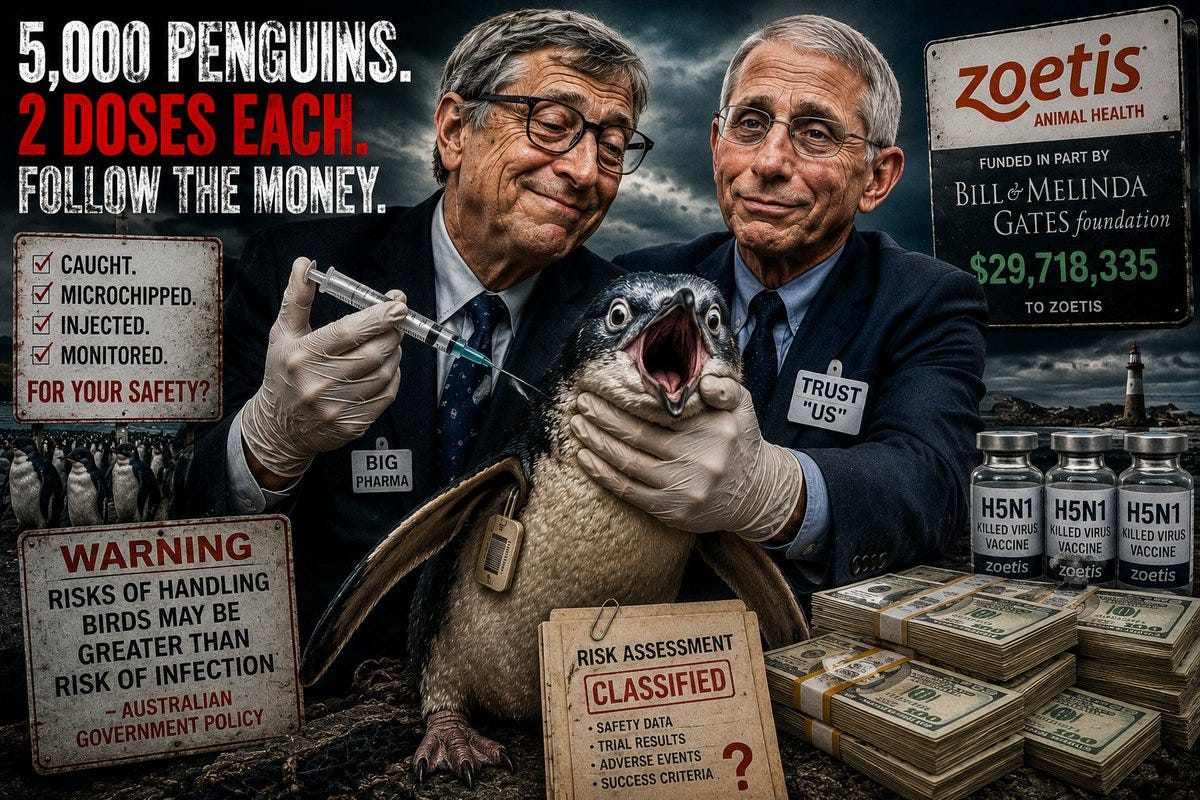
It sounds like satire.
Five thousand wild penguins are being rounded up in Australia.
They will be vaccinated.
They will be microchipped.
And because the vaccine requires two doses, authorities will have to identify and handle them again.
But this isn’t satire.
It is now part of Australia’s response to H5 bird flu — and when you start following the vaccine, the trials, the regulatory framework and the money behind the company supplying it, the story becomes considerably more interesting.
Because the vaccine Australia purchased comes from Zoetis, one of the world’s largest animal-health pharmaceutical companies.
And Zoetis has another significant relationship.
The Bill & Melinda Gates Foundation has given the company tens of millions of dollars to expand animal medicines, vaccines, diagnostics and veterinary infrastructure.
Does that mean Bill Gates is behind Australia’s penguin vaccination programme?
No.
I have found no evidence of that.
But the documented connections deserve examining — as do some extraordinary admissions contained within Australia’s own vaccination policy.
Because buried in the official documentation is a sentence everyone should read:
“The risks of handling birds for vaccine administration and post vaccination monitoring may be greater than the risk of them becoming infected.”
That isn’t an anti-vaccine campaigner speaking.
That is Australian government policy.
So let’s follow the evidence.
5,000 PENGUINS — TWO DOSES EACH
Victoria announced plans to vaccinate around 5,000 little penguins on Phillip Island and at St Kilda against H5 bird flu.
Phillip Island contains the world’s largest little-penguin colony, numbering roughly 40,000 birds.
The operation is extraordinary in scale.
These are not captive chickens.
They are wild birds.
They must be identified, caught, handled and injected.
The programme also involves microchipping for identification and monitoring.
And each bird requires two doses.
When the programme was initially announced, the remarkable part was that no little penguins had yet been reported infected.
That has now changed.
On August 15, authorities confirmed Australia’s first H5-positive little penguin, found dead on Phillip Island. That discovery accelerated the vaccination programme.
That is an important development and it changes the risk calculation.
H5N1 is not imaginary.
It has caused devastating mortality among birds and other wildlife internationally, and Australian authorities have legitimate reasons to fear what could happen if the virus spreads through a densely populated penguin colony. Australia’s CDC currently assesses the risk to humans as low.
The question therefore isn’t whether H5 exists.
It plainly does.
The question is:
WHAT IS THE EVIDENCE THAT THIS PARTICULAR INTERVENTION, IN THIS PARTICULAR SPECIES, WILL PRODUCE MORE BENEFIT THAN HARM?
And that takes us to the vaccine.
FOLLOW THE VACCINE
In February 2025, long before H5 was detected in Australian wildlife, the Australian Government purchased an inactivated H5 bird-flu vaccine from Zoetis.
The government said the intention was to prepare for protecting priority non-poultry bird species, particularly threatened species.
Australia’s own documentation says the product had previously been used overseas to protect free-ranging California condors.
But at that stage it wasn’t simply approved for widespread use in Australian wildlife.
It was initially permitted for government research, with CSIRO’s Australian Centre for Disease Preparedness conducting trials.
And what was the purpose of those trials?
According to the government:
To evaluate the vaccine’s safety and efficacy in small Australian bird species.
The resulting data was requested by the Australian Pesticides and Veterinary Medicines Authority to inform an application for emergency use in priority native species.
There is therefore a clear chain:
AUSTRALIAN GOVERNMENT
↓
ZOETIS H5 VACCINE
↓
CSIRO SAFETY AND EFFICACY TRIALS
↓
REGULATORY AUTHORISATION
↓
WILDLIFE VACCINATION
↓
5,000 LITTLE PENGUINS
But there is something I still want answered.
WERE LITTLE PENGUINS ACTUALLY TESTED?
Public information describes the CSIRO work as trials involving small Australian bird species.
Yet from the publicly accessible material I have examined, I have not been able to establish that little penguins themselves were among the species used in those pre-rollout trials.
That doesn’t prove they weren’t.
It means we need transparency.
And this matters because Australia’s own Western Australian government guidance acknowledges:
vaccine effectiveness varies between different bird species and different virus strains.
It also states that ineffective vaccination may contribute to viral spread and that effective vaccination requires two doses.
So the obvious questions are:
Which species did CSIRO test?
Were little penguins among them?
How many animals were involved?
What adverse reactions occurred?
What efficacy was demonstrated?
And if little penguins weren’t tested, what evidence supports extrapolating those results to them?
These aren’t anti-science questions.
THEY ARE SCIENTIFIC QUESTIONS.
NOW FOLLOW THE COMPANY
And this is where Bill Gates enters the wider story.
The Australian government identifies Zoetis as the company from which it purchased the H5 vaccine.
Zoetis has also had a longstanding and very substantial financial relationship with the Bill & Melinda Gates Foundation.
In February 2017, the Gates Foundation committed:
$14,399,710
to Zoetis.
According to the Foundation’s own grant database, the purpose was to reduce livestock disease and improve outcomes for smallholder farmers in Sub-Saharan Africa by reducing barriers to animal-health products.
Zoetis called the resulting programme the:
African Livestock Productivity and Health Advancement — A.L.P.H.A. — initiative.
The company said the Gates funding would help establish veterinary diagnostic networks and animal-health infrastructure in Africa.
Then came another grant.
In December 2022, the Gates Foundation committed another:
$15,318,625
to Zoetis.
The stated purpose was to accelerate access to animal-health products and tools for livestock owned by small-scale producers in Sub-Saharan Africa.
Together, those two grants amount to approximately:
$29.7 MILLION
And this wasn’t simply academic research sitting in laboratories.
Zoetis says its Gates-backed programmes encompass veterinary medicines, vaccines, diagnostic services and animal-health infrastructure — including poultry.
By 2021, Zoetis said the original Gates-backed A.L.P.H.A. programme had resulted in 1.7 billion doses of vaccines and medicines being administered over four years, alongside more than 650,000 diagnostic tests.
That is a massive animal-health programme.
BUT HERE IS THE LINE THE EVIDENCE DOES NOT CROSS
This distinction is absolutely essential.
I have found no evidence that the Gates Foundation financed the Victorian penguin vaccination programme.
I have found no evidence that Bill Gates selected Zoetis for Australia.
I have found no evidence that Gates Foundation money paid for Australia’s vaccine doses.
And I have found no evidence demonstrating that Gates Foundation funding financed development of the specific H5 vaccine being deployed in this programme.
Anyone claiming those things needs to produce the evidence.
What we can establish is this:
GATES FOUNDATION
↓ approximately $29.7 million in documented grants
ZOETIS
↓ animal-health company involved in Gates-backed vaccine/medicine programmes
ZOETIS
↓ supplies Australia’s H5 wildlife vaccine
AUSTRALIAN GOVERNMENT / CSIRO
↓ testing and regulatory pathway
VICTORIAN AUTHORITIES
↓
5,000 LITTLE PENGUINS
That is a corporate relationship, not evidence of Gates directing the penguin programme.
There is a very important difference.
But it is still worth knowing who the players are.
AUSTRALIA’S OWN POLICY CONTAINS A REMARKABLE WARNING
Perhaps the most important evidence I’ve found has nothing to do with Gates.
It comes from Australia’s own Vaccination Policy for Rare, Protected and Valuable Avian Species.
The document makes clear that vaccination isn’t considered a replacement for biosecurity.
It also acknowledges something that rarely makes the headline:
vaccinated birds can still become infected and can still shed virus, although the policy says shedding is generally at lower levels than in unvaccinated birds.
Then comes that extraordinary sentence:
“The risks of handling birds for vaccine administration and post vaccination monitoring may be greater than the risk of them becoming infected.”
Read that again.
Australia’s own policy acknowledges circumstances in which the intervention and monitoring process itself can carry greater risk than infection.
That does NOT mean this is necessarily true for the Phillip Island penguins.
The policy is explaining precisely why risk assessment is necessary.
And that makes the next part particularly important.
The same policy says an application to use these vaccines should be preceded by an:
“evidence-based risk assessment”
covering considerations including animal welfare, logistics and safety.
Excellent.
THEN SHOW US THE PHILLIP ISLAND RISK ASSESSMENT.
THIS ISN’T JUST ABOUT PENGUINS
This is where the story becomes much bigger.
We are entering an era in which increasingly sophisticated biomedical interventions are being considered not only for humans and farm animals, but for vulnerable wildlife populations.
Australia’s Parliamentary Library noted only last month that broad-scale vaccination of wild birds isn’t considered practicable, while vaccination may be considered for priority at-risk species.
And Australia’s own authorities recognise the uncertainties.
Western Australia’s guidance states plainly that effectiveness varies between species and virus strains and warns that ineffective vaccination may contribute to viral spread.
None of this proves that vaccinating the little penguins is wrong.
Indeed, if H5 threatens to devastate the colony, vaccination could ultimately prove to have been an extraordinarily valuable conservation intervention.
But that’s precisely why the data matters.
This programme could help inform how governments respond to wildlife disease elsewhere.
Success matters.
Failure matters.
Adverse events matter.
Unexpected consequences matter.
And all of it should be documented.
“TRUST US” SHOULD NEVER SUBSTITUTE FOR TRANSPARENT SCIENCE
There is a tendency whenever vaccination is discussed for people immediately to divide themselves into camps.
Pro-vaccine.
Anti-vaccine.
Trust the science.
Don’t trust the science.
I think that misses the fundamental point.
Science worthy of public trust should withstand scrutiny.
So show us:
THE RISK ASSESSMENT.
THE CSIRO TRIAL DATA.
THE SPECIES THAT WERE TESTED.
THE ADVERSE-EVENT DATA.
THE EFFICACY DATA.
THE CRITERIA FOR SUCCESS.
And once thousands of penguins have received their injections:
PUBLISH THE RESULTS.
If the programme prevents a catastrophic H5 outbreak and protects one of Australia’s most extraordinary wildlife colonies, then the evidence should demonstrate that.
And if unforeseen problems emerge, the public should know about those too.
Because whether we’re talking about human beings, livestock or wild penguins:
“TRUST US” IS NOT EVIDENCE.
The Gates Foundation connection to Zoetis is real and documented.
The Zoetis connection to Australia’s H5 vaccine is real and documented.
But a direct Gates connection to the penguin programme itself has not been established.
That is where the evidence currently ends.
And that’s where responsible investigation should stop — until further evidence takes us somewhere else.
In the meantime, I’ll continue following the documents, the regulatory trail and the results of what Victoria is now attempting.
Because 5,000 wild penguins are about to become part of an extraordinary real-world vaccination programme.
They deserve for us to know whether it works.
And perhaps, just this once...
FREE THE PENGUINS.
H5 Bird Flu has never been isolated. In fact, no virus has ever been isolated. There are only "announcements" to that effect. The charade that Louis Pasteur invented and sold to moronic European elites and royalty continues to control modern allopathic medicine. The scam is now over 150 years old, but it is still taught in universities and medical "schools."
The medical schools and associated facilities at Stanford University are all located on Louis Pasteur Drive. When i had the opportunity to speak with a Stanford Professor of Economics, I noted this fact and asked if the Business and Econ schools were located on Bernie Madoff Blvd.
That phrase "Trust" us.....