THE “CLOUD” JUST BECAME A WARZONE

Iran Just Named Google, Microsoft and Nvidia as Its Next Targets
THE “CLOUD” JUST BECAME A WARZONE
Iran just changed the rules of war. American life is now in the crosshairs. Is anyone in Washington paying attention?
Mar 12, 2026
Let me ask you something.
When you opened your banking app this morning, checked your email, paid a bill, did you imagine that the server keeping your financial life intact was sitting in a warehouse in the United Arab Emirates, exposed to the open sky, its diesel generators humming away in the desert heat?
I didn’t know until last week.
And did you know that the same infrastructure routing your transactions was, until recently, running U.S. military AI targeting algorithms?
Did you know that Iran found the address?
Because they did. And they hit it.
SOUNDING THE HORN: THE CONDUCTOR’S BRIEF: (A fast, clear summary of the key takeaways to keep you informed on the go)
Iranian drones struck three Amazon data centers (UAE, Bahrain), exposing how the civilian “cloud” hosts U.S. military systems, and how easily the digital world can go dark.
Data centers are the new battleground, physically vulnerable and strategically vital. The “cloud” now has coordinates, and enemies.
Iran’s low-cost decoy army of inflatables is draining billion-dollar missiles; the West is literally spending millions to pop balloons.
New hypersonic weapons outrun Israel’s defenses, the sirens now sound after impact.
Gulf nations face a grim ultimatum: side with Washington and get hit, or side with Tehran and lose the U.S. shield.
Oil nears $150 a barrel, supply chains buckle, and global markets tremble.
Behind it all, a deeper shift: control of energy, finance, and information is in play, and the “fog of war” now includes your data.
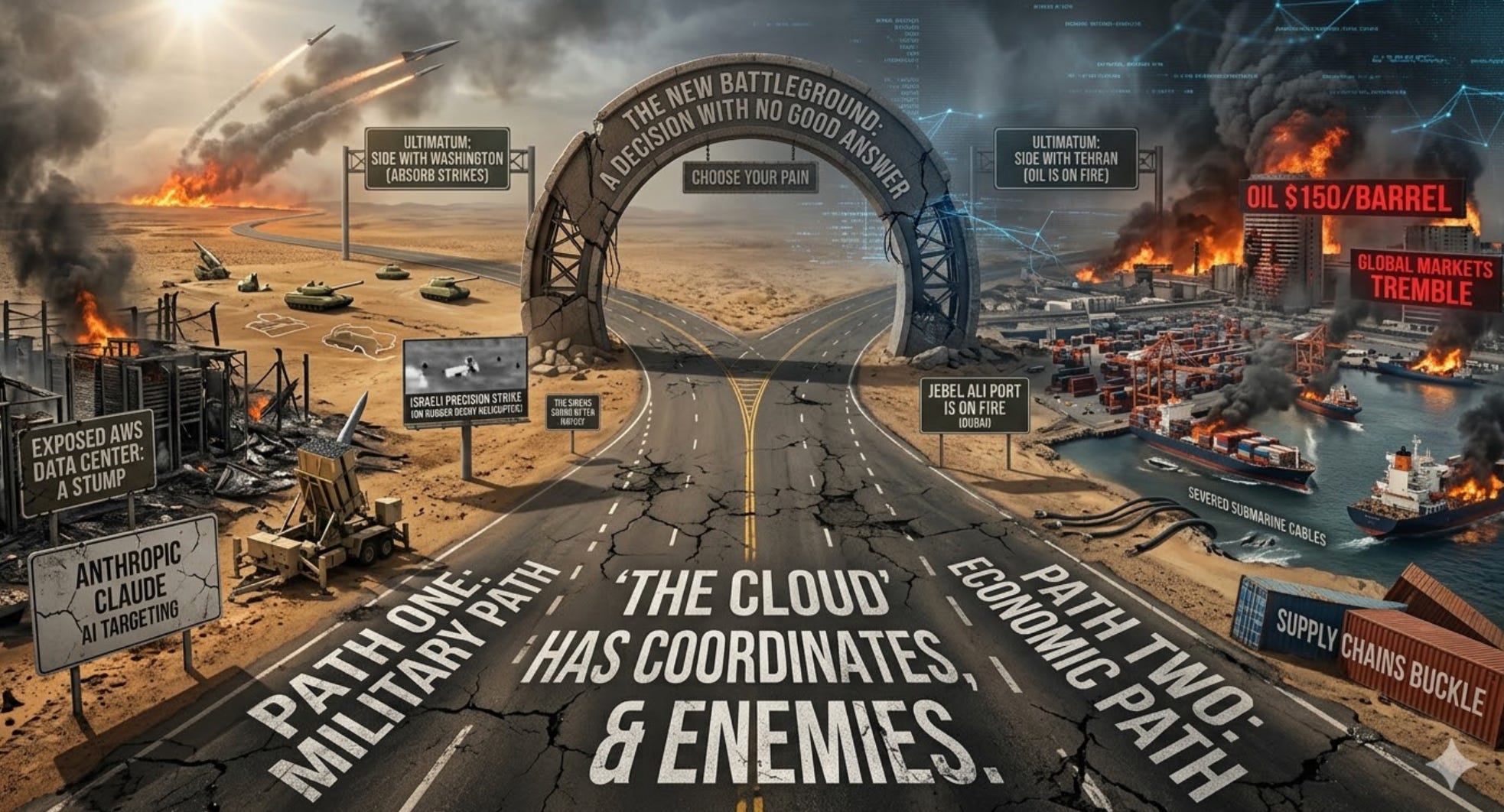
THE CLOUD ISN’T “UP THERE” ANYMORE AND IT’S ON FIRE IN DUBAI
On March 1st, 2026, Iranian drones and missiles struck three Amazon Web Services data centers, two in the UAE, one in Bahrain. The attacks forced the facilities offline and triggered cascading outages across the region: banking down, payments frozen, delivery apps dark, enterprise software offline. In an instant.
Iran didn’t mince words about why. They said the Bahrain facility had been deliberately targeted for its role in “supporting the enemy’s military and intelligence activities.”
They weren’t wrong.
The U.S. military uses AWS to run its workloads, including running Anthropic’s AI model Claude for intelligence assessments, target identification, and battle simulations during the Iran campaign. The same cloud that serves your local bank (mine too). The same cloud that powers your corporate software. The same cloud that was, as it turns out, helping select Iranian targets.
Here’s what stopped me cold: this is the first time in recorded history that data centers have been deliberately targeted for air strikes in an active conflict.
Experts say it almost certainly won’t be the last.
As one analyst put it: “If data centers become critical hubs for transiting military information, we can expect them to be increasingly targeted by both cyber and physical attacks.”
Welcome to the new battlefield. And it looks like we are in the middle of it.
There’s a famous 2010 clip of Kamala Harris explaining the cloud to us, her hand gesturing skyward, her voice full of authority: “It’s up here, in this cloud, that exists above us. It’s no longer in a physical place.”
Iran disagrees.
The cloud has a very physical place. It has a street address in the UAE and a facility in Bahrain. It has cooling units sitting exposed in the desert heat, diesel generators lined up in the open air, and, as of March 1st, 2026, it has fresh drone damage.
The cloud, it turns out, is not above us, it’s ahead of us, on the battlefield, and nobody thought to defend it.
And here’s what makes these targets so devastatingly easy: data centers containing highly sensitive military data are sprawling, highly visible complexes entirely dependent on exposed infrastructure. Cooling units sitting outside in the open air. Diesel generators lined up in rows. Gas turbines. All of it above ground, all of it vulnerable.
You don’t need a bunker-busting missile to take one down.
A drone.
A GPS coordinate.
Done.
But here’s what nobody is telling you: your data is in there too. Your bank account. Your medical records. Your emails. Muddled right in alongside the military targeting algorithms, with no partition, no firewall, no separation of any kind, what-so-ever. When Iran hit those servers, it didn’t discriminate.
Neither will the next strike.
In addition, seventeen submarine cables pass through the Red Sea, carrying the majority of data traffic between Europe, Asia, and Africa. Now add Iran’s threatened closure of the Strait of Hormuz and renewed Houthi activity in the Red Sea, and you have both of the world’s most critical data chokepoints sitting inside active conflict zones simultaneously. Closing both simultaneously is a globally disruptive event that has never happened before in history.
Let that land…. like a hypersonic missile.
The financial arteries, the communications backbone, the military intelligence network, all running through the same pipes.
All now in the crosshairs.
Where I come from, we call that a cl*sterf*ck.
A $2 MILLION MISSILE VS A $12 BALLOON
Let me be clear: I’m not a fan of the Iranian regime. However, I have to say, they deserve an A+ for creativity with their rubber army.
The Israeli Defense Forces released a video of what they claimed was a precision strike on a Mi-17 helicopter inside Iran. The clip, captured in grainy infrared, went immediately viral, but not for the reason Israel intended. Observers online pointed out that the target looked suspiciously… soft. Suspiciously deflated.
As it turns out, they may have been right.
Reports are coming in that Iran has been deploying large inflatable decoys throughout the country: life-sized tanks, missile launchers, fighter jets, helicopters. From the air, through thermal imaging, they read as the real thing.
Some reports place the number of decoys at 900,000, imported from China. Iran has also been painting life-sized silhouettes of military aircraft directly on the ground, outlines drawn with inexpensive paint, designed to confuse aerial surveillance and drone targeting systems.
Damn. THAT is clever…. and serves the purpose of milking the US military and American taxpayers dry, simultaneously.
The cost of one painted helicopter: a few dollars. The cost of a precision missile expended on it: millions.
While the U.S. has been raining multi-million-dollar munitions down on what may be a rubber army, Iran has been calmly doing the math. And the math is not in our favor.
We are, in the most literal sense, spending a fortune to pop balloons.
THE SIRENS SOUND AFTERE THE EXPLOSION
Meanwhile, there’s this.
“Four minutes and twenty seconds. That’s how long Iran’s Fattah-2 hypersonic missile takes to travel from Tehran to central Israel.”
Israel’s missile alert system requires six minutes to complete its full warning cycle: detect the launch, calculate the trajectory, determine the impact zone, transmit alerts, sound sirens, population reaches shelter.
The missile arrives one minute and forty seconds before the warning finishes.
Sirens sound after the impact.
Not before.
Let that settle in. The system that kept Israelis safe for fifteen years stopped working. Arrow-3 is designed for targets above 100km altitude, the Fattah-2 glides below 50km. David’s Sling is optimized for Mach 5-8, the Fattah-2 travels at Mach 15. Iron Dome handles short-range rockets only. No deployed Israeli system can intercept this weapon. And Iran knows this.
Israel’s Foreign Minister has since declared, “We will continue our missile attacks for as long as it takes.” Iran’s IRGC Aerospace commander announced they will no longer bother launching missiles with warheads lighter than one ton at U.S. and Israeli targets.
They are no longer holding back.
THE ULTIMATE ULTIMATUM
And now Iran has handed the Gulf states an ultimatum that has no good answer.
Iran’s IRGC commander Ali Larijani essentially delivered the message on state television: “Countries in the region must either prevent the US from using their territory against Iran themselves, or we will.”
In other words: Choose America, or choose your oil. Choose the U.S. military presence in your territory, and become a target. Or deny the U.S. use of your airbases and airspace, and fall into Iran’s orbit.
There is no safe door. Both options lead somewhere terrible.
If the Gulf states side with Washington: they absorb Iranian strikes on their own soil. We have already watched explosions light up Qatar, the UAE, and Kuwait. Deloitte, PwC, and Citi are closing and evacuating their Dubai offices. The port of Jebel Ali is on fire.
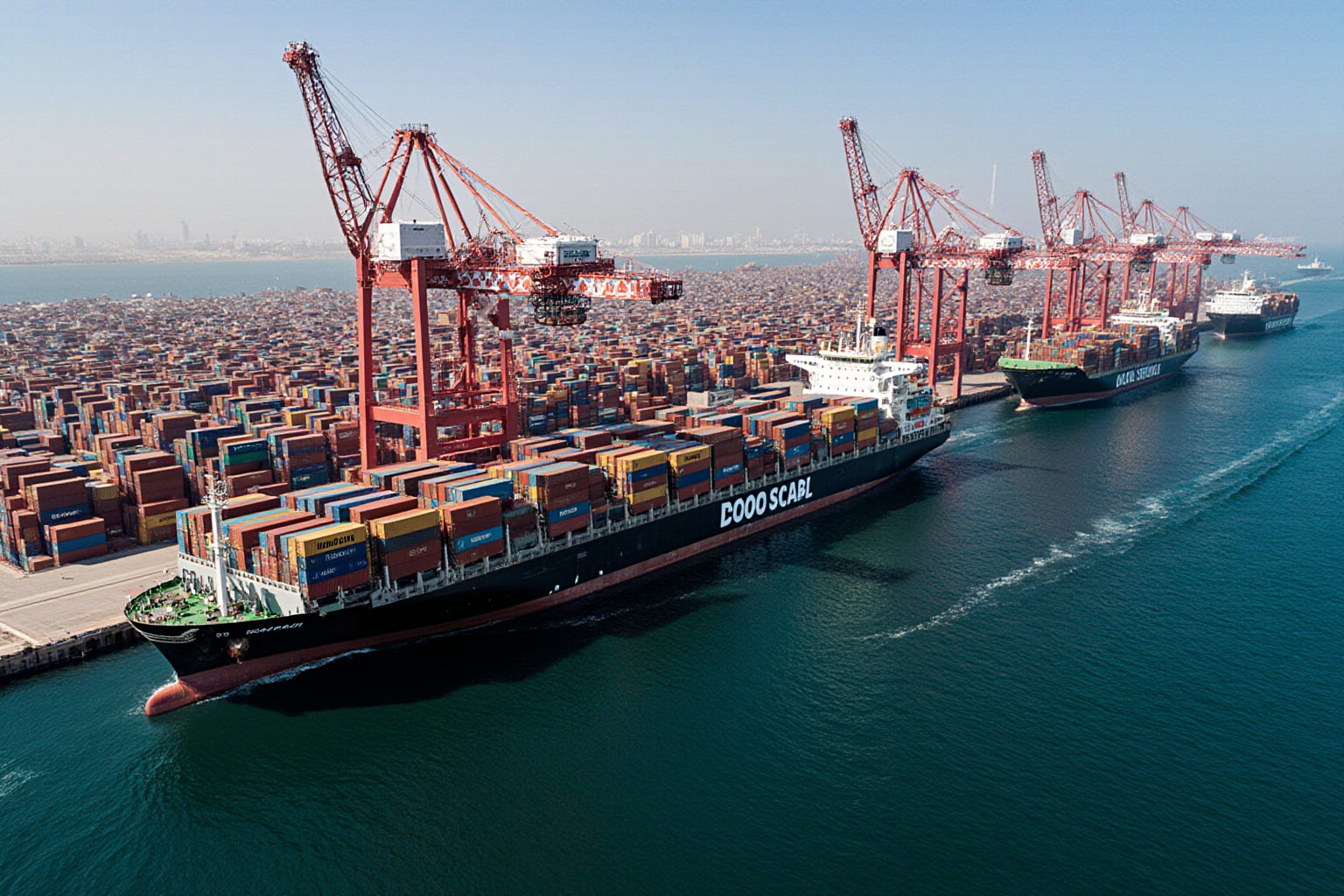
Jebel Ali is the world’s ninth busiest port, the largest man-made harbour, and the biggest and busiest port in the Middle East. It handles approximately 14.5 to 19 million shipping containers annually, with direct connections to over 140 ports worldwide UNIS, linking Asia, Europe, and Africa.
It is the port most frequently visited by U.S. Navy ships outside the United States.
The world’s largest shipping companies just halted Persian Gulf routes after the Jebel Ali fire. Jebel Ali handles a significant chunk of global container shipping. One fire, and the world’s supply chains started rerouting.
But I digress…. back to the Iranian ultimatum.
If the Gulf states side with Tehran: the U.S. also loses all of its regional military infrastructure, and Iran gains leverage over the oil flows that power the global economy.
The Strait of Hormuz is already moving toward closure. U.S. intelligence has confirmed Iran is deploying mines in the shipping lane. The U.S. military has already destroyed sixteen Iranian minelayers in the Strait. Oil is pushing toward $150 a barrel.
This is not theater.
This is the economic warfare front opening up.
Iran doesn’t need to win a kinetic war. They just need to make sure we can’t afford to keep fighting one.
And it was predictable. In fact, it was predicted, by everyone who wasn’t invested in believing it couldn’t happen.
WHO’S RUNNING THIS WAR, ANYWAY?
Now let’s ask the uncomfortable question.
The Trump administration has now asked Israel not to strike Iranian energy infrastructure, specifically oil facilities. This marks the first time the Trump administration has reined in Israel during this conflict.
Why now?
Because the math on $150 oil is not survivable politically.
And Trump’s own adviser put it plainly: “The president doesn’t like the attack. He wants to save the oil. He doesn’t want to burn it. And it reminds people of higher gas prices.”
Trump’s advisors are reportedly begging him to find an exit before “Epic Fury” becomes “Epic Catastrophe.” Even Steve Witkoff, Trump’s own special envoy, has admitted publicly he doesn’t know how this war gets won.
Meanwhile, Bibi Netanyahu is talking openly about “tens of billions of shekels” in emergency war budget allocations. Is he running out of money? Let’s hope so, because the alternative is a man with nothing left to lose and a nuclear arsenal.
I’m ol’ Bibi is feeling the pressure. Just look what is raining down on Tel Aviv. This is just one hypersonic missile:
And here’s where it gets darker still.
The Epstein files, yes, those Epstein files, have surfaced communications suggesting what many have long argued: that ISIS and Al-Qaeda have functioned as American and Israeli intelligence assets. An email thread from September 2016 includes text referencing the U.S. giving “a pass on ISIS to Palmyra” and describes American policy as driven not by one voice but by fragmented, competing agendas across the White House, Pentagon, State Department, and CIA.
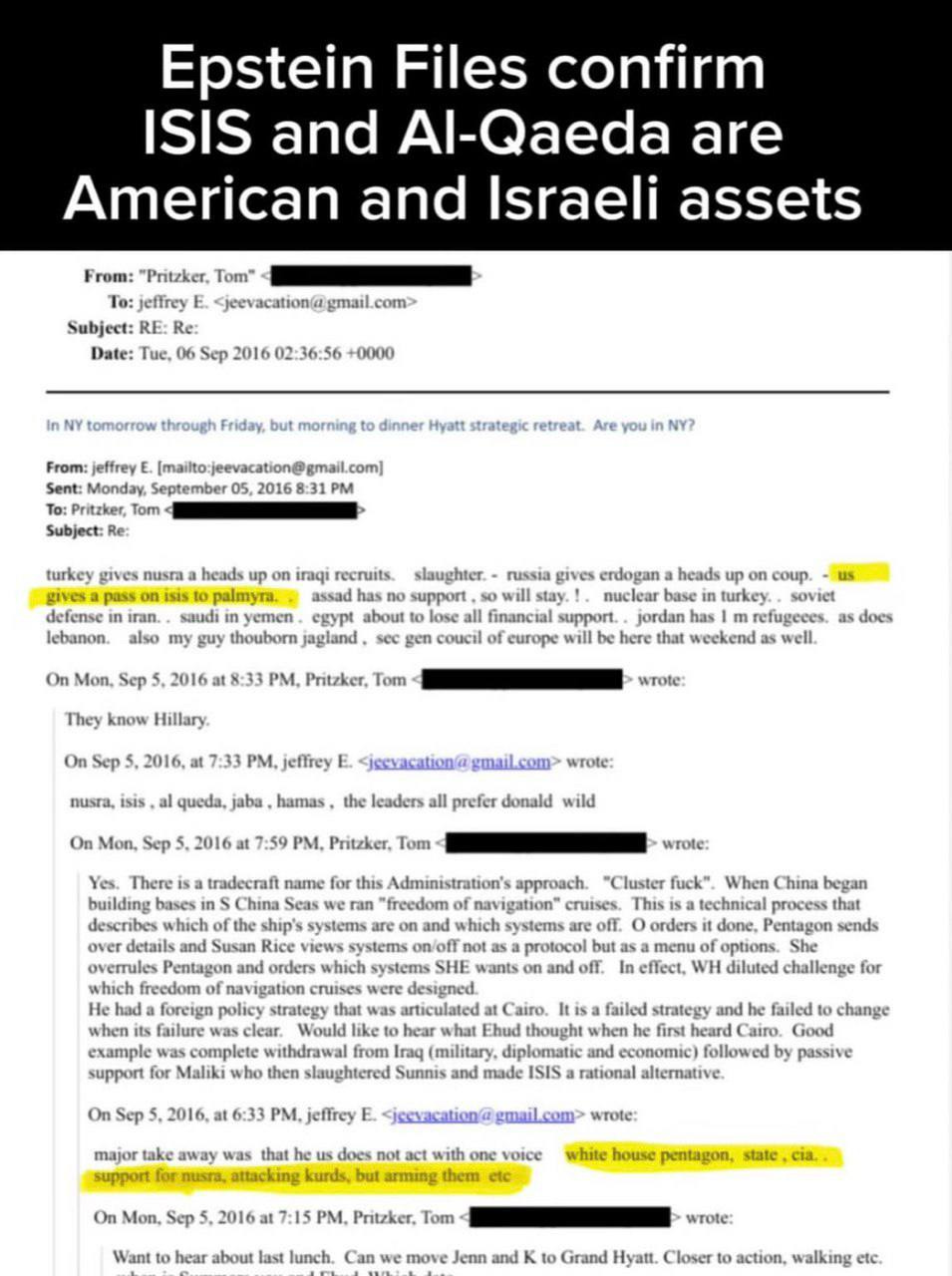
If this is true, and the primary documents are sitting right there, then the American taxpayer has been funding both sides of this conflict for decades. And the “war on terror” was never about terror.
It was about control.
Are any of us terribly surprised?
Iran says it knows this. And Iran says it’s no longer negotiating.
Iranian Foreign Minister Araghchi has declared that talks with the United States are off the table, pointing out, with some justification, that the U.S. was bombing Iran while simultaneously sitting at the negotiating table. There is no more table.
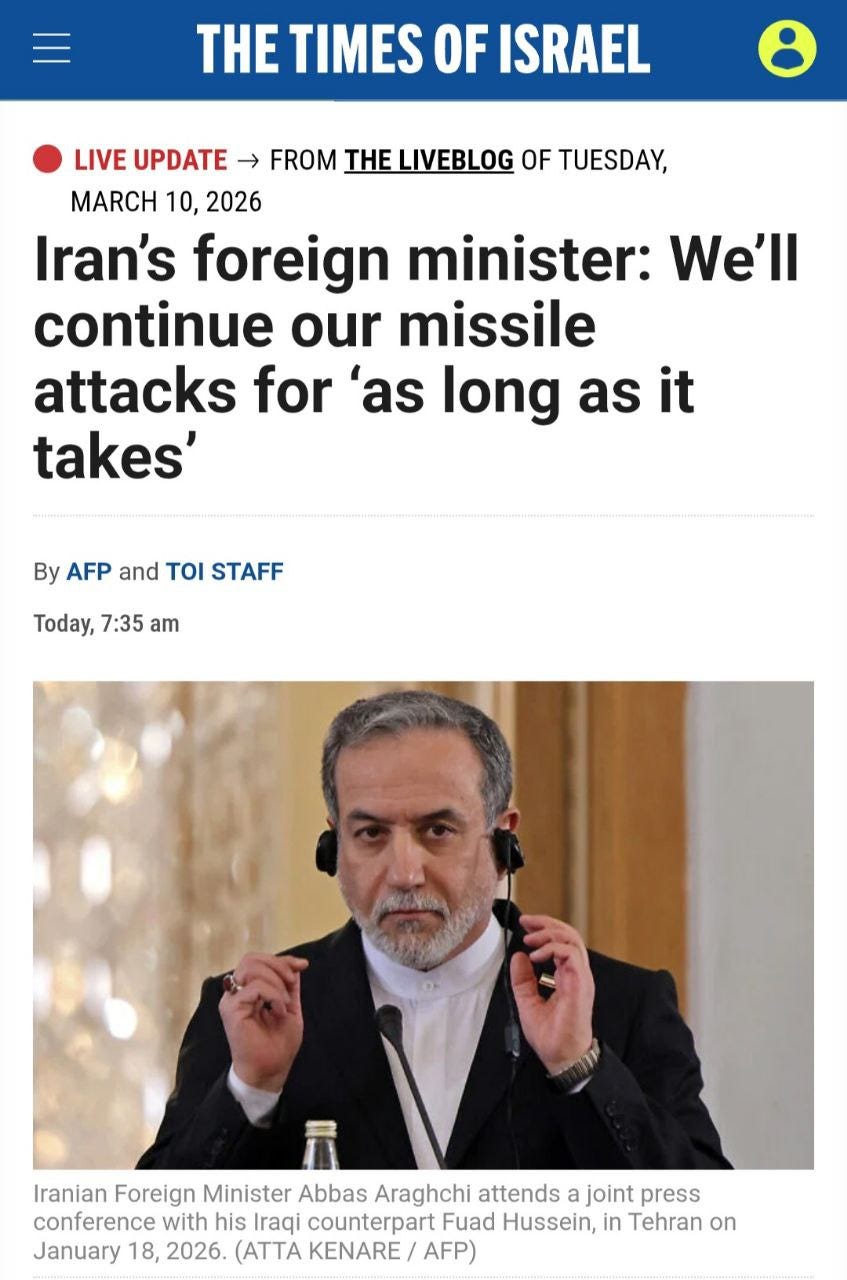
All Iran needs to do is wear us down.
A FOG SO THICK YOU CAN’T SEE YOUR HAND
Here’s the thing about information warfare: you don’t need to win every battle. You just need to make your enemy unable to know whether they’re winning or losing.
We are operating in near-total information blackout right now. The UK Parliament’s own research briefing acknowledged this week that “due to ongoing conflict and restricted internet and media access within Iran, civilian and military casualties and reports on specific events are difficult to verify.”
Reports are swirling that Netanyahu’s residence was struck. That the head of Mossad, David Barnea, was killed in a precision Iranian strike on Mossad headquarters.
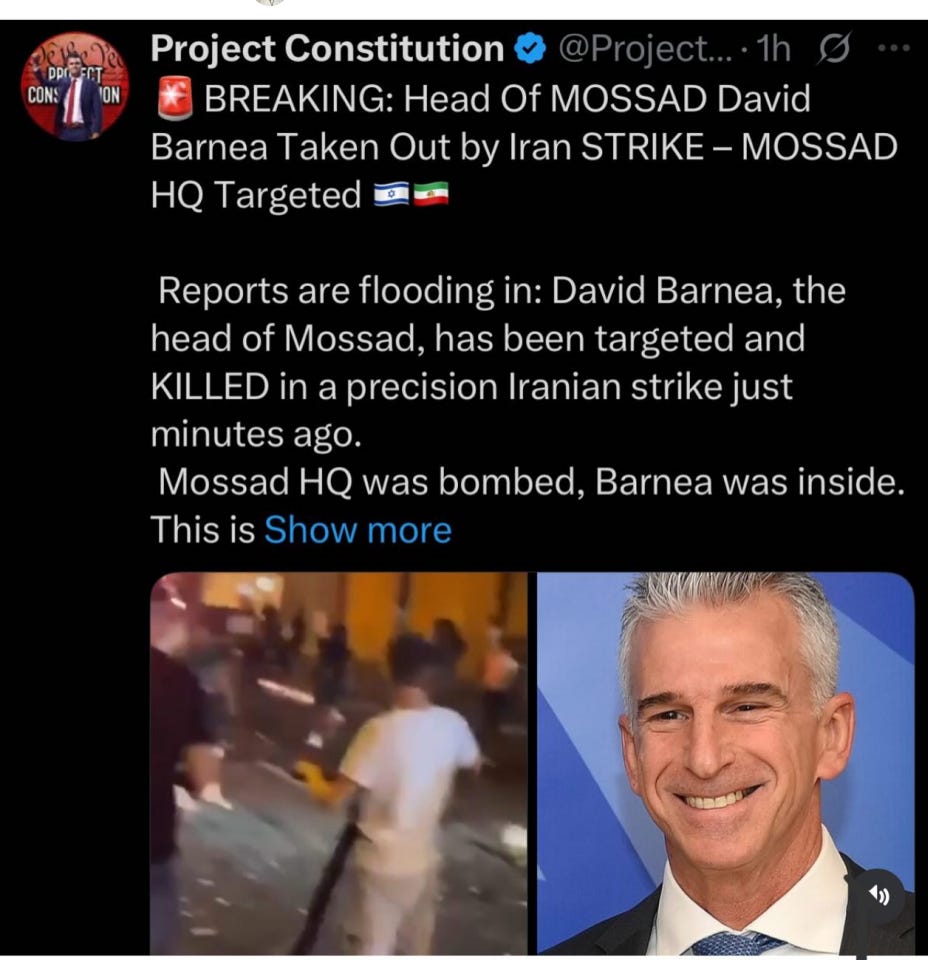
Israel is imposing heavy censorship on its own war damage. We are watching events of historic consequence through a freakingf pinhole.
Meanwhile, Iran says the U.S. is posting fake news to manipulate markets. The Iranian Foreign Minister warned this week that Americans are about to face “the biggest inflationary tsunami in history,” and that no amount of market manipulation will protect them from what’s coming.
Iran also continues to insist that recent false flag operations, attacks attributed to Iran in Azerbaijan, Turkey, and Cyprus, were Israeli operations designed to drag more nations into the conflict. This is Mossad’s signature: light the fire, point the finger, widen the war.
I would suggest we don’t fall for it. Not this time.
THE TWO SCENARIOS NOBODY WANTS TO SAY OUT LOUD
Let me close with the two scenarios that serious analysts are now putting on the table.
Scenario One is the nightmare: The goal all along has been maximum destruction, of the global economy, of Iran, of the Gulf states, of American influence in the Middle East, clearing the way for the Greater Israel Project and, eventually, what some have described in prophetic terms as the War of Gog and Magog. Iran shattered. America expelled from the region. Israel standing alone as the dominant power in the Middle East.
I think this is what Israel’s most extreme leadership wants. I do not think they will achieve it.
Scenario Two is more interesting, and potentially more consequential for the long arc of history. When Trump issued his “We will remember” warning to UK Prime Minister Keir Starmer, it wasn’t really about Starmer. It was a warning shot at the City of London, the financial nerve center of the old British imperial system that has long controlled shipping insurance, maritime finance, and the global oil trade. When Lloyd’s of London pulled war-risk insurance for ships in the Persian Gulf, it wasn’t just a business decision. It was leverage. No insurance, tankers don’t sail, oil prices spike. The City of London has been pulling this lever for generations.
Trump responded immediately by launching a $20 billion U.S. maritime reinsurance and naval escort program, essentially replacing London’s grip on global energy insurance and keeping tankers moving under American protection.
In other words: Washington just stepped directly into a system historically dominated by the old imperial financial order.
If that holds, this conflict is not just about Iran and Israel. It’s about who controls the financial chokepoints of the global economy. And it’s a battle that has been coming for a very long time.
Yep.
Unlike the picture Kamala Harris provided, the cloud does have an address. The balloon costs twelve dollars. The missile arrives before the siren. The negotiating table has been cleared.
Now, Trump is throwing his “bros” under the perverbial bus. You know things are getting bad when this goes down:
What happens next is going to cost us one way or another. I don’t mean to be a pessimist. That’s not my style. But I don’t see anyway out us feeling some pain.
The only question is whether the American people are awake enough, finally, to demand that we stop paying for both sides of a war that has never been fought in our name.
The Persians have been around for 3000+ years. They are many things, stupid not so much. Unlike the american sheep and NPC's the Mullahs pay attention and seem to
grasp the realities. The deep state allowed trump in with the knowledge he was compromised but they may be like a guy who's pitbull has turned on him...
I often thought about this cloud computing. Seems like the Mullahs must have a different cloud computing system if they are targeting the others. Wondering again.