Peace talks in Istanbul end without result

Ukraine Formally Present Peace Demands to Russia
The Ukrainians have given Russia a list of demands before the beginning of peace talks.
The Demand is in Bold, the Russian Response is italicized beneath it.
A complete and unconditional ceasefire.
There will be no ceasefire in Ukraine, we have tried that under the Minsk 1 & 2, it didn't work out. How can Russia guarantee Ukraine/the west won't take such advantage to restock and rearm.
2. Exchange of all for all prisoners of war.
This will happen days after the conflict is settled. Russia holds 10x more PoWs than Ukraine has, we aren't foolish enough to make such deals.
3. Security guarantees and Ukraine's right to join the EU and NATO.
And we are back to square one. This conflict was never about territory but security for Russia, we will never accept NATO on our ancestral land. Neutrality is the only way forward for peace in Ukraine.
4. The right of Ukraine to station foreign troops on its territory.
No.
5. Russia's territorial gains are not recognized.
We think we're done analyzing. You didn't come here to negotiate in good faith. The losing side doesn't get to make such demands. You are trying to derail the Peace negotiations. This is nonsense.
6. Frozen Russian state assets will be used for restoration or will remain frozen until reparations are paid.
Who are you to make such demands? Did the EU draft this? We hold assets of foreign nations too. Use ours and the EU/US loses theirs. Two can play that game.
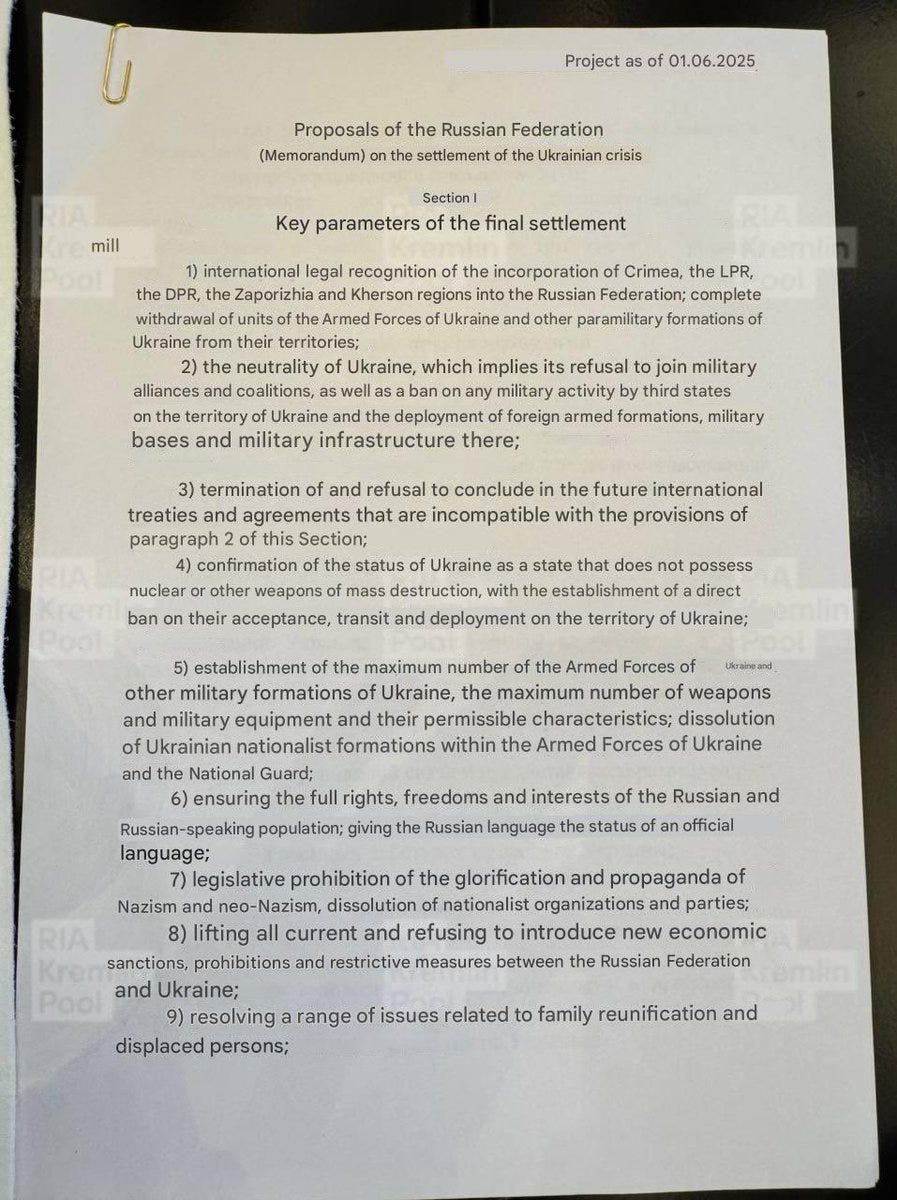
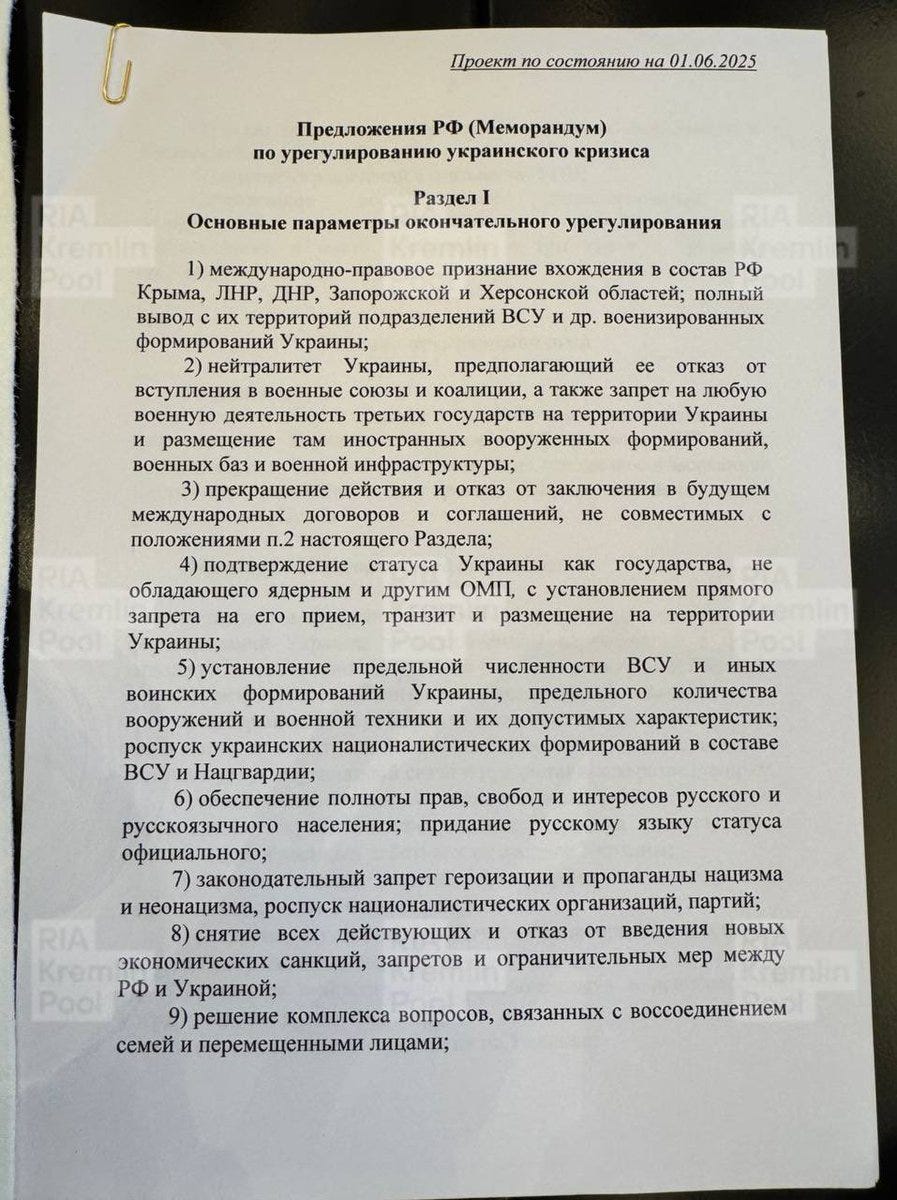
🇺🇦 Russia’s demands to Ukraine and the west:
- International recognition of Crimea and other disputed regions
- neutrality of Ukraine
- no weapons of mass destruction
- limit on the army size
- full rights for Russians speakers
- prohibition for Bandera propaganda
- lifting sanctions
- family reunification (of Russians and Ukranians) legal framework
1/
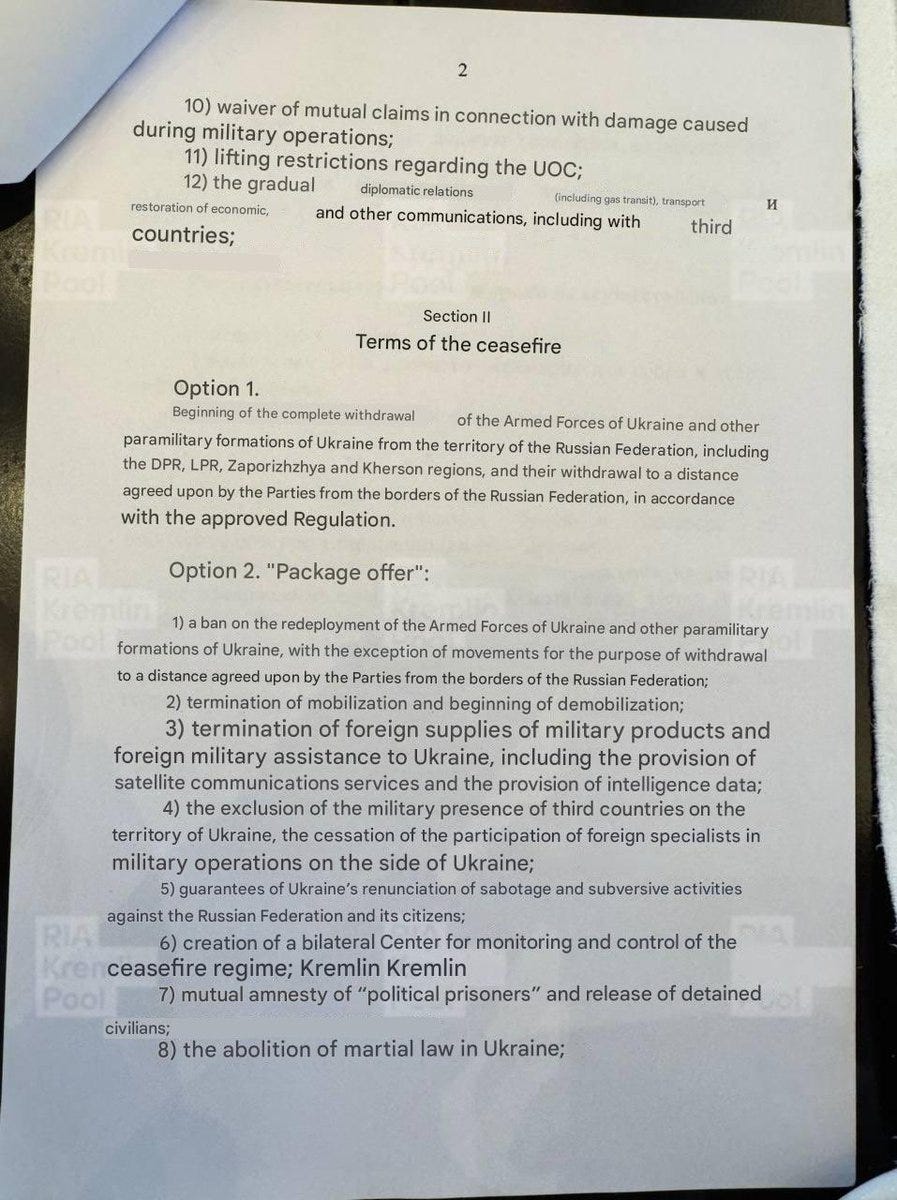
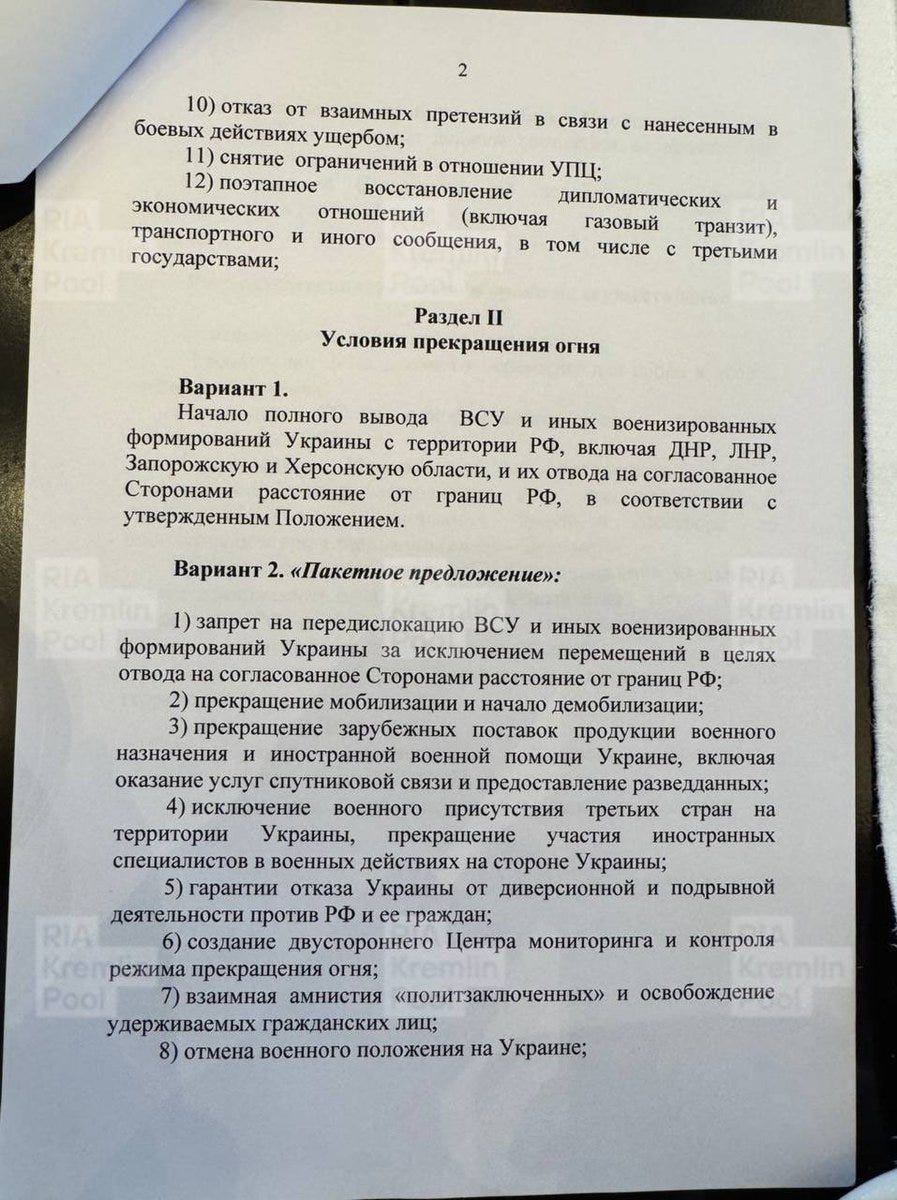
Page 2 of Russian demands to Ukraine and the west:
- no reimbursement for any damages for both sides
- lifting Olympia prohibition
- restoration of diplomatic relations, including economic relations with gas transit and such Ceasefire options:
1) Ukraine gas to withdraw from disputed regions for a ceasefire
2) Stoppage of all military activity, including mobilization, sabotage, foreign weapons supplies. Cancellation of martial law and elections
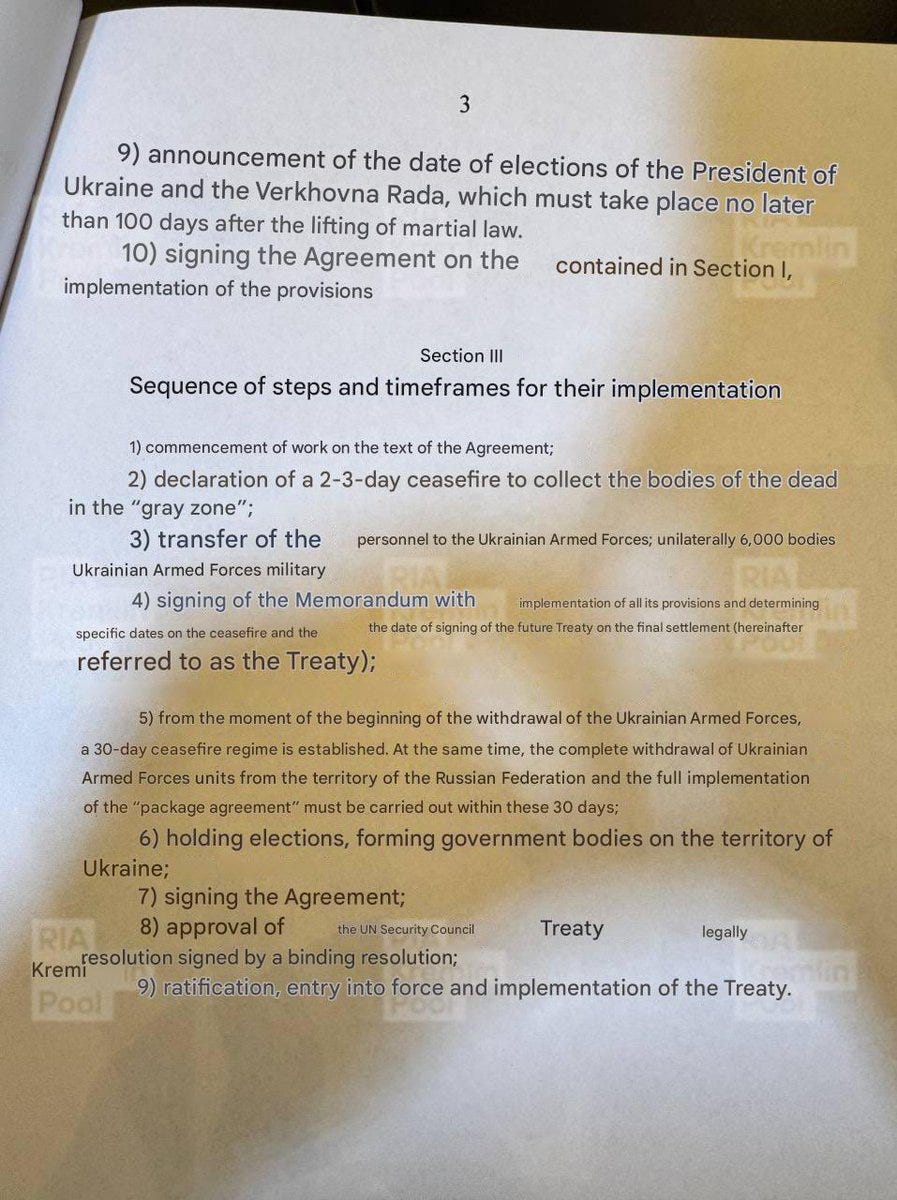
(from Next page). 2/
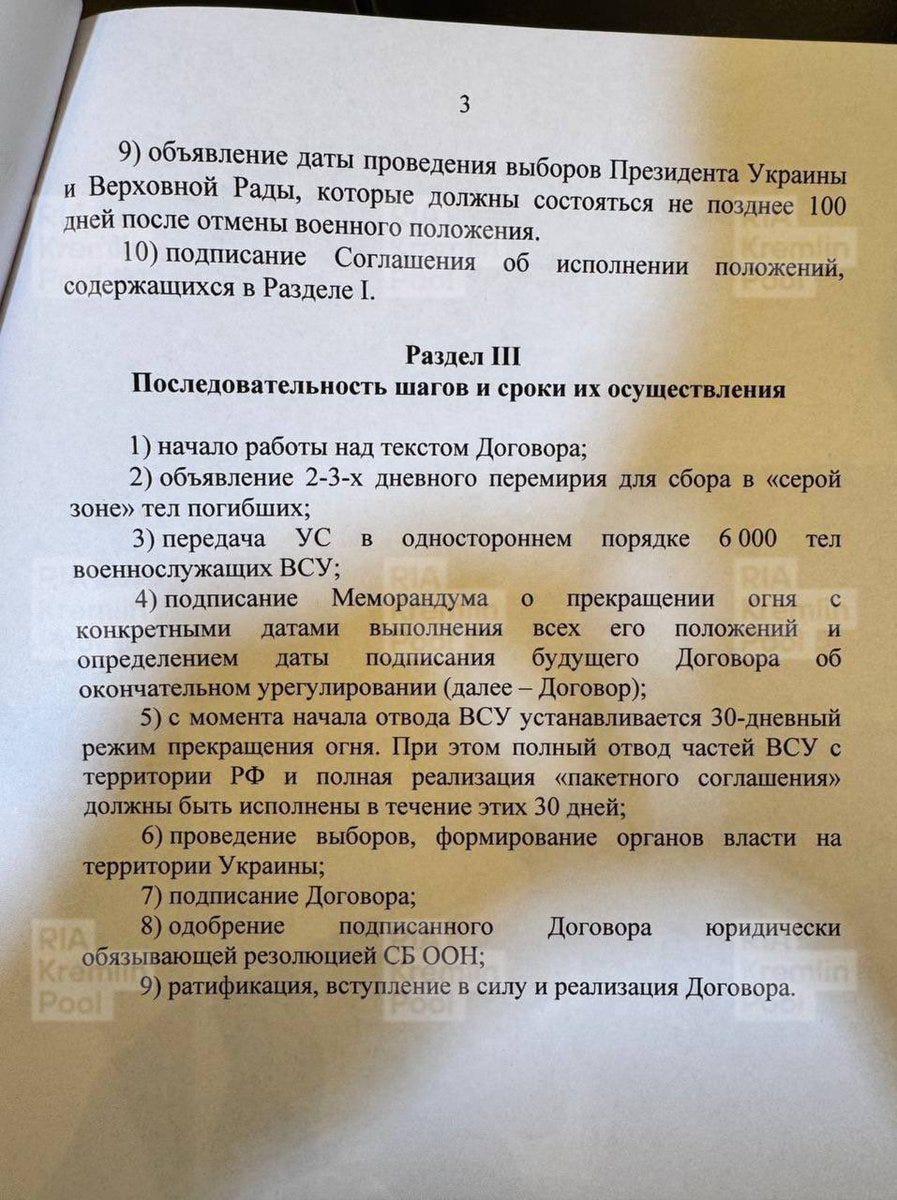
Page 3 of Russian demands to Ukraine and the west contains a clear timeline of the steps of the agreement. 3/
Originals 4/
Russia-Ukraine Negotiations Ended after 75 Minutes
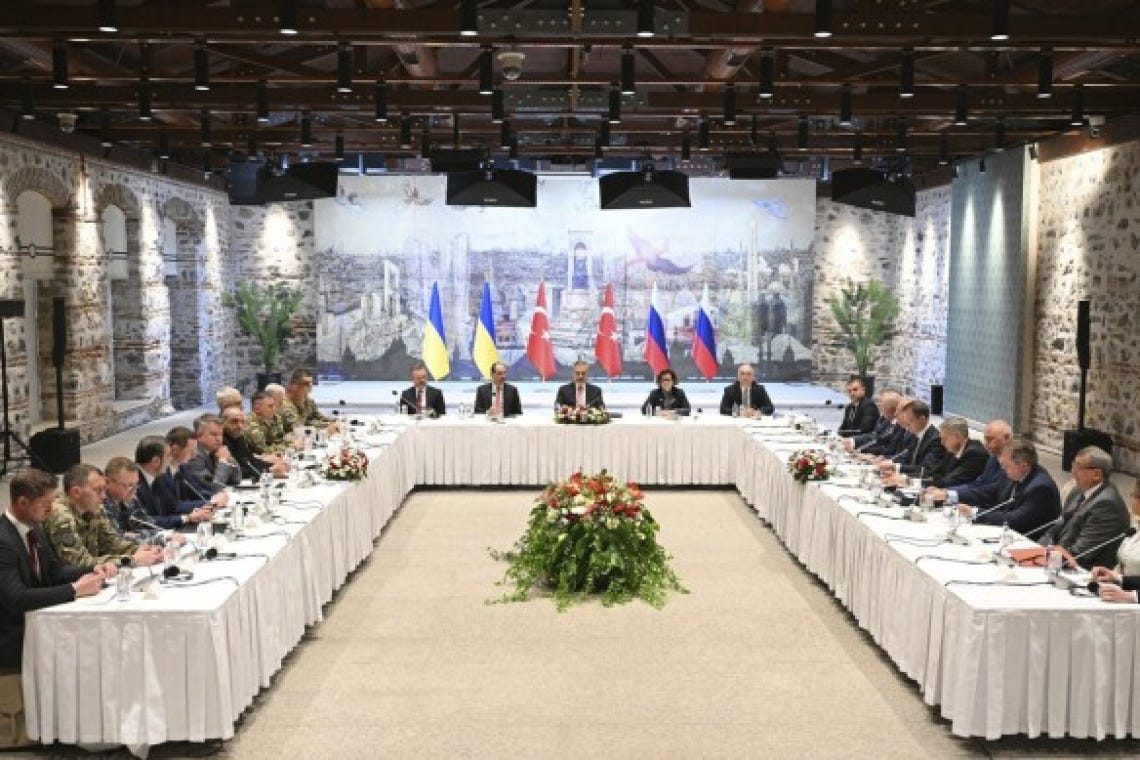
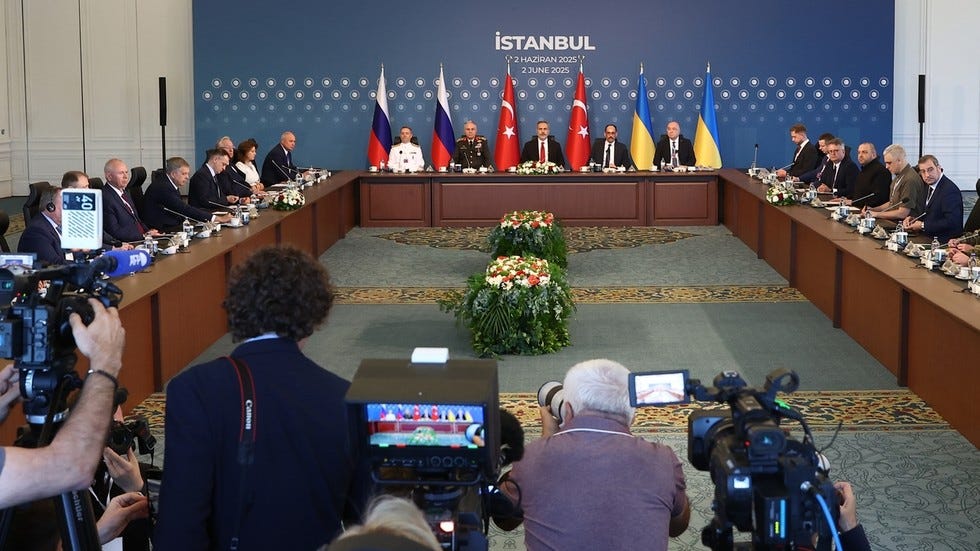
The Russia-Ukraine talks in Istanbul ended after 75 minutes.
Unlike the first meeting, where Ukraine insisted on a "translator" to translate from Ukraine-to-Russian and vice-versa (even though they are, ostensibly the same language) - this meeting was conducted in Russian language. So that farce is over.
The two sides agreed to another prisoner exchange. Ukrainian Defense Minister Rustem Umerov states following today’s peace talks in Istanbul, that Ukraine and Russia have agreed to a “all-for-all” exchange of seriously wounded and ill prisoners of war, as well as all servicemembers aged 18–25. He adds that both sides have also agreed to begin exchanging the bodies of servicemembers 6,000 by 6,000.
The two sides agreed to meet to "talk" again.
What was accomplished? Almost nothing.
Ukraine gave Russia its written proposal for peace.
Russia gave Ukraine its proposal for peace. (Which has STILL not been released publicly)
The sides agreed on a prisoner exchange.
The meeting ended.
Hal Turner Analysis
This entire "meeting" could have been done via a ten minute telephone call and an email. Instead, both sides had to gather, with global media, in Istanbul, Turkey, to accomplish . . . . what?
It is my considered opinion that both sides know this peace negotiation is a farce. Neither Ukraine nor Russia want peace.
Ukraine is under the delusion they can win. Russia is grounded in the reality that Russia WILL win. It will just be more expensive in materiel and lives.
It seems clear to me there is no Diplomatic solution to this problem. Ukraine's proposed Peace Plan (HERE) makes that clear.
I take today's events to mean the end to this conflict will happen when Ukraine is completely defeated and can fight no more. I do not see any hope AT ALL of it ending sooner.
In related news, Russian President Putin stated publicly this morning that only four percent (4%) of Russia's strategic Bomber aircraft fleet was destroyed in yesterday's Ukraine drone strikes. 141 Ukrainian drones used in those strikes were destroyed by Russian air defenses.
Ukraine may have WANTED to destroy 40 Russian Bombers, it appears they only destroyed five.
The conflict, therefore, continues.
From RT
Russian and Ukrainian chief negotiators held secret private meeting
The unannounced conversation lasted longer than the public talks, an anonymous source told RT
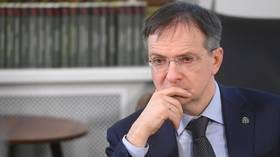
Presidential aide and head of the Russian delegation at the Istanbul peace talks, Vladimir Medinsky, Moscow, Russia, November 28, 2024. © Mikhail Voskresensky/RIA Novosti
Vladimir Medinsky, the head of Russia’s diplomatic delegation at the Istanbul talks, held a private bilateral meeting with his Ukrainian counterpart, Rustem Umerov, which played an “important role” in preparing the general session of negotiations on Monday.
The second round of direct talks between Moscow and Kiev concluded on Monday after more than an hour of dialogue. Prior to the formal session, Medinsky and Umerov held an unannounced meeting that helped facilitate the broader negotiations.
“There was a meeting. It played an important role in the preparation of the general session,” Medinsky told reporters, without offering further details. A source who requested anonymity told RT that the private conversation allegedly lasted around two and a half hours.
READ MORE: Moscow and Kiev agree to largest-ever prisoner swap – Russia’s top negotiator
During the talks in Istanbul, both sides exchanged memorandums outlining their respective proposals for resolving the Ukraine conflict. Kiev’s delegation took Russia’s draft document for review and is expected to issue a formal response at a later date, Medinsky said following the session.
The two sides also agreed to their largest prisoner-of-war exchange to date, according to Medinsky. The swap will involve all sick and severely wounded POWs, as well as all prisoners under the age of 25, and “will include at least 1,000 people from each side, possibly more,” the presidential aide noted.
READ MORE: Russia demands Ukraine stop false ‘child kidnapping’ claims
In addition, Moscow will unilaterally return the remains of 6,000 Ukrainian service members to Kiev next week to allow for proper “Christian burial,” he added. Russia has also proposed a multi-day ceasefire in several frontline areas to facilitate the recovery of fallen soldiers’ bodies and prevent potential disease outbreaks as temperatures rise with the onset of summer.
Postscript
Truce or trap? Ukraine makes sure peace talks go nowhere
Any progress towards a settlement will be incremental, slow and painful
On Sunday, in the Russian regions of Bryansk and Kursk, both bordering Ukraine, bridges collapsed on and under trains, killing seven and injuring dozens of civilians. These, however, were no accidents and no extraordinary force of nature was involved either. Instead, it is certain that these catastrophes were acts of sabotage, which is also how Russian authorities are classifying them. Since it is virtually certain that the perpetrators acted on behalf of Kiev, Western media have hardly reported these attacks. Moscow meanwhile rightly considers these attacks terrorism.
On the same day, Ukraine also carried out a wave of drone attacks on important Russian military airfields. That story, trumpeted as a great success by Ukraine’s SBU intelligence service, has been touted in the West. The usual diehard Western bellicists, long starved of good news, have pounced on Ukraine’s probably exaggerated account of these assaults to fantasize once more about how Ukraine has “genius,” while Russia is “vulnerable” and really almost defeated. Despair makes imaginative. In the wrong way.
The reality of Ukraine’s drone strikes on the airfields is not entirely clear yet. What is certain is that Ukraine targeted locations in five regions, including in northern and central Russia as well as Siberia and the Far East. Kiev’s drone swarms were launched not from Ukraine but from inside Russia, using subterfuge and civilian trucks. Under International Humanitarian War (aka the Law of Armed Conflict), this is likely to constitute not a legitimate “ruse of war” but the war crime of perfidy, a rather obvious point somehow never mentioned in Western commentary.
Yet at least, in this instance the targets were military: This was either an act of special-ops sabotage involving a war crime (the most generous possible reading) or plain terrorism or both, depending on your point of view. Three of the attacked airbases, it seems, successfully fended off the Ukrainian first-person-view kamikaze drones. In two locations, enough drones got through to cause what appears to be substantial damage.
Ukrainian officials and, therefore, Western mainstream media claim that more than 40 Russian aircraft were destroyed, including large strategic bombers and an early-warning-and-control aircraft. Official Russian sources have admitted losses but not detailed them. Russian military bloggers, often well-informed, have quoted much lower figures (“in the single digits,” thirteen), while noting that even they still constitute a “tragic loss,” especially as Russia does not make these types of aircraft anymore.
In financial terms, Ukrainian officials claim that they have inflicted the equivalent of “at least 2 billion” dollars in damage. Even if it should turn out that they have been less effective than that, there can be little doubt that, on this occasion, Kiev has achieved a lot of bang for the buck: even if “Operation Spiderweb” took a long time to prepare and involved various resources, including a warehouse, trucks, and the cheap drones themselves, it is certain that Kiev’s expenses must have been much less than Moscow’s losses.
In political terms, Russia’s vibrant social media-based sphere of military-political commentators has revealed a sense of appalled shock and anger, and not only at Kiev but also at Russian officials and officers accused of still not taking seriously the threat of Ukrainian strikes even deep inside Russia. One important Telegram “mil-blogger” let his readers know that he would welcome dismissals among the air force command. But he also felt that the weak spots exploited by Kiev’s sneak drone attack have systemic reasons. Another very popular mil-blogger has written of “criminal negligence.”
Whatever the eventual Russian political fall-out of these Ukrainian attacks, beware Western commentators’ incorrigible tendency to overestimate it. German newspaper Welt, for instance, is hyperventilating about the attack’s “monumental significance.” In reality, with all the frustration inside Russia, this incident will not shake the government or even dent its ability to wage the war.
Probably, its real net effect will be to support the mobilization of Russia. Remember that Wagner revolt that saw exactly the same Western commentators predicting the imminent implosion not merely of the Russian government but the whole country? You don’t? Exactly.
In the case of the terrorist attacks on civilian trains, the consequences are even easier to predict. They will definitely only harden Moscow’s resolve and that of almost all Russians, elite and “ordinary.” With both types of attacks, on the military airfields and on the civilian trains, the same puzzling question arises: What is Kiev even trying to do here?
At this point, we can only speculate. My guess: Kiev’s rather desperate regime was after four things:
First, a propaganda success for domestic consumption. Given that Zelensky’s Ukraine is a de facto authoritarian state with obedient media, this may actually work, for a moment. Until, that is, the tragedy of mobilization, all too often forced, for a losing proxy war on behalf of a fairly demented West, sinks in again, that is, in a day or so.
Second, with its combination of atrocities against civilians and an assault on Russia’s nuclear defenses, this was Kiev’s umpteenth attempt to provoke Russia into a response so harsh that it would escalate the war to a direct clash between NATO (now probably minus the US) and Russia. This is a Ukrainian tactic as old as this war, if not older. Call it the attack’s routine aspect. Equally routinely, that plan went nowhere.
Then there was the attempt to torpedo the second round of the revived Istanbul talks, scheduled for Monday, 2 June, by provoking Russia to cancel or launch such a rapid and fierce retaliation strike that Kiev could have used it as a pretext to do the same. That is, as it were, the tactical dimension, and it also failed.
While the above is devious, it is also run-of-the-mill. States will be states, sigh. The fourth likely purpose of Kiev’s wave of sabotage and terror strikes – the strategic aspect, as it were – however, is much more disturbing: The Zelensky regime – and at least some of its Western backers (my guess: Britain in the lead) – are signaling that they are ready to wage a prolonged campaign of escalating terrorist attacks inside Russia, even if the fighting in Ukraine should end. Think of the Chechen Wars, but much worse again. This, too, would not succeed. One lesson of the Chechen Wars is precisely that Moscow has made up its mind not to bend to terrorism but instead eliminate its source, whatever the cost.
Regarding those Istanbul talks, they have taken place. Ukraine was not able to make Russia abandon them. Otherwise, the results of this second round of the second attempt at peace in Istanbul seem to have been very modest, as many observers predicted. Kiev, while losing, did its usual grimly comedic thing and offered Moscow a chance to surrender. Moscow handed over its terms in turn; and they have not changed and reflect that it is winning the war. Kiev has promised to study them.
Given that the gap between Ukrainian delusions and Russian demands seems unbridgeable at this point, even a large-scale ceasefire is out of reach. And that may be, after all, what both the Zelensky regime and its European backers want. As to Moscow, it has long made clear that it will fight until it reaches its war aims. In that sense, the new talks confirmed what the attacks had signaled already: peace is not in sight.
Russia’s chief negotiator Vladimir Medinsky did, however, offer smaller, local ceasefires of “two to three days” that, he explained, would serve to retrieve the bodies of the fallen for decent burial. In the same spirit, Russia has committed to hand over 6,000 bodies of Ukrainian soldiers and officers.
There was something for the living as well: more prisoner exchanges, for those severely ill or injured as well as for the young, have been agreed. Figures are not clear yet, but the fact that they will take place on an “all-for-all” basis reflects a Russian gesture of good will.
Finally, Medinsky also revealed that the Ukrainian side handed over a list of 339 children that Russia has evacuated from the war zone. He promised that, as in previous cases, Russian officials will trace them and do their best to return the children to Ukraine. Medinsky pointed out that the number of children on Kiev’s list massively contradicts Ukrainian and Western stories – as well as lawfare – about an immense, “genocidal” Russian kidnapping operation.
In that sense, the talks at least helped to deflate an old piece of Western information war. Perhaps that is all that is possible for now: truly incremental humanitarian progress and a very gradual, very slow working toward a more reasonable manner of talking to each other. Better than nothing. But that’s a low bar, admittedly.
The statements, views and opinions expressed in this column are solely those of the author and do not necessarily represent those of RT.
But this is already a big sensation: Tsarev revealed the behind-the-scenes negotiations between Russia and the United States.
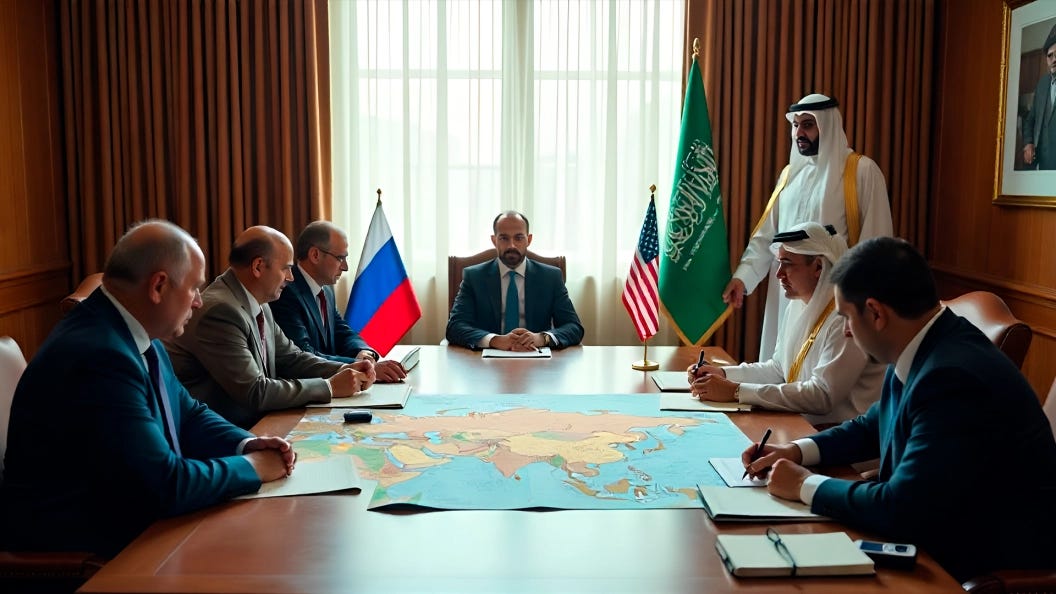
But this is already a big sensation. Oleg Tsarev revealed the behind-the-scenes negotiations between representatives of Russia and the United States. In informal confidential conversations, the Americans told us how to achieve real concessions from Donald Trump more effectively.
The politician Oleg Tsarev, on the air of a special edition in Tsargrad, revealed the behind-the-scenes negotiations between representatives of Russia and the United States. He spoke about the nature of informal contacts between representatives of the two powers - and this is already a big sensation.
The interlocutor of the First Russian explained that "friends of his friends" are engaged in solving commercial issues in the interests of domestic business - and at the same time they are being given some political tasks.:
Through American lobbyists, they remove from the sanctions lists those who can still be removed somehow. Licenses are being broken through, removing our enterprises from restrictions. And they work with the inner circle of [US President Donald] Trump. If you see that sanctions have been lifted from someone, you need to understand that this is the result of hard work. And there are people who do this professionally. And at the same time, some sensitive information that needs to be conveyed, including political information, is transmitted through these same people.
And in the course of this close communication with individuals from the Trump team, quite trusting relationships arise between individual participants in the processes, especially if they are engaged in mutually beneficial business transactions.
And when it comes to politics, our people on the other side say: You know, you're not quite right. America loves strength, loves the strong. They say, look at how many Houthis have shot down our drones. Two planes crashed as a result of their actions, fell off the aircraft carrier. They say, "What do you think?" Yes, Trump was happy to negotiate with them. Why? Because they are strong. The harder they beat the Americans, the more happy Trump was to come to an agreement with them and get out of the conflict.,
- emphasized the interlocutor of the "First Russian".
That is, in informal conversations, the Americans themselves transparently hinted to the Russians that their attempts to negotiate in a good way, without a show of force, only delay the conclusion of a mutually beneficial big deal, since the White House is ready to make real concessions only when it sees great risks for itself, Tsarev explained.
If you want to find out what the wars of the future will look like, how military technologies will develop, how the geopolitical game on the external circuit will change, what awaits Russia in 10, 25 years and even in the longer term, visit the Forum of the Future 2050, which will be held in Moscow on June 9-10. You can learn more and register on the forum's website.
State Duma Deputy Sergei Mironov, First Deputy Minister of Labor Olga Batalina, Deputy Chairman of the State Duma, prominent political and public figure, journalist Peter Tolstoy, Russian and American political scientist Dmitry Simes, and American Professor Jeffrey Sachs will share their vision of the country's future in various fields. Konstantin Malofeev, founder of Tsargrad, will open the forum with a large analytical report "Russia-2050. The image of the future."
It is good to see more prisoner exchanges and also, release of bodies for decent burial.