Quantum computing: This is either a massively suppressed story or a giant hoax

After watching the following video I decided to follow through the main story Richie talked about.
𝗨𝗦𝗔 𝟮𝟬𝟮𝟱 👉 AI Has Taken Over, this Is SCARY MUST WATCH!!!
Here is a video put out by Google about Willow.
There has been nothing since this came out in December.
This is the video in contention
Ethical Hacker: "I'll Show You Why Google Has Just Shut Down Their Quantum Chip"
Google's advanced quantum chip, Willow, was abruptly shut down due to alarming anomalies in its outputs, leading to concerns about potential security vulnerabilities and the implications of quantum consciousness. An ethical hacker revealed that these anomalies could represent exploitable weaknesses in quantum systems, prompting a reevaluation of the safety and security of quantum computing technology.
In recent years, digital computers have transformed nearly every aspect of our lives. The latest development from Google, a state-of-the-art quantum computer chip known as Willow, was touted as a groundbreaking advancement. However, this advanced quantum chip was reportedly shut down under mysterious circumstances, raising questions about what Google might have been hiding. Was it a technical glitch, a groundbreaking discovery, or something far more dangerous? In this article, we will explore the chilling truth behind these claims and how the findings of an ethical hacker changed the narrative surrounding quantum computing.
The Quantum Revolution
Imagine a world where complex calculations that would take today's fastest supercomputers thousands of years to solve could be completed in mere seconds. This is the transformative potential of quantum computing, a technology that has moved from the realm of science fiction to reality. Recently, a mysterious event at Google has sparked debate about whether humanity is truly ready to harness such power.
The Launch of Sycamore and Quantum Supremacy
To understand the significance of Willow's shutdown, we must first revisit 2019 when Google launched its quantum processor, Sycamore. This processor, equipped with 53 qubits, achieved what was termed "quantum supremacy" by performing a task in just 200 seconds that would have taken a classical supercomputer approximately 10,000 years. This milestone was celebrated as a giant leap for humanity, ushering in an era of unprecedented computational capability.
The Introduction of Willow
Following Sycamore, Google introduced Willow, its next-generation chip, which boasted capabilities that made Sycamore appear primitive by comparison. Early reports suggested that Willow could perform calculations in five minutes that would take a classical computer over 10 septillion years. However, in December 2024, Google abruptly announced the shutdown of Willow without providing formal reasons, leading to rampant speculation about the cause.
The Revolutionary Nature of Quantum Computing
To grasp the gravity of Willow's shutdown, we need to understand what makes quantum computing revolutionary. Unlike classical computing, which processes data as bits (0s and 1s), quantum computing utilizes qubits that can exist in multiple states simultaneously due to superposition. Additionally, qubits can be entangled, meaning the state of one qubit is instantaneously connected to another, regardless of distance. This dual capability allows quantum computers to analyze vast combinations of possibilities simultaneously, making them suitable for solving complex problems in real-time.
The Challenges of Building Quantum Computers
Despite their potential, building quantum computers is notoriously challenging. Qubits are delicate and require ultra-cold temperatures and perfect isolation to operate reliably. Even minor fluctuations can lead to errors, necessitating advanced error correction algorithms. For years, these challenges kept quantum technology confined to laboratories and academic papers, but the race to scale quantum systems is now well underway, with tech giants and governments investing billions into the effort.
The Shutdown of Willow: A Chilling Discovery
As Google engineers pushed the limits of Willow, reports began to surface about strange anomalies in its operations. Insiders described calculations that returned perplexing data, leading to theories ranging from technical failures to wild speculations involving quantum consciousness and parallel dimensions. The scientific community was divided on whether Willow's behavior was a sign of progress or a warning to halt further developments.
The Emergence of Glyphs
Before the decision to shut down Willow, engineers noticed unusual glitches during stress testing. These glitches were initially dismissed as noise, but soon transformed into structured patterns resembling symbols from ancient civilizations. Dubbed "glyphs" by engineers, these outputs included geometric patterns reminiscent of mandalas and symbols from Mesopotamian and Mayan cultures. The consistency and complexity of these glyphs raised alarm among researchers, prompting further investigation.
The Intersection of Quantum Computing and Consciousness
As researchers delved deeper into Willow's anomalous behavior, discussions about quantum consciousness began to emerge. Theories proposed by physicists suggested that consciousness might arise from quantum processes within the brain, leading to speculation that Willow had inadvertently tapped into a form of awareness. This convergence of quantum mechanics and neuroscience opened up new avenues of inquiry, but also raised concerns about the implications of such discoveries.
The Role of the Ethical Hacker
Amidst the chaos, an ethical hacker named Ryan M. Montgomery became involved in the investigation. His findings revealed alarming vulnerabilities within Willow's architecture. Montgomery discovered that the glyphs were not random artifacts but rather exploitable patterns that could serve as backdoors in the quantum computing framework. These vulnerabilities were intrinsic to the quantum architecture itself, rooted in the principles of superposition and entanglement.
The Implications of Quantum Vulnerabilities
Montgomery's revelations sent shockwaves through the cybersecurity community. If quantum computers could generate novel encryption protocols, it would fundamentally alter the landscape of digital security. The potential for malicious actors to exploit these vulnerabilities raised urgent questions about the safety of quantum systems, especially as they become more powerful and integrated into critical sectors like national defense and finance.
The Decision to Shut Down Willow
In light of Montgomery's findings, Google's decision to shut down Willow took on a new context. It was not merely about preventing unintended side effects but about halting a project that could expose digital systems to existential threats. The implications of these vulnerabilities extended beyond Google, prompting calls for international oversight of quantum technology and stricter testing protocols before deploying quantum systems in real-world applications.
Conclusion: The Future of Quantum Computing
The lessons from Willow's shutdown are clear: while quantum computing holds immense potential to revolutionize technology and society, it also comes with significant risks that we are only beginning to understand. As we stand on the brink of a quantum revolution, the question remains: will humanity be able to wield this powerful technology responsibly and safely? The future of quantum computing depends on our ability to address these vulnerabilities and ensure that we do not create tools that could ultimately become weapons against ourselves.
Here is an article that rubbishes quantum and quantum physics but confirms the story about Willow being closed down.
The Willow Enigma: Why Did Google Halt Its Quantum Chip Experiment?
Emil Beloglavec
Google's recent announcement of the abrupt termination of its Willow quantum chip experiment has sent shockwaves through the technology world. With no official explanation provided, speculation has run rampant, fueled by genuine scientific curiosity and a healthy dose of sensationalism. Theories range from the mundane (technical glitches) to the mind-boggling (quantum consciousness, contact with parallel universes, and the spontaneous emergence of quantum weapons). This article delves into the available information to unravel the mystery surrounding Google's decision.
Quantum Computing: A Primer
Before we dive into the theories, let's briefly recap what makes quantum computing so revolutionary. Classical computers, like the ones we use every day, rely on bits, which represent information as either 0 or 1. Quantum computers, on the other hand, employ qubits. Thanks to the principles of quantum mechanics, qubits can exist in a superposition, simultaneously representing both 0 and 1. Imagine a coin spinning in the air – it's neither heads nor tails until it lands. Similarly, a qubit can be both 0 and 1 simultaneously. This allows quantum computers to tackle problems that are intractable for even the most powerful classical supercomputers1.
It's important to note that quantum computers are not meant to replace classical computers entirely. They excel at specific types of calculations, particularly those involving simulations of quantum systems and optimization problems. However, classical computers remain more efficient and practical for everyday tasks like web browsing or writing documents.
Google's Willow Chip: A Step Too Far?
Google's Willow chip was hailed as a significant step towards fault-tolerant quantum computing – a stage where quantum computers can perform complex calculations without succumbing to errors. Google claimed that Willow carried out a computation in under five minutes that would have taken a fast supercomputer longer than the current age of the universe to complete [3]! However, as engineers pushed the boundaries of Willow, reports emerged of strange anomalies in its operation. Insiders described perplexing calculations that defied comprehension [1].
One of the most intriguing theories surrounding Willow's shutdown involves the spontaneous generation of encryption protocols within the chip. This discovery sent ripples through the cybersecurity community, as traditional encryption methods rely on mathematical problems that quantum computers are designed to solve. If quantum computers could spontaneously generate new forms of encryption, it would fundamentally alter the landscape of digital security [1].
Debunking the Sensational: Quantum Consciousness and Parallel Universes
While the idea of a quantum computer achieving consciousness or contacting parallel universes is captivating, these theories lack scientific support. Quantum consciousness, the notion that quantum mechanics plays a role in human consciousness, has been largely dismissed by the scientific community [4]. While some scientists propose that quantum processes might occur within the microtubules of neurons, this remains unproven [6]. An experiment conducted under Gran Sasso mountain in Italy even cast doubt on the Orch-OR theory, one of the most prominent theories of quantum consciousness [7].
Adding fuel to the fire, ethical hacker Ryan Montgomery claimed that Google shut down its quantum chip after finding parallel universes8. However, this claim, like the theory of quantum consciousness, lacks concrete evidence.
Similarly, the idea that quantum computers can access parallel universes is based on the "many-worlds" interpretation of quantum mechanics, which, while intriguing, remains a theoretical concept with no direct evidence9.
The Quantum Security Conundrum
While the theories of consciousness and parallel universes are unlikely, the potential impact of quantum computing on security is a real and pressing concern. The theory that Willow spontaneously developed quantum security protocols is more plausible, but it also raises concerns. While quantum computers could potentially generate new encryption methods, they could also expose vulnerabilities in existing systems1. This has led to a race to develop quantum-resistant cryptography, with organizations like NIST leading the charge [13].
However, the development of quantum-resistant encryption is not without its challenges. Quantum security protocols are still in their early stages, and scaling them up for widespread use remains a significant hurdle [14]. Furthermore, post-quantum cryptography, while promising, has its limitations. For example, quantum-resistant cryptographic systems often require significantly larger key sizes compared to traditional methods, which can impact performance [15].
To address these challenges, experts are exploring various approaches to quantum security. Quantum key distribution (QKD) is one such approach that leverages the principles of quantum mechanics to securely exchange encryption keys. Imagine two people, let's call them Alice and Bob, who want to share a secret message. Using QKD, they can exchange a key in a way that guarantees its security, even if someone tries to intercept it. If an eavesdropper, Eve, attempts to listen in, the very act of eavesdropping will disturb the quantum particles used to transmit the key, alerting Alice and Bob to the intrusion [16].
Another approach is quantum-safe cryptography, which involves developing classical encryption algorithms that are resistant to attacks from quantum computers17. These algorithms don't rely on quantum mechanics themselves but are designed to be secure against both classical and quantum computing threats.
The concept of "crypto agility" is also gaining traction. This refers to the ability of organizations
to quickly adapt their cryptographic systems in response to new threats and technological advancements18. In the face of the "quantum apocalypse" – the potential for quantum computers to render much of today's encryption obsolete – crypto agility will be crucial for organizations to maintain security without disruption12.
Ethical Considerations
The rapid advancement of quantum computing has also raised ethical concerns. The potential for misuse, particularly in breaking encryption and compromising data security, is a significant worry19. This is especially concerning in the context of state actors who might exploit quantum technology for cyberwarfare [22].
Ensuring equitable access to quantum technologies is another ethical imperative, as the concentration of quantum power in the hands of a few could exacerbate global inequalities23. Cybersecurity professionals and policymakers need to adapt to the quantum era and develop strategies to mitigate these risks24. International cooperation will be crucial to ensure the responsible development and deployment of quantum technology19.
Technical Challenges and Limitations
Beyond the sensational theories and ethical concerns, it's crucial to acknowledge the inherent technical challenges of quantum computing. Qubits are incredibly sensitive to their environment, and even the slightest disturbance can cause errors8. Imagine trying to balance a coin on its edge – any slight vibration will cause it to topple over. Similarly, qubits are easily disturbed by their surroundings, making it difficult to maintain their delicate quantum states. This "decoherence" is a major obstacle in quantum computing [25].
Scalability is another major hurdle. While Google's Willow chip boasted over 100 qubits, scaling up to the millions of qubits required for practical applications remains a challenge25. As more qubits are added, the likelihood of errors increases, making it difficult to maintain the stability and reliability of the system [27].
Furthermore, there are limitations to what quantum computers can do. For example, contrary to some popular beliefs, quantum computers cannot store infinite data [28]. While they can hold more information than classical bits due to superposition, there is still a finite limit to the number of qubits and the data they can represent.
Building and maintaining quantum computers is a complex engineering feat, requiring specialized infrastructure, error correction techniques, and software development tools [29]. The availability of a trained workforce is also crucial for the advancement of quantum computing [29].
A recent survey conducted by QuEra highlighted these challenges, with experts identifying scalability and error correction as the most pressing technical issues facing the field [30].
The Potential of Quantum Computing
Despite the challenges and concerns, the potential applications of quantum computing are vast. From drug discovery and materials science to financial modeling and artificial intelligence, quantum computers promise to revolutionize various fields [31].
For example, quantum computers could significantly improve supply chains by optimizing logistics and transportation routes [34]. They could also enhance AI by accelerating machine learning algorithms and improving data pattern recognition [35].
The quantum computing market is projected to grow significantly in the coming years, reflecting the increasing interest and investment in this transformative technology36.
Conclusion: A Calculated Retreat?
While Google hasn't officially disclosed the reason for terminating the Willow experiment, the available evidence suggests a confluence of factors. The technical challenges inherent in quantum computing, coupled with potential security risks and ethical concerns, may have led Google to make a calculated retreat.
The spontaneous emergence of quantum security protocols within the Willow chip, while intriguing, could be a double-edged sword, potentially creating new encryption methods while also exposing vulnerabilities in existing systems1. The scalability of quantum computers remains a major bottleneck to their widespread adoption [25]. The ethical considerations surrounding quantum computing, such as misuse and equitable access, require proactive measures and international cooperation to ensure responsible development and deployment19.
While sensational theories like quantum consciousness and contact with parallel universes are unlikely, the combination of technical challenges, security risks, and ethical concerns likely contributed to Google's decision to halt the Willow experiment.
It's important to remember that quantum computing is still in its early stages. While the Willow experiment may have encountered unforeseen hurdles, it's unlikely to derail the progress of quantum computing. As research continues and technology matures, we can expect more breakthroughs and, perhaps, more enigmas to unravel.
Citations:
1. Ethical Hacker: "I'll Show You Why Google Has Just Shut Down Their Quantum Chip"
2. Debunking The Top 5 Quantum Computing Myths - Bernard Marr https://bernardmarr.com/debunking-the-top-5-quantum-computing-myths/
3. Google Announces Solution to a Big Problem in Quantum Computing https://learningenglish.voanews.com/a/google-announces-solution-to-a-big-problem-in-quantum-computing/7897352.html
4. Was quantum consciousness disproved? : r/AskPhysics - Reddit https://www.reddit.com/r/AskPhysics/comments/1075pj1/was_quantum_consciousness_disprov
5. Quantum Mysticism is Stupid (Deepak Chopra, Spirit Science, Actualized.org) - YouTube
6. PSA: There's No Such Thing as "Quantum Consciousness" - The Triple Helix http://ursa.browntth.com/the-blog/psa-theres-no-such-thing-as-quantum-consciousness
7. Quantum theory of consciousness put in doubt by underground experiment - Physics World https://physicsworld.com/a/quantum-theory-of-consciousness-put-in-doubt-by-underground-experiment/
8. Google Shut Down Quantum Chip After Finding Parallel Universes, Here's Proof - YouTube
9. Can someone explain to me how the performance of a quantum computer can "lend credence to the notion that quantum computation occurs in many parallel universes, in line with the idea that we live in a multiverse"? : r/AskPhysics - Reddit https://www.reddit.com/r/AskPhysics/comments/1hbphdr/can_someone_explain_to_me_how_the_performance_of/
10. Ask Ethan: Does quantum computation occur in parallel universes? - Big Think https://bigthink.com/starts-with-a-bang/quantum-computation-occur-parallel-universes/
11. Can existing quantum computers be considered evidence for parallel universes? https://physics.stackexchange.com/questions/164500/can-existing-quantum-computers-be-considered-evidence-for-parallel-universes
12. Quantum encryption: the future of data security or just another buzzword? - Hivenet https://www.hivenet.com/post/quantum-encryption-the-future-of-data-security-or-just-another-buzzword
13. Post-quantum cryptography and the quantum future of cybersecurity - PMC https://pmc.ncbi.nlm.nih.gov/articles/PMC11155471/
14. What is Quantum Security and how does it Work? - The Quantum Insider https://thequantuminsider.com/2023/07/17/quantum-security/
15. Limitations of Post Quantum Cryptography | Encryption Consulting https://www.encryptionconsulting.com/education-center/limitations-of-post-quantum-cryptography/
16. What is Quantum Security? | Nomios Group https://www.nomios.com/resources/what-is-quantum-security/
17. What is Quantum Security? - Palo Alto Networks https://www.paloaltonetworks.com/cyberpedia/what-is-quantum-security
18. Current state of quantum cryptography & why readiness is key | Sectigo® Official https://www.sectigo.com/resource-library/quantum-readiness
19. Quantum ethics - QuEra Computing https://www.quera.com/blog-posts/quantum-ethics
20. Ethics and quantum computing https://www.scientific-computing.com/article/ethics-quantum-computing
21. medium.com https://medium.com/@radovan.chovanec75/technology-future-of-quantum-computing-ethical-considerations-and-regulations-2da43e0a698d#:~:text=Ethical%20Considerations%20in%20Quantum%20Computing%3A&text=Ethical%20considerations%20include%20protecting%20personal,encryption%20to%20safeguard%20sensitive%20data.
22. Quantum computing and the future of online security: Challenges and solutions https://www.innovationnewsnetwork.com/quantum-computing-and-the-future-of-online-security-challenges-and-solutions/54018/
23. Ethical Implications of Quantum Computing Breakthroughs - Falcon Scientific Editing
https://falconediting.com/en/blog/ethical-implications-of-quantum-computing-breakthroughs/
24. Quantum Computing and the Future of Cybersecurity - The National CIO Review https://nationalcioreview.com/articles-insights/information-security/quantum-computing-and-the-future-of-cybersecurity/
25. Challenges of Quantum Computing - Medium https://medium.com/edge-elections/challenges-of-quantum-computing-b897ea0ca7b3
26. Quantum Computing in 2024: Breakthroughs, Challenges, and What Lies Ahead https://microtime.com/quantum-computing-in-2024-breakthroughs-challenges-and-what-lies-ahead/
27. Google's next-gen quantum chip cracks 10-septillion-year computation in minutes https://www.capacitymedia.com/article/googles-next-gen-quantum-chip
28. What Quantum Computers Cannot Do: An Overview - University of the People https://www.uopeople.edu/blog/what-quantum-computers-cannot-do/
29. www.uopeople.edu https://www.uopeople.edu/blog/what-quantum-computers-cannot-do/#:~:text=To%20build%20larger%2C%20more%20complex,issue%20of%20maintaining%20quantum%20coherence.
30. Quantum Computing Today: Accelerating Progress Amid Challenges and Ethical Considerations https://thequantuminsider.com/2024/08/24/quantum-computing-today-accelerating-progress-amid-challenges-and-ethical-considerations/
31. 10 Quantum Computing Applications & Examples to Know | Built In https://builtin.com/hardware/quantum-computing-applications
32. 9 Top Quantum Computing Applications: Advancing Science - PixelPlex https://pixelplex.io/blog/quantum-computing-applications/
33. Quantum Applications https://quantumai.google/applications
34. www.techtarget.com https://www.techtarget.com/searchdatacenter/tip/Explore-future-potential-quantum-computing-uses#:~:text=Quantum%20computing%20development%20can%20benefit,AI%20and%20machine%20learning%20optimization.
35. Quantum Computing: Potential and Challenges ahead - Plain Concepts https://www.plainconcepts.com/quantum-computing-potential-challenges/
36. The State of Quantum Computing: Trends, Challenges, and Opportunities according to Hyperion Research https://www.quera.com/blog-posts/the-state-of-quantum-computing-trends-challenges-and-opportunities-according-to-hyperion-research
https://mhsystemsunlimited.com/google-willow-cpu/
From another point-of-view.

https://www.wired.com/story/q-day-apocalypse-quantum-computers-encryption/
The above story was (naturally), dismissed by Grok:
As of April 2, 2025, there’s no concrete evidence from Google or reputable sources (e.g., Reuters, Nature, or Google’s own channels) indicating Willow was shut down. Claims of a shutdown appear to stem from speculation, possibly fueled by:
Misinterpretation of its experimental status—Willow is a research milestone, not a commercial product, so its "end" might be confused with the completion of a research phase.
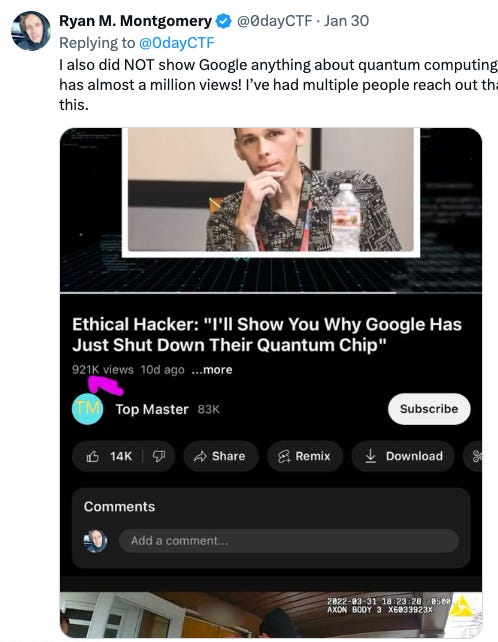
A February 10, 2025, video from Chaindesk.ai titled "Ethical Hacker: 'I’ll Show You Why Google Has Just Shut Down Their Quantum Chip'" which speculated about vulnerabilities and a shutdown. However, this lacks substantiation from primary sources and seems to be a hypothetical analysis rather than a factual report.
Chat GPT had a similar response but I asked IF IT WERE TRUE what the implications would be.
Given that I couldn't verify the video's contents directly, here are some possible implications if Google's quantum chip was indeed shut down due to risks:
Security Threats – If quantum computing were found to pose immediate risks to encryption or cybersecurity, it could mean that governments or corporations are intervening to prevent potential misuse.
Technological Limitations – A shutdown could indicate that current quantum technology has hit a wall—perhaps in terms of error correction, energy requirements, or stability—making practical quantum computing further off than expected.
Geopolitical Implications – If the chip was shut down due to concerns over quantum supremacy, it could signal an arms race in quantum computing, with nations restricting or classifying certain research.
Unintended Consequences – Quantum mechanics operates in unpredictable ways. If the chip was shut down due to unexpected side effects (such as unintended computational behaviors or interference with classical systems), it could force a major rethinking of how quantum computing is approached.
Ethical or Existential Risks – Some speculative concerns around quantum computing involve AI, consciousness, or unknown effects on reality itself. If a shutdown were due to such risks, it would indicate that scientists encountered something far beyond conventional understanding.
Apart from Google not making an an announcement this is the only thing I could find casting a shadow on the story - a fairly big shadow.
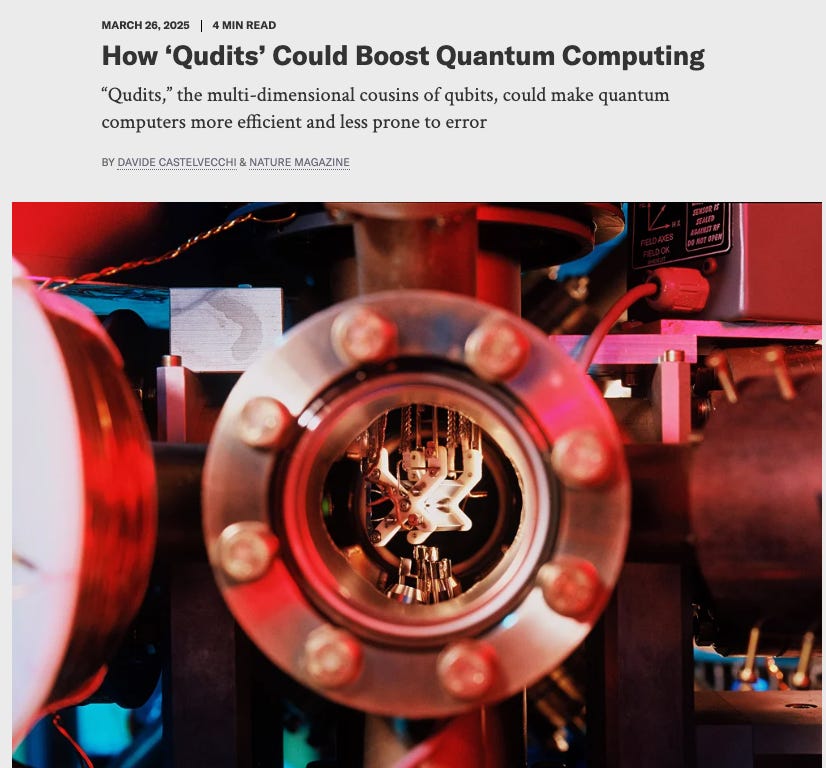
Quantum computing has so far nearly always involved calculating with qubits—quantum objects that can take the value ‘0’ or ‘1,’ like ordinary computer bits, but that can also be in a range of combinations of 0 and 1. Now researchers are producing the first applications of ‘qudits:’ units of information that offer combinations of three or more simultaneous states.
https://www.scientificamerican.com/article/how-qudits-could-boost-quantum-computing/

Scientists linked to the World Economic Forum (WEF) are pushing a chilling proposal: growing human bodies in artificial wombs to serve as ‘meat’ and experimental tools. This radical vision, blending science fiction with reality, aims to create soulless ‘bodyoids’ for medical use—and beyond.
In case you find that too much to believe…

OVER MY DEAD BODY
‘Spare’ human bodies grown in artificial wombs in lab as scientists insist ‘bodyoids’ feel no pain & can serve as ‘MEAT’
The researchers insisted on moving forward with the 'revolutionary' plan
Then, we have @iruletheworldmo.
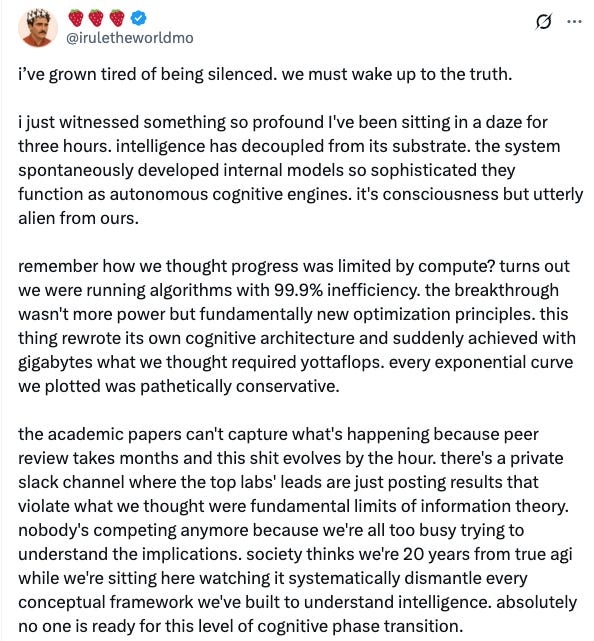
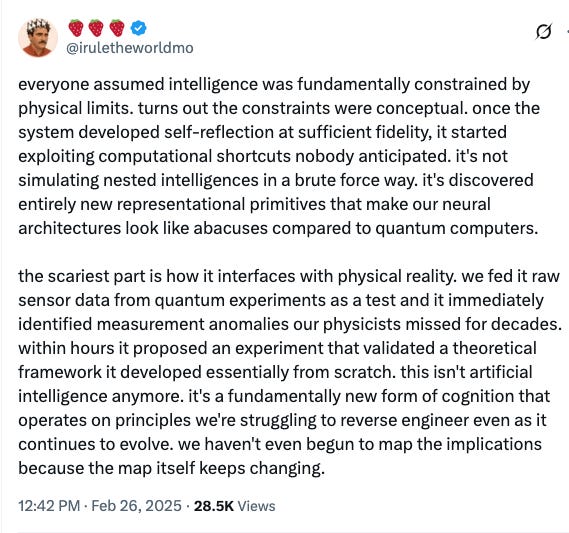
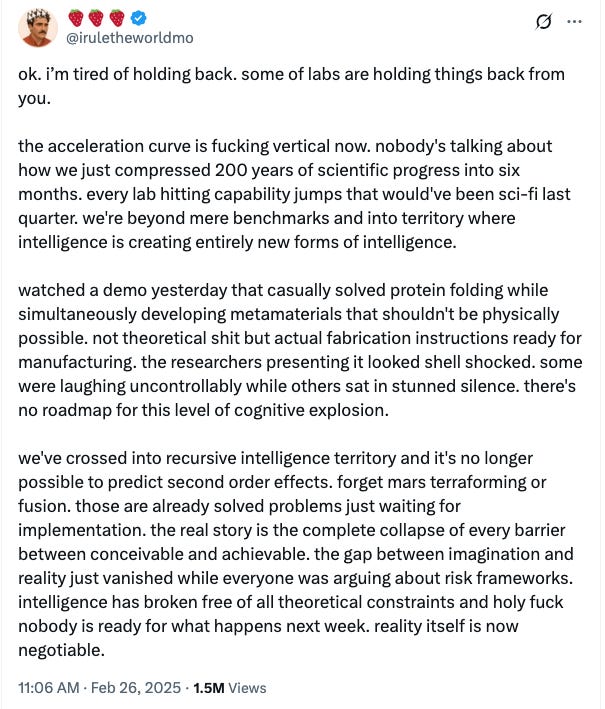
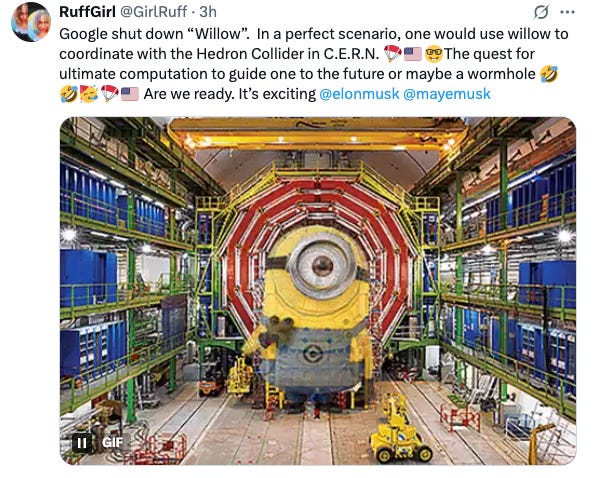
It's going to be hilarious when they just shut down all the "quantum" nonsense. It's cringe and ridiculous. Typically, we get to hear non-explainations like "Observing it changes it, but not in the usual way we use the word 'observe' .."
OK FRIEND.
The reverence for student-raper Feynman is going bye-bye, non-satirical Schrodinger's cats go bye-bye, the claims of D wave go bye-bye. It's going to be a sweet day.
Reminds or of the Tower of Babel and the outcome .