Panic Buying has Already Started with First Day of Dockworkers Strike Closing Down Half of the U.S. Ports

This is the first time in my 68 years that I have seen any government siding with the unions.
Usually they are for cohesion and the status quo.
Biden scolds ocean carriers for not paying dockworkers ‘fair’ wages
President warns against price gouging in aftermath of Hurricane Helene
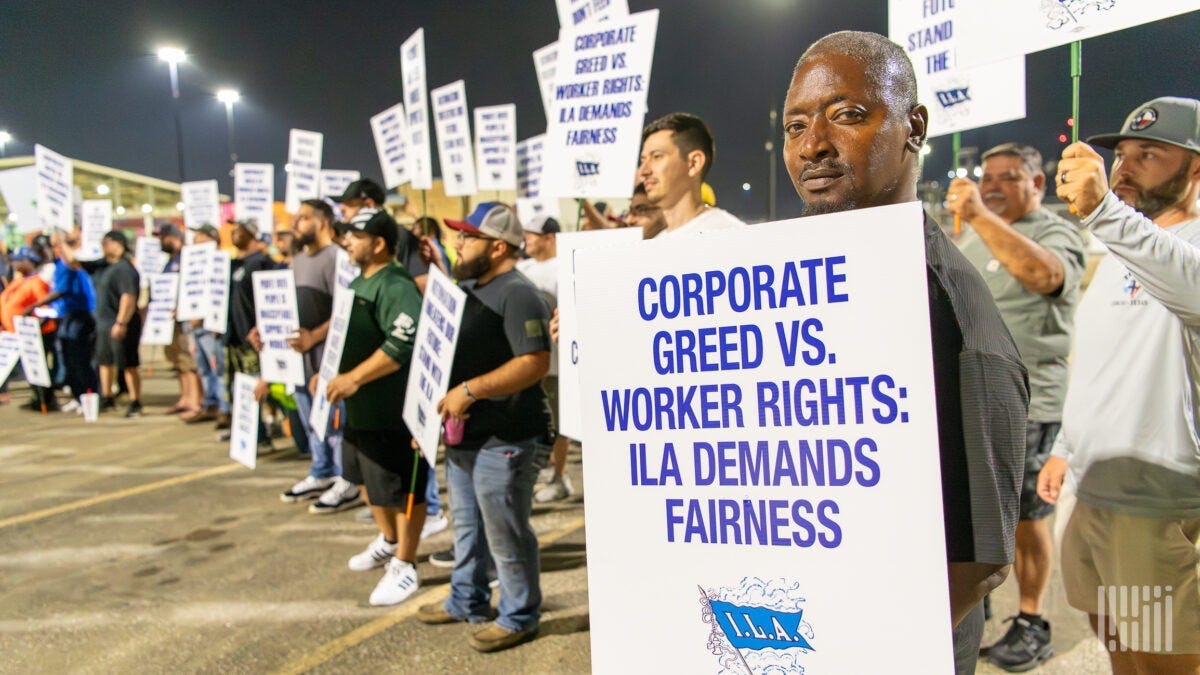
WASHINGTON — President Joe Biden broke his silence on the labor dispute between the International Longshoremen’s Association (ILA) and the United States Maritime Alliance (USMX) by accusing employers of hoarding profits.
“Ocean carriers have made record profits since the pandemic and in some cases profits grew in excess of 800 percent compared to their profits prior to the pandemic,” Biden said in a statement issued by the White House on Tuesday, after the ILA went on strike at 14 ports on the U.S. East and Gulf coasts, halting container and roll-on/roll-off operations at 36 marine terminals.
“Executive compensation has grown in line with those profits and profits have been returned to shareholders at record rates. It’s only fair that workers, who put themselves at risk during the pandemic to keep ports open, see a meaningful increase in their wages as well.”
In urging USMX to the bargaining table with an acceptable wage offer, Biden also warned the carriers against taking advantage of supply chain disruptions caused by Hurricane Helene.
“As our nation climbs out of the aftermath of Hurricane Helene, dockworkers will play an essential role in getting communities the resources they need. Now is not the time for ocean carriers to refuse to negotiate a fair wage for these essential workers while raking in record profits.
“My administration will be monitoring for any price gouging activity that benefits foreign ocean carriers, including those on the USMX board.”
Among USMX members are foreign-based container ship operators CMA CGM (France), Maersk (Denmark), Cosco (China), MSC (Switzerland), OOCL (Hong Kong) and Evergreen (Taiwan).
The compounding effect of the strike and disruptions caused by the hurricane is raising transportation fears among food producers and retailers.
“There’s never a good time for a strike,” said Food Industry Association President and CEO Leslie Sarasin in a statement on Tuesday.
“Now, the current strike is compounding the horrific situation in the Southeastern United States resulting from Hurricane Helene and parties need to return to the negotiating table.
“This action has already begun to jeopardize food supply chain operations, and the strike has the potential to disrupt the long-term stability of markets and commodities, namely pharmaceuticals, seafood, produce, meat, cheese, ingredients, and packaging.”
White House Press Secretary Karine Jean-Pierre told reporters on Tuesday that the strike is not yet hindering relief and recovery efforts related to the hurricane because emergency supplies had been positioned ahead of the storm.
She said the administration has stood up the Supply Chain Disruptions Task Force, created by the White House in 2021 in the wake of the pandemic, to monitor the situation.
“We are engaged extensively with labor, industry, state and local officials, ocean carriers, rail and truck companies, including multiple meetings with retailers, grocers, manufacturers, and agriculture,” Jean-Pierre said. “We are assessing ways to address any concerns, if necessary.”
On whether that would include ordering the union workers back to work by invoking the Taft-Hartley Act, “We have not used Taft-Hartley and we’re not planning to,” she said.
VIOLENT CLASH IN BALTIMORE AS PICKETING PORT WORKERS ATTACK TRUCK DRIVER TRYING TO WORK! AMERICA DIVIDED AGAINST ONE ANOTHER!
“A House divided against itself cannot stand”
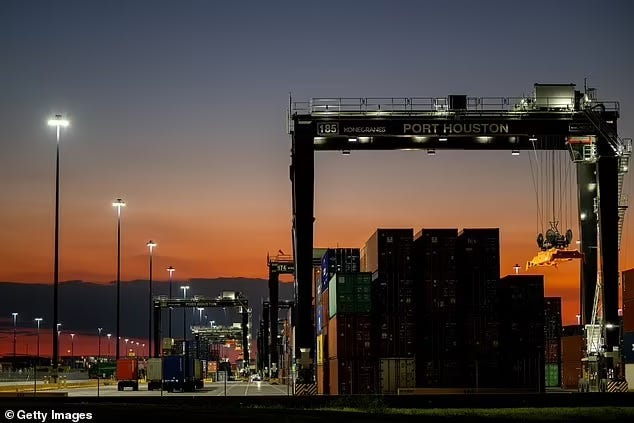
The East Coast port workers’ strike turned ugly overnight in Baltimore, hours after a contract between ports and members of the International Longshoremen’s Association (ILA) lapsed at midnight.
A trash hauler appeared on television with blood streaking down his face, saying striking workers had attacked his vehicle at picket lines at the Broening Highway Dundalk Marine Terminal in southeast Baltimore.
The waste remover, known only as Robin, told Fox 5 that striking dockers stormed his truck as he tried to enter the port, smashed his windshield and ‘lacerated my face’.
‘I come here for seven years. I’ve pulled the trash and the debris out of here for the Port of Baltimore,’ Robin said.
‘The officer told me to come back and go in there and get out of my way, and they attacked me and broke the windshield and lacerated my face. Look at it.’
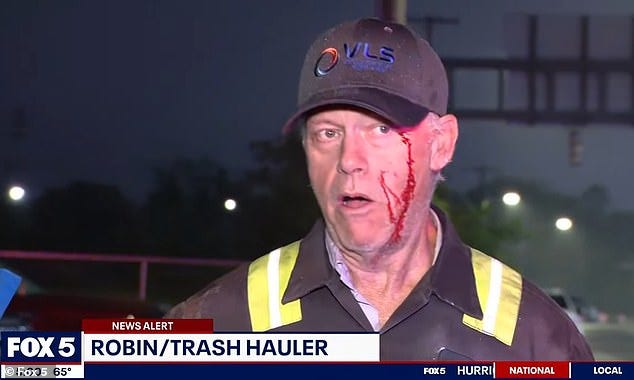
The trash hauler, known only as Robin, said striking dock workers attacked his vehicle as he tried to enter the port
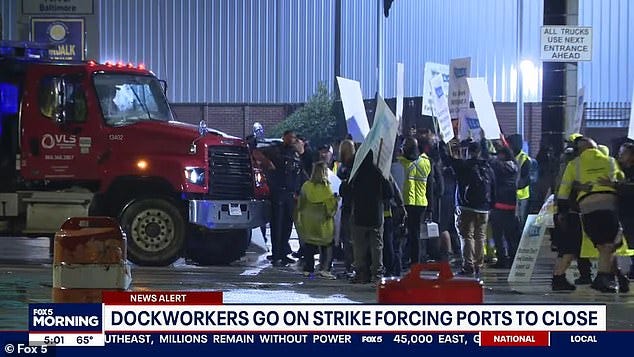
Union members at the scene reported that Robin’s truck had collided with the picketers as they swarmed around the vehicle. The injured driver was later assisted by an ambulance crew and spoke to police about the clash.
On social media, pro-union activists slammed the trash hauler as a ‘scab’ and accused cops of being ‘anti worker.’ Still, others blamed strikers for making unreasonable demands and blocking workers from accessing the port.
Baltimore Police Department did not immediately answer The Mail’s request for more details.
The incident in Baltimore was the first sign of violence to blight a strike over wages, job security, and automation between port owners and the union’s roughly 45,000 members that started at midnight.
The industrial action affects 36 ports from Maine to Texas and is the first by the union since 1977.
Members seek a pay rise that works out at about 77 percent over six years. For union members on a typical rate, their wage would go from $81,120 to around $143,520.
Workers began picketing at the Port of Baltimore shortly after midnight, walking in a circle holding signs that read ‘Machines Don’t Feed Families Support ILA Worker’ and ‘No Work Without A Fair Contract.’
Supply chain experts say consumers won’t see an immediate impact from the strike because most retailers stocked up on goods, moving ahead shipments of holiday gift items.
But if it goes more than a few weeks, a work stoppage would significantly snarl the nation’s supply chain, potentially leading to higher prices and delays in goods reaching households and businesses.
If drawn out, the strike will force businesses to pay shippers for delays and cause some goods to arrive late for peak holiday shopping season – potentially impacting delivery of anything from toys or artificial Christmas trees to cars, coffee and fruit.
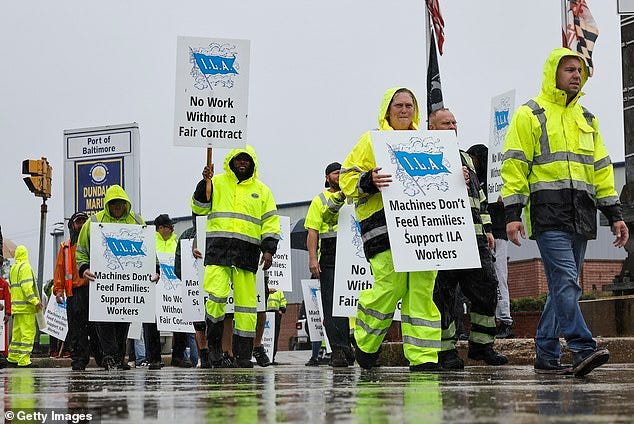
International Longshoremen’s Association (ILA) members and their supporters picket at the Dundalk Marine Terminal at the Port of Baltimore on Tuesday
US East Coast dockworkers strike outside Port of Baltimore
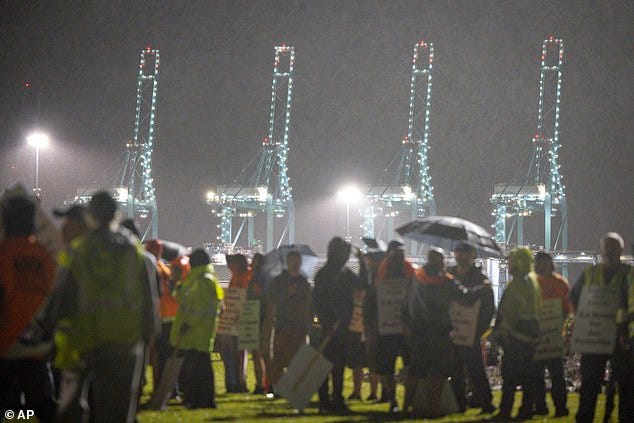
Hundreds of longshoremen strike together outside of the Virginia International Gateway in Portsmouth, Virginia, on Tuesday.
The strike will likely have an almost immediate impact on supplies of perishable imports like bananas, for example.
The union had message boards on the side of a truck reading: ‘Automation Hurts Families: ILA Stands For Job Protection.’
At Port Houston, which is in the Central time zone an hour behind the East Coast, at least 50 workers gathered outside the port with signs saying ‘No Work Without a Fair Contract’ shortly after midnight on Tuesday.
They appeared poised to begin picketing. Workers showed a statement from the ILA on the strike saying that employers have refused to compensate workers fairly.
‘The ILA is fighting for respect, appreciation and fairness in a world in which corporations are dead set on replacing hard-working people with automation,’ the statement said.
‘Robots do not pay taxes and they do not spend money in their communities.’
The U.S. Maritime Alliance, which represents the ports, said Monday evening that both sides had moved off of their previous wage offers, but when picket lines went up just after midnight, it was apparent that no deal had been reached.
The ports that affected by the shutdown include:
Baltimore and Brunswick, Georgia, the top two busiest auto ports
Philadelphia, which gives priority to fruits and vegetables
New Orleans, which handles coffee, mainly from South America and Southeast Asia, various chemicals from Mexico and North Europe, and wood products such as plywood from Asia and South America.
Other major ports affected include Boston; New York/New Jersey; Norfolk, Virginia; Wilmington, North Carolina; Charleston, South Carolina; Savannah, Georgia; Tampa, Florida; Mobile, Alabama; and Houston.
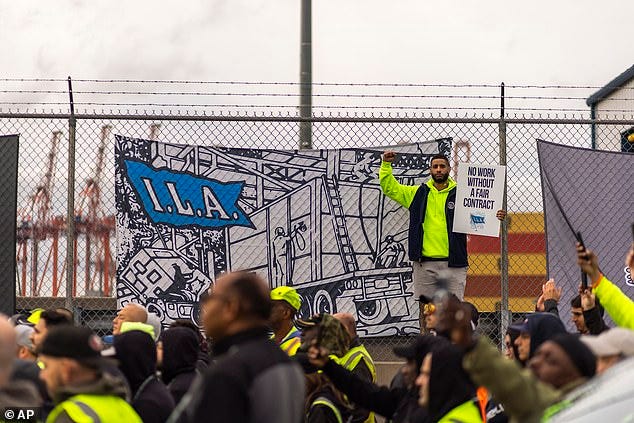
Workers take part in a port strike at Port Newark, Tuesday, in Bayonne, New Jersey.
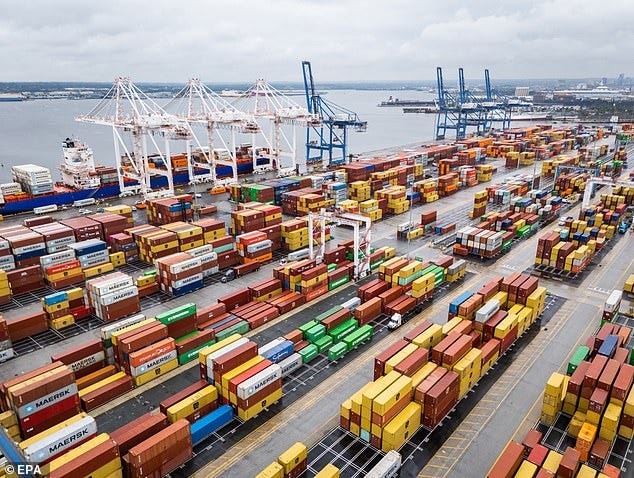
On Monday evening, the alliance said it had increased its offer to 50 percent raises over six years, and it pledged to keep limits on automation in place from the old contract
The union’s opening offer in the talks was for a 77 percent pay raise over the six-year life of the contract, with President Harold Daggett saying it’s necessary to make up for inflation and years of small raises.
ILA members make a base salary of about $81,000 per year, but some can pull in over $200,000 annually with large amounts of overtime.
But on Monday evening, the alliance said it had increased its offer to 50 percent raises over six years, and it pledged to keep limits on automation in place from the old contract.
The union wants a complete ban on automation. It wasn’t clear just how far apart both sides are.
‘We are hopeful that this could allow us to fully resume collective bargaining around the other outstanding issues in an effort to reach an agreement,’ the alliance statement said.
The union didn’t answer requests for comment on the talks Monday night, but said earlier in the day that the ports had refused demands for a fair contract and the alliance seemed intent on a strike. The two sides had not held formal negotiations since June.
The alliance said its offer tripled employer contributions to retirement plans and strengthened health care options.
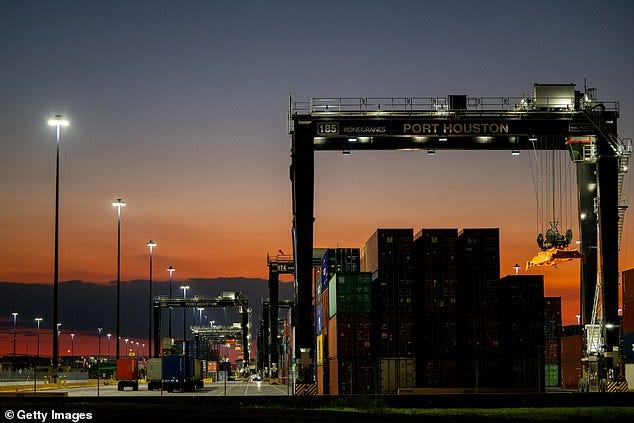
Supply chain experts say consumers won’t see an immediate impact from the strike because most retailers stocked up on goods, moving ahead shipments of holiday gift items
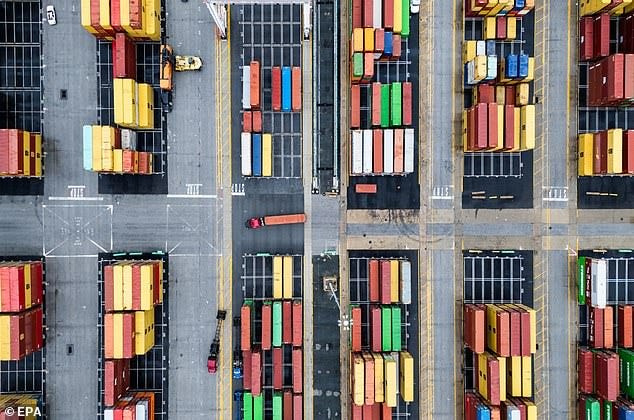
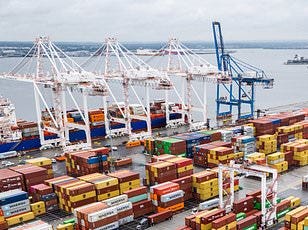
An image made with a drone shows shipping containers at the Seagirt Marine Terminal. The ILA strike shuts down 36 ports up and down the East and Gulf Coast, and cause the biggest supply chain disruption since the Covid pandemic
The Port of Virginia spent Monday preparing for the work stoppage and said on its website early on Tuesday morning that the strike had begun.
‘As a result of the expiration of the master agreement between United States Maritime Alliance and the International Longshoremen’s Association, there is a work stoppage at the Port of Virginia and other ports along the U.S. East and Gulf coasts,’ the website said.
Railroads say they can ramp up to carry more freight from the West Coast, but analysts say they can´t make up the cargo handled to the east.
‘If the strikes go ahead, they will cause enormous delays across the supply chain, a ripple effect which will no doubt roll into 2025 and cause chaos across the industry,’ noted Jay Dhokia, founder of supply chain management and logistics firm Pro3PL.
J.P. Morgan estimated that a strike that shuts down East and Gulf coast ports could cost the economy $3.8 billion to $4.5 billion per day, with some of that recovered over time after normal operations resume.
The strike comes just weeks before the presidential election and could become a factor if there are shortages.
Retailers, auto parts suppliers and produce importers had hoped for a settlement or that President Joe Biden would intervene and end the strike using the Taft-Hartley Act, which allows him to seek an 80-day cooling off period.
But during an exchange with reporters on Sunday, Biden, who has worked to court union votes for Democrats, said ‘no’ when asked if he planned to intervene in the potential work stoppage.
A White House official said Monday that at Biden’s direction, the administration has been in regular communication with the ILA and the alliance to keep the negotiations moving forward.
The president directed Chief of Staff Jeff Zients and National Economic Council Director Lael Brainard to convene the alliance’s board members Monday afternoon and urge them to resolve the dispute fairly and quickly – in a way that accounts for the success of shipping companies in recent years and contributions of union workers.
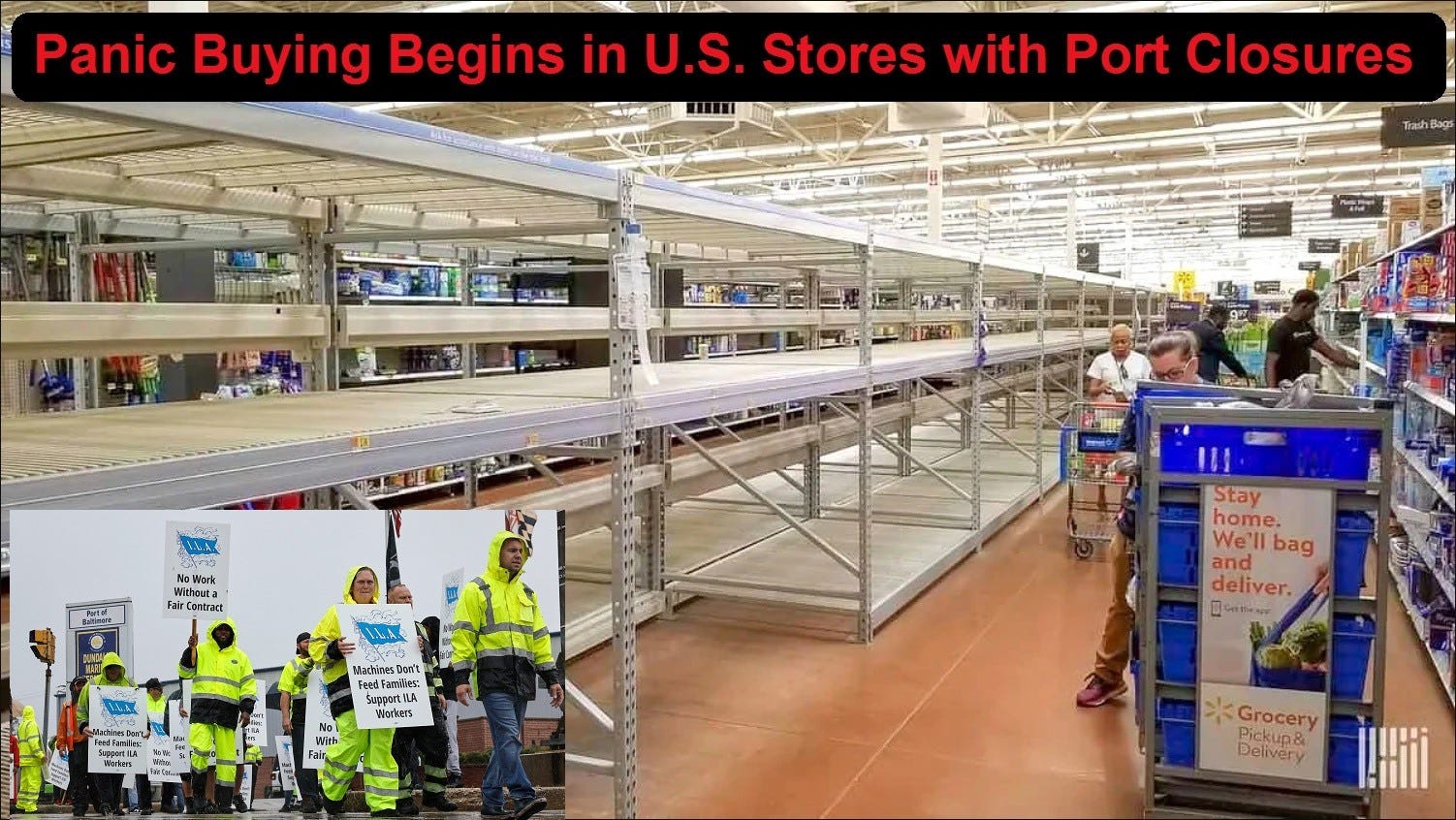
Panic Buying has Already Started with First Day of Dockworkers Strike Closing Down Half of the U.S. Ports
by Brian Shilhavy
Editor, Health Impact News
With the United States already suffering major loss of lives and farmland due to Hurricane Helene, and as the war in the Middle East now escalates with Iran starting to bomb Israel today, perhaps the most significant news that affects you RIGHT NOW, is the first day, today, of the dockworkers strike in the eastern and southern United States that has now closed down HALF of the ports in the U.S.
Massive port strike begins across America’s East Coast, threatening shortages and rising prices
New York CNN — Nearly 50,000 members of the International Longshoremen’s Association (ILA) are on strike Tuesday against the nation’s East and Gulf Coast ports, choking off the flow of many of America’s imports and exports in what could become the country’s most disruptive work stoppage in decades.
The strike, which began at midnight, will stop the flow of a wide variety of goods over the docks of almost all cargo ports from Maine to Texas.
This includes bananas, European beer, wine and liquor, along with furniture, clothing, household goods and European autos, as well as parts needed to keep US factories operating and American workers in those plants on the job, among many other goods.
It could also stop US exports now flowing through those ports, hurting sales for American companies.
A wide gap remained between the union’s demands and the contract offer from the United States Maritime Alliance, which uses the acronym USMX. The maritime alliance represents the major shipping lines, all of which are foreign owned; as well as terminal operators and port authorities.
“If we have to be out here a month or two months, this world will collapse,” said ILA President Harold Daggett in an interview with CNN Tuesday morning.
“Go blame them. Don’t blame me, blame them.”
The strike at half of the nation’s ports that started today will cost the U.S. economy about $5 billion a day.
How would a strike affect businesses and consumers?
A strike could cost the economy $5 billion a day, or about 6 percent of gross domestic product, JPMorgan analysts said. More than 68 percent of all U.S. container exports and more than 56 percent of container imports flow through East and Gulf Coast ports, according to the National Association of Manufacturers.
Many businesses would be hurt by a walkout because lots of raw materials — wood and cotton, for example — pass through these ports. Most imports of pharmaceutical products carried in containers flow through the affected ports. And a wide variety of food shipments pass through the East and Gulf Coast ports. (Source: NYT)
With stores and gas stations still closed in North Carolina and Tennessee due to the devastation caused by Hurricane Helene, it is being reported that panic buying is now beginning in stores in other parts of the U.S. today.
Panic-buying already spreading as ILA dockworker strike gets underway
As union dockworkers began striking against employers at East and Gulf Coast ports early Tuesday morning, reports of panic-buying at supermarkets almost immediately started spreading across social media.
Video clips posted by social media users on X and Facebook showed people rushing to buy water, toilet paper, paper towels and other items at supermarkets and retailers across the U.S.
“Are people already panic buying because of the Port Strike? Here are the grocery shelves in the water section at my local Kroger this morning. I realize that we are probably also low on water due to the Helene aftermath in East Tennessee, but still not great to see this already,” photographer and author Denise Van Patten posted in a social media video clip on X.
Micheal Coker posted on X, “Well the panic buying is in full swing in my little town in South carolina. Sam’s at 8:30 a.m., no water. Same at Walmart and grocery stores. Next will be toilet paper.”
A prolonged strike could cause major disruption to the domestic supply chain, according to American Farm Bureau Federation Economist Daniel Munch.
“For international destinations, waterborne exports are vital to us farmers,” Munch said in a podcast on Thursday.
“They make up over 75% of total U.S. agricultural export volume. The potential strike that we’re looking at would mainly disrupt containerized agricultural exports, which account for 30% of U.S. waterborne agriculture exports by volume. The remaining 70%, often grains and oil seeds, are shipped via bulk carriers, which are usually managed by independent workforces and will not be affected by the strike.”
He said U.S. farmers could be particularly vulnerable to a strike that lasts a week or more.
“The strike could have disastrous impacts on U.S. agriculture, depending on how long it lasts,” Munch said.
“The disruption to overall agricultural trade is expected to be about $1.4 billion each week that a strike is in place. When we think about what commodities are at risk, nearly 80% of waterborne exports of poultry leave East Coast ports, 56% of raw cotton, 36% of red meat, 30% of dairy products and even 6% of soybeans all go through those ports, through containerized exports. Not having an outlet to move those goods will create supply surpluses domestically and reduce prices for farmers.”
The top retailers that could be affected by the work stoppage at the ports are Walmart, Ikea, Samsung and Home Depot, according to data from ImportGenius and Arbor Data Science. (Full article.)
Went to Costco to get a few things at 10:30. We were low on paper towels and TP. Noticed parking lot was full. Saw people walking out with carts full of paper goods.
I went in with the intent of getting one pack of towels and one of TP. Nay nay Nasty Butt! The aisle was empty. Associate told me people were waiting in line when they opened.
She said some people had 10 packs of TP! Costco sized packs!!!!!
All because of a strike that started at midnight. (Source.)
This is also going to affect my own store, Healthy Traditions, as we have two containers scheduled to arrive from Chile within the next 30 days, our world-class raw Andes Mountain honeys, and our Chilean Extra Virgin Olive oil, which we bring through the Port of Houston from Chile, in route to our warehouse in Texas.
With more bad weather on the way that could affect the same areas still searching for survivors in the Appalachians, and with the war escalating not only in the Middle East, but also in Ukraine and potentially soon in the Pacific, with the very real possibility that there could be attacks on U.S. soil, you don’t need me to warn you that NOW is the time to stock up on water and food and try to have an alternative energy source.
Even if we don’t see major food shortages, the prices are absolutely going to start climbing at some point, from their already high pricing currently.
Related:
When the fires were ongoing outside of Santa Rosa California I asked the Armory there why the water buffalo trailers weren't being deployed ( had about 30 in their yard) ...Newsom had allowed deployments to Iraq. During the height of fire season.