It's a total cliff dive today

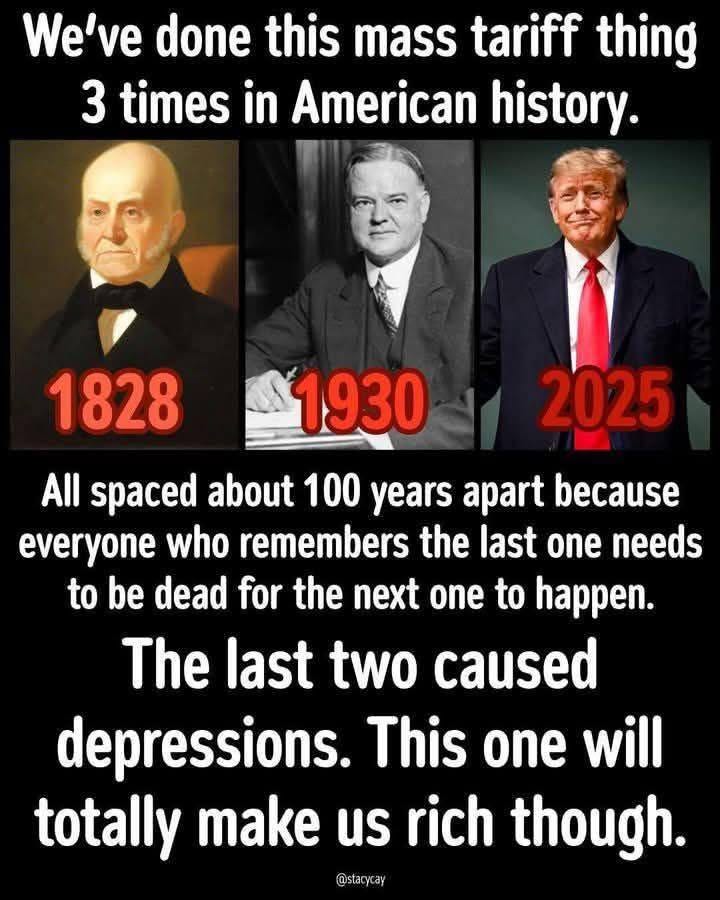
Everything Is Crashing After China Retaliates With 34% Tariffs On US Goods
For a few hours it seemed like we could even stabilize, if only a bit, ahead of today's scheduled main event: the March jobs report at 8:30am ET. And then all hell broke loose at 6:08am when this Bloomberg headline hit:
*CHINA ANNOUNCES EXTRA 34% TARIFFS ON US GOODS
In other words, far from seeking concessions, Beijing is now looking to escalate the trade war further, and forcing Trump to double down with even harsher retaliatory tariffs on China of his own, which at this point may push the blended tariff rate on Chinese goods above 100%.
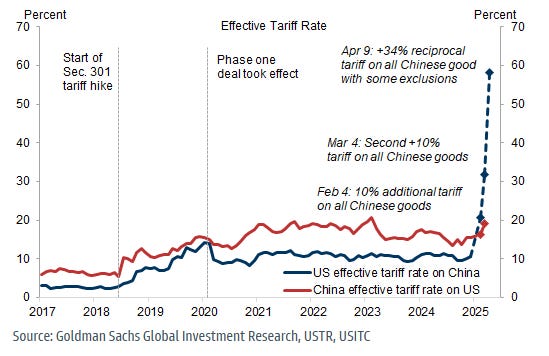
What followed instantly was sheer, unadulterated liquidation panic:
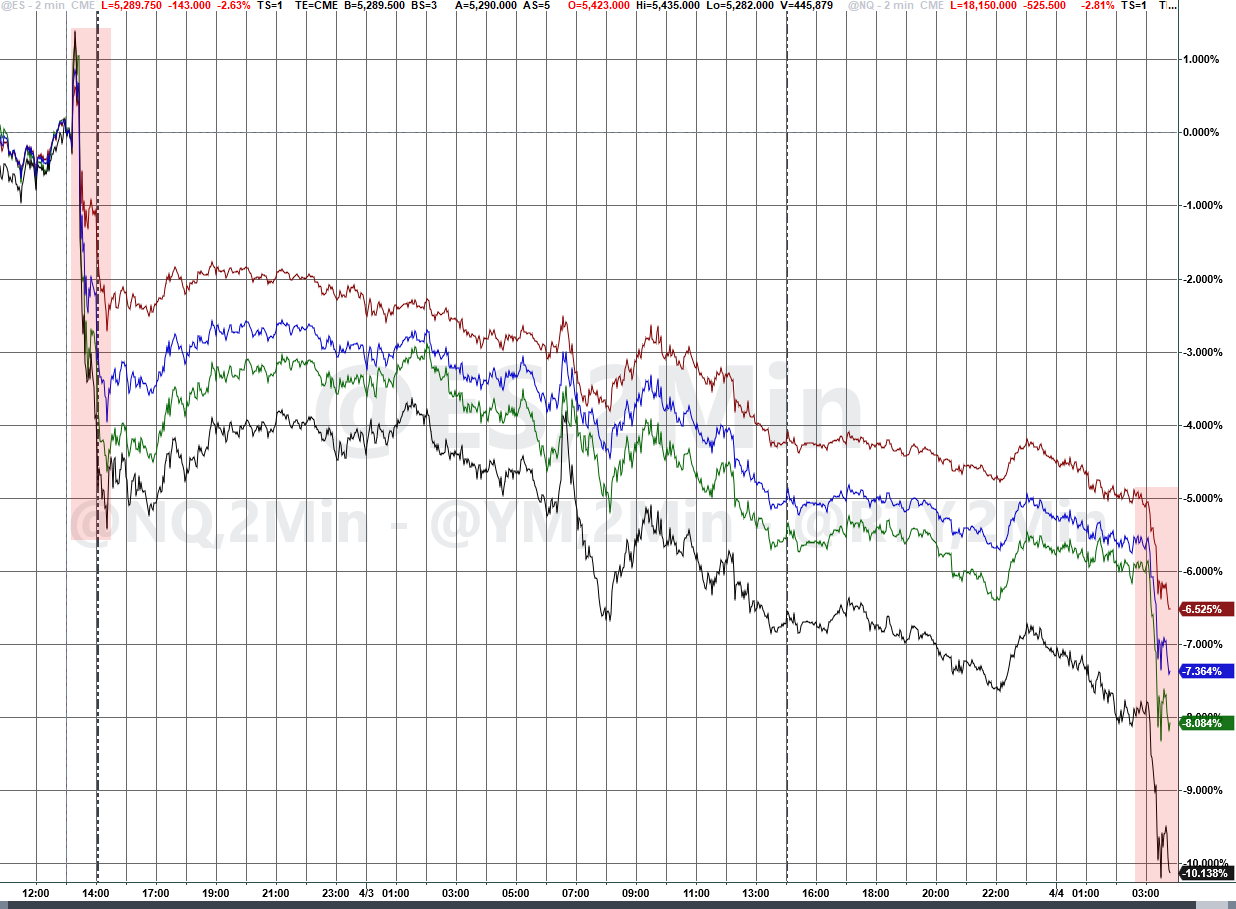
*S&P 500 FUTURES DECLINE 4.1%, NASDAQ 100 FUTURES DOWN 4.6%
*COPPER PLUNGES MORE THAN 5%, BIGGEST LOSS SINCE JULY 2022
*US 2-YEAR YIELD FALLS TO 3.498%, LOWEST SINCE SEPTEMBER 2022
*BRENT OIL DROPS BELOW $65 FOR FIRST TIME SINCE AUGUST 2021
*US CREDIT RISK GAUGE JUMPS MOST SINCE REGIONAL BANKING CRISIS
*STOXX EUROPE 600 INDEX FALLS 5.2%, MOST SINCE MARCH 2020
Instead of writing, we'll let the charts do the talking, summarizing the bloodbath so far. The S&P is set to record losses on six of the past seven weeks.
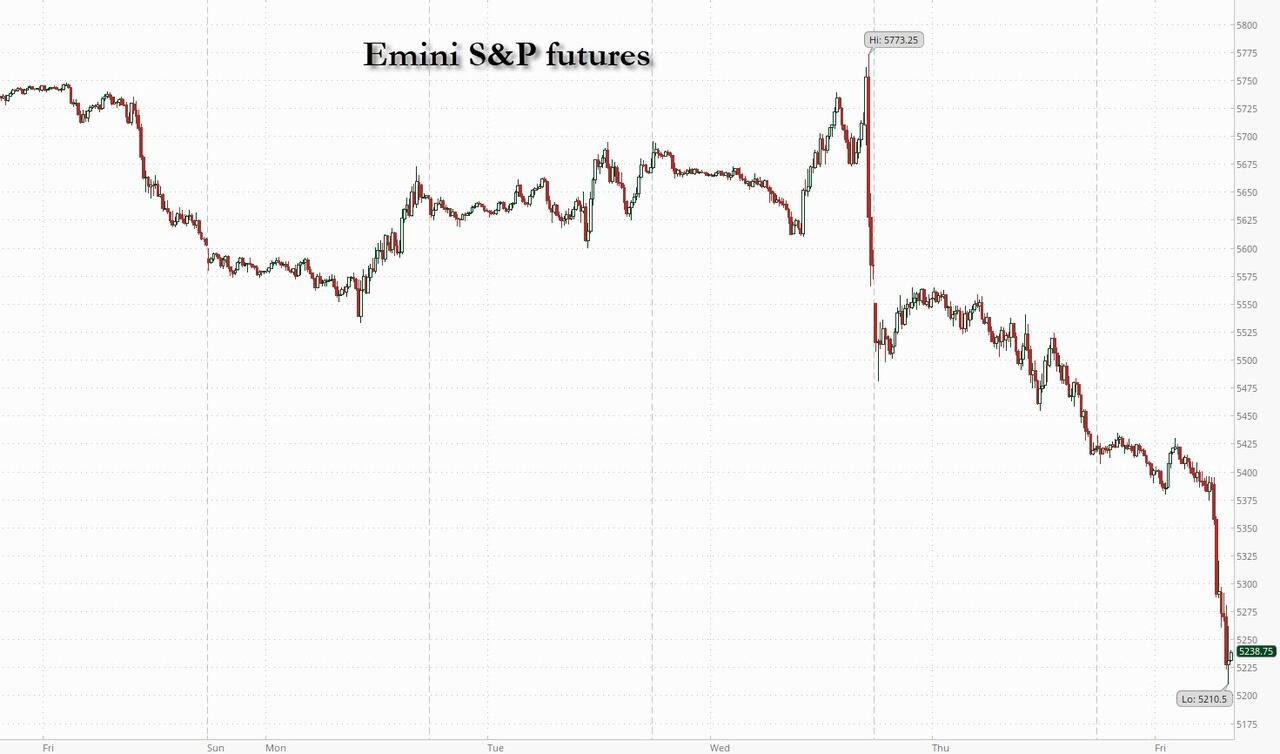
Volatility has come roaring back as VIX explodes above 45. A continuation of the selloff on Friday — when the government’s jobs report for March is released — threatens to extend Fund managers yanked $4.7 billion out of US stocks in the week through April 2 in the second week of outflows, data compiled by EPFR Global and Bank of America show.
The post-liberation day market has been a historic bloodbath
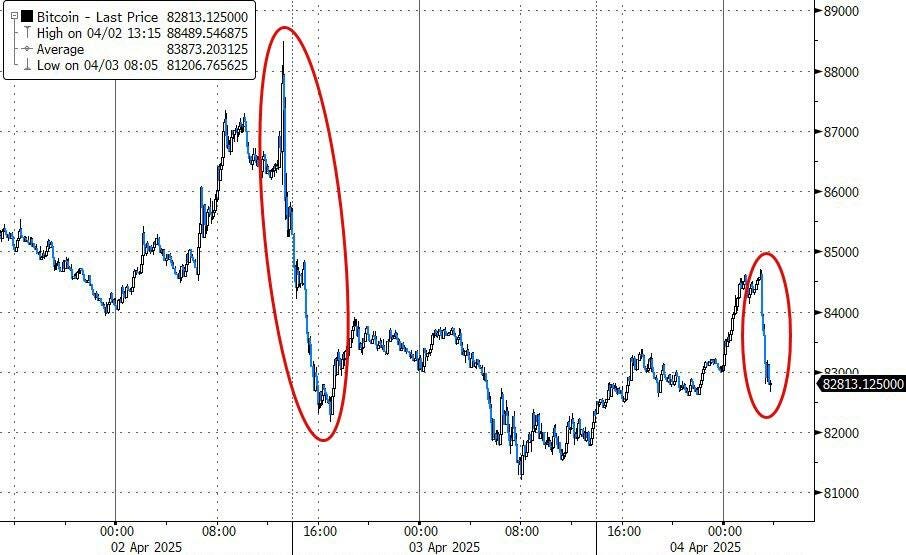
Bitcoin reversed all modest overnight gains, but remains surprisingly resilient.
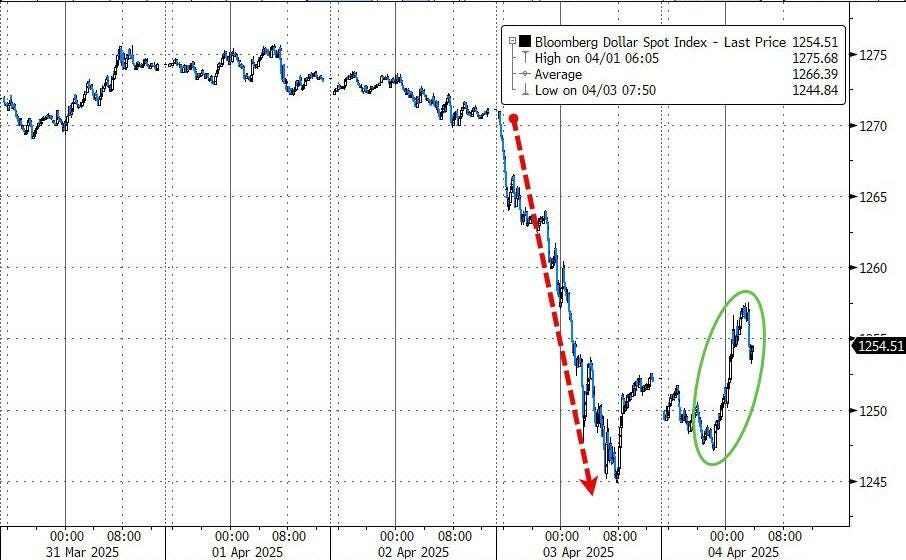
The dollar's modest reversal higher was promptly halted, and the greenback reversed just as it was gaining.
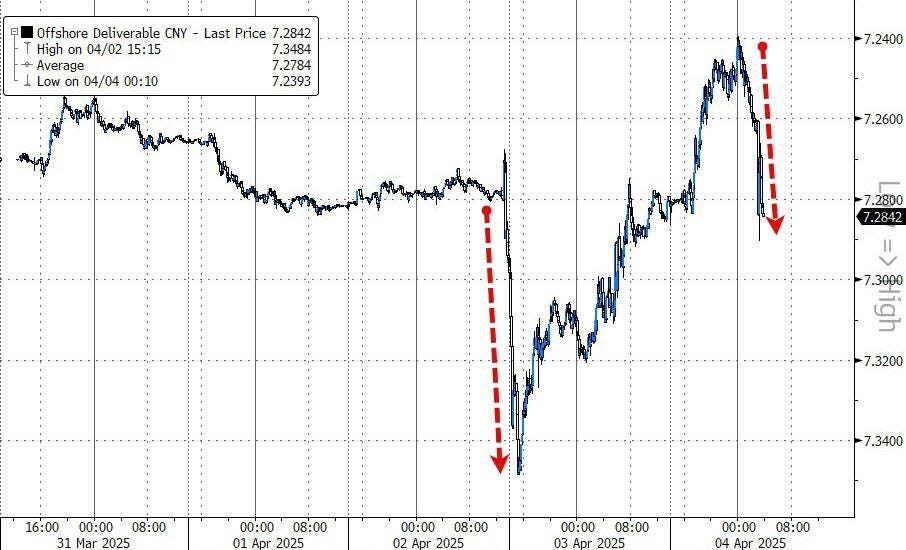
It wasn't just the dollar: the yuan also tumbled, reversing its bizarre gains since Trump declared trade war on China.
“The market is bleeding and more pain is clearly coming as this escalating trade war risks pushing the US economy into a recession,” Luca Paolini, chief strategist at Pictet Asset Management said over the phone. “It’s not a surprise China would retaliate. But this will inevitably cause a recession because the damage is done — unless Trump backs off.”
Well, there is an alternative: an emergency rate cut by the Fed, which now looks increasingly likely, because credit has officially cracked..
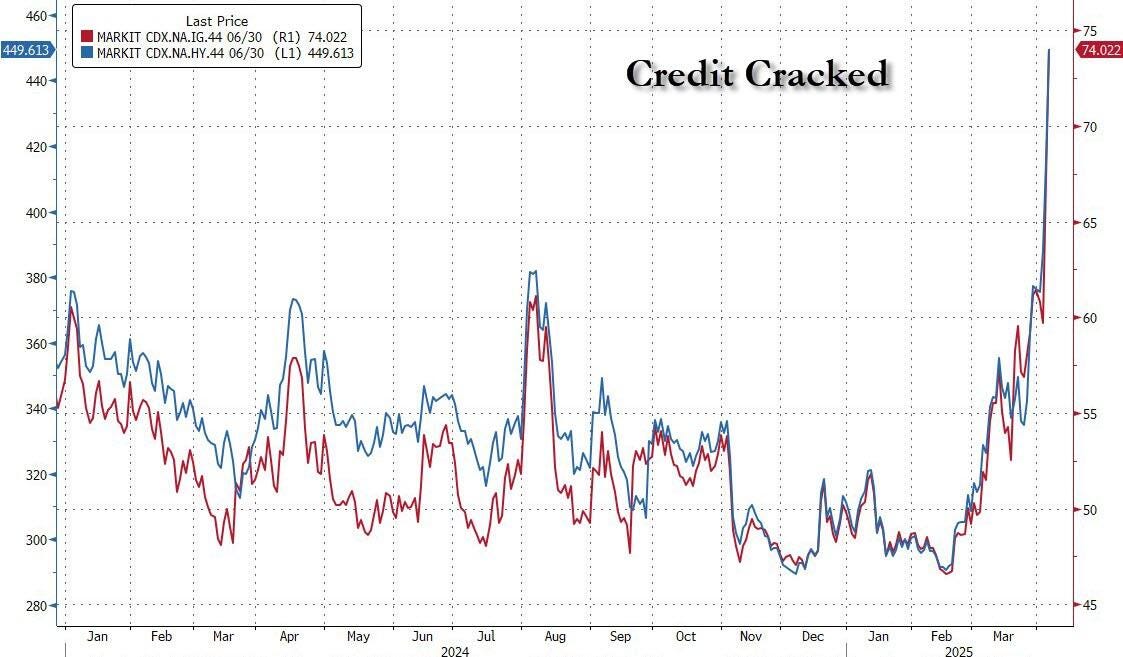
... but worse, the 3Y SOFR swap spread, a metric of Treasury market stress is the lowest on record.
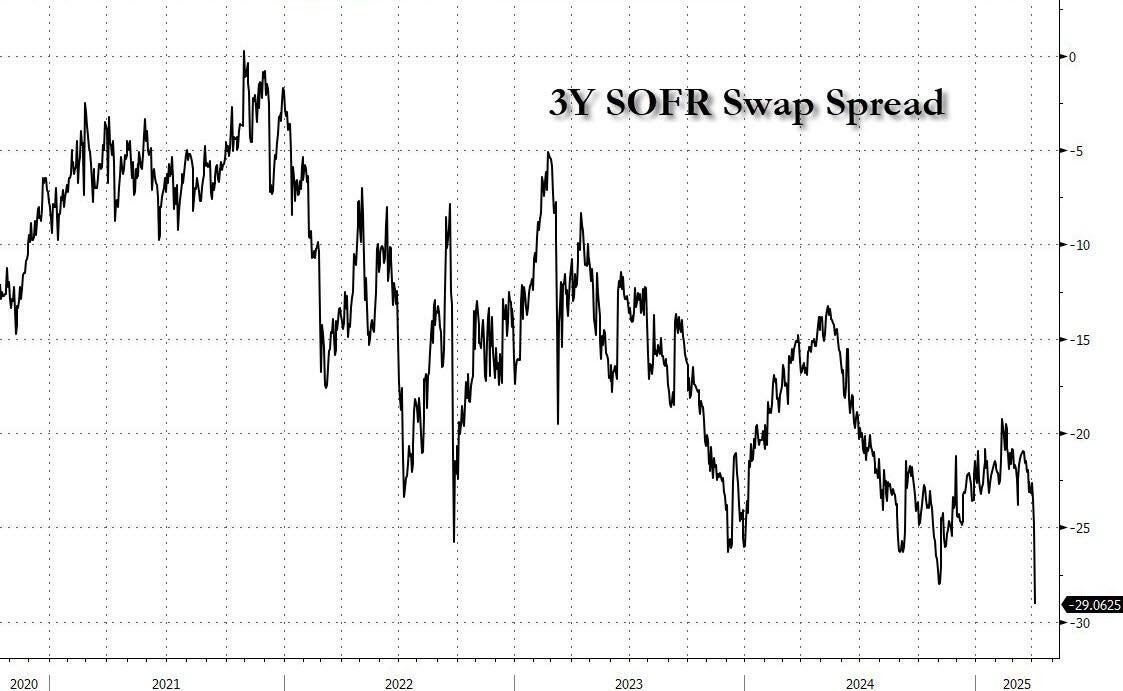
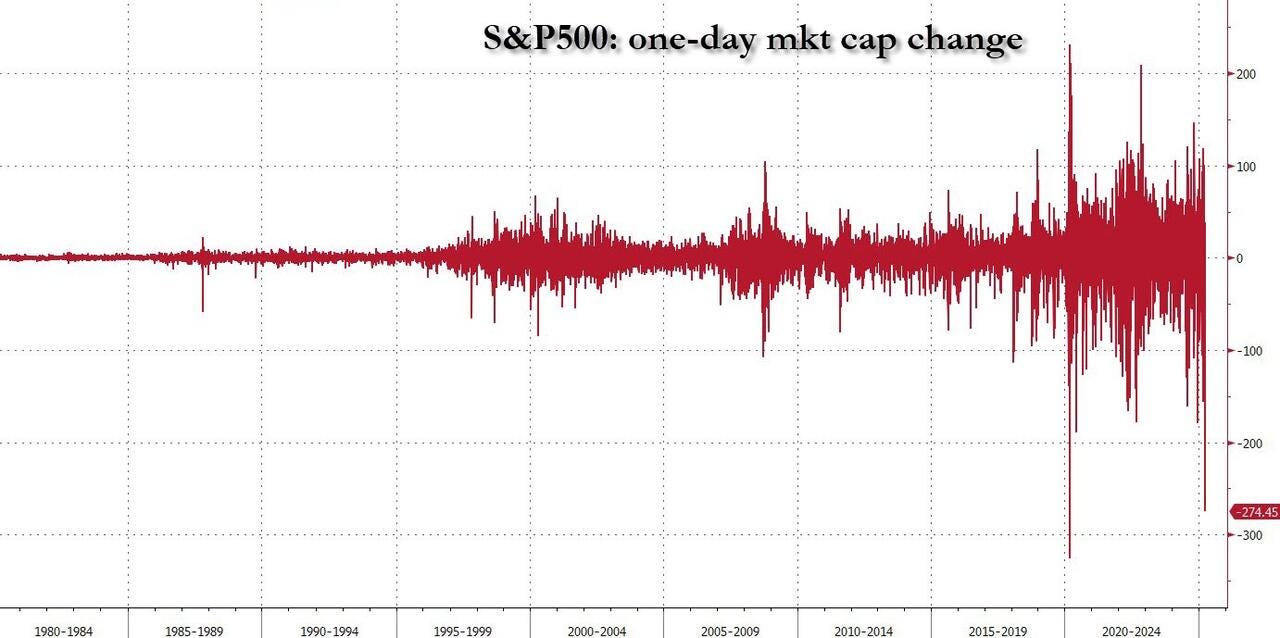
Friday’s losses follow a massive wipe out by US stocks on Thursday that erased $2.7 trillion in value - the second biggest one day loss in history - in the wake of Trump’s drastic new trade tariffs which ignited widespread recession fears.
In a few minutes, investors will get a look at the latest monthly jobs print — the first major piece of data for the quarter — which could have wide-ranging implications for bond, stock and currency markets as well as the Fed’s next moves. Jerome Powell is scheduled to deliver remarks at 11:25 a.m. in Arlington, Virginia, which will be parsed for signs of weakness spreading to the workforce.
The derivatives market is pricing in more volatility ahead. Options traders are betting that the S&P 500 will move roughly 1.6% in either direction after the jobs print today, based on the price of at-the-money straddles, according to Citigroup Inc. That’s well above the average straddle price for a 0.9% swing in either direction over the past 12 months. It's also well below what the market has already swung!
“How bad will it get for the economy? With so much uncertainty swirling, stocks are selling off and that’s signaling that investors see both economic and profit growth slowing because of the trade war,” Adam Sarhan, founder of 50 Park Investments said by phone.
Bloomberg reports that the equity rout now has Wall Street’s biggest stock bull, Oppenheimer’s John Stoltzfus, rethinking his 7,100 price target on the S&P 500, which is among the highest on Wall Street tracked by Bloomberg and would imply a 25% gain through Thursday’s close. That comes as RBC Capital Markets’s Lori Calvasina cut her price target on the index for a second time this year to 5,550 from 6,200, given a dimmer outlook for economic and profit growth.
“Without a doubt, where we’re sitting here it is under review and has been under review for awhile,” John Stoltzfus said on Bloomberg Television Friday. “The reality has been until we got these rather surprising unpleasant levels of tariffs and the market’s reaction, we’re naturally going to have to take a look and sharpen our pencils, so to speak.”
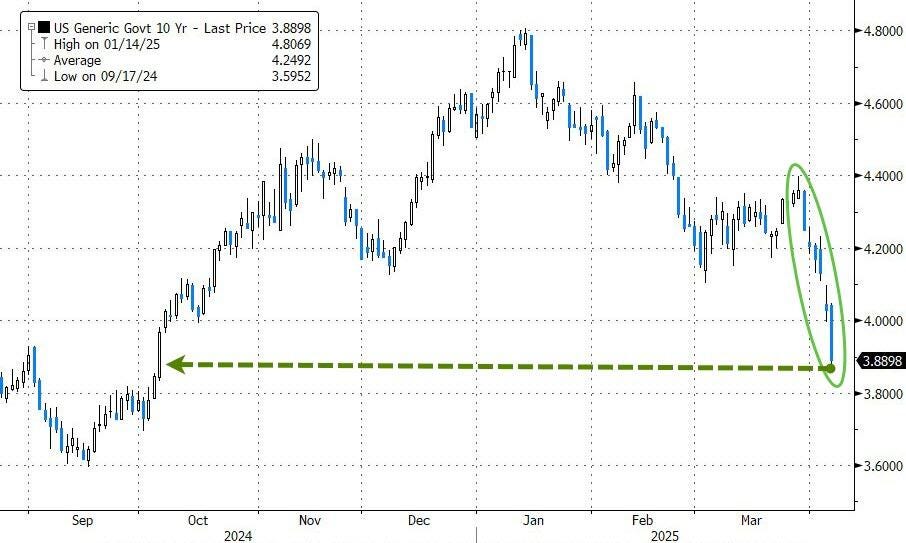
Treasuries added to steep weekly gains unleashed by unfolding trade war, sending 2-year yields to lowest level since September 2022, after China retaliated against US tariffs with measures including a 34% levy on all American imports. Yields across maturities are lower by at least 11bp led by the 2-year, down nearly 19bp and below 3.5%. Fed-dated OIS contracts price in additional easing, with 115bp anticipated by year-end and about 50% odds of move in May. US session includes March jobs report and a speech by Fed Chair Powell at 11:25am New York time. US 10-year yield, around 3.89% near session low, is richer by 15bp on the day, more than 40bp on the week, and 100bps since January; bunds outperform by an additional 2bp in the sector while gilts trade broadly in line. Front-end-led gains — as more Fed easing is priced in — extend the steepening in 2s10s and 5s30s curves by nearly 3bp and 6bp on the day
More stuff is happening, but honestly it is meaningless to go over everything since prices are moving at a furious pace and everything will be stale as soon as we write about it, and certainly after the jobs report is published.
US economic calendar includes March jobs report at 8:30am. Fed speaker slate includes Chair Powell at 11:25am on the economic outlook, with text release and Q&A expected. Barr (12pm) and Waller (12:45pm) also speak
Market Snapshot
S&P 500 mini -2.9%
Nasdaq 100 mini -3.1%
Russell 2000 mini -4.1%
Stoxx Europe 600 -5%
10-year Treasury yield -12 basis points at 3.91%
VIX +14 points at 44
Bloomberg Dollar Index +0.2% at 1254.8,
Euro +0.1% at $1.1055
WTI crude -4% at $64.15/barrel
Top Overnight News
Trump administration officials are assuring farm-state Republicans they will funnel billions of taxpayer dollars to farmers who are hit by Trump’s intensifying trade war. But it may be some time before any money is released. The administration wants to take stock of the economic fallout of the tariffs in the agriculture sector before rolling out aid, which will likely take several more months. Politico
While there have been expressions of displeasure, Republicans (who could use their own votes to stop the new tariffs cold) made clear they had no intention of acting anytime soon. “I think most members on our side are very willing to give the president time,” Arkansas Sen. John Boozman said, summing up the view of many GOP lawmakers who might have qualms about Trump’s massive new levies but showed little interest — at least for now and the near future — in doing anything concrete to restrain him. Politico
President Donald Trump on Thursday contradicted his top aides on the purpose of his sprawling new global tariff regime, adding to the uncertainty over the trade war that has sent markets reeling. Earlier in the day, top Trump aide Peter Navarro and Commerce Secretary Howard Lutnick said the president was not looking to strike deals over the tariffs. “This is not a negotiation,” Navarro told CNBC. But after markets closed down sharply, Trump told reporters on Air Force One that he would be open to striking deals with individual countries. WaPo
US Social Security faces thousands more job cuts. The Social Security Administration is drafting plans to begin layoffs of potentially thousands more employees as soon as next week: WaPo
Republicans are weighing the creation of a new bracket for those earning $1 million or more to offset some of the costs of their tax bill, a stark departure from decades of GOP opposition to tax increases. BBG
China retaliated against the new US tariffs, announcing a 34% levy on all American imports starting April 10. Earlier, Donald Trump said he’s open to negotiations if other nations can offer something “phenomenal.” BBG
President Trump’s jumbo tariffs on China threaten to create a new problem for a global economy already stressed over trade: a $400 billion deluge of Chinese goods looking for new markets. WSJ
Japanese PM Shigeru Ishiba will meet opposition leaders today to discuss responses to the tariffs, which he said should be called a “national crisis.” BOJ Governor Kazuo Ueda said the US’s move will weigh on growth. BBG
Traders now see the Fed cutting 100 bps by year-end, with a 50% chance of a cut in May. BBG
A more detailed look at global markets courtesy of Newsquawk
APAC stocks resumed the post-Liberation Day selling after Wall St suffered its worst loss since 2020, while fresh drivers are light amid the Greater China holiday closures and with participants now awaiting US jobs data. ASX 200 re-entered correction territory with the declines led by heavy losses in tech and energy in which the latter was pressured after oil prices fell by around 7% amid tariff turmoil and news that OPEC+ decided to increase output by a larger-than-scheduled 411k barrels per day in May. Nikkei 225 sold off again and fell below the USD 34,000 level with better-than-expected Household Spending data doing little to spur a recovery. KOSPI was initially choppy but ultimately weakened after the Constitutional Court upheld President Yoon's impeachment which sparked some angry protests and triggered an election to be held within 60 days.
Top Asian News
BoJ Governor Ueda said US tariffs are likely to exert downward pressure on Japan and global economies, while he added it is hard to say now how US tariffs will affect Japan's price moves and they will closely monitor US tariff impact on Japan, overseas economic and price developments in deciding monetary policy. Ueda said they will scrutinise data, including from hearings, available at the time of each policy meeting to gauge the US tariff impact on Japan's economy and prices.
BoJ Deputy Governor Uchida said they will raise interest rates if underlying inflation heightens against the background of continued improvements in the economy. Uchida said they will examine, without any preset idea if economic and price forecasts laid out in the quarterly report will be achieved, as well as scrutinise at each meeting economic, and price developments and risks including the impact from US tariffs.
South Korean Constitutional Court ruled to oust impeached President Yoon with the decision made unanimously.
European bourses (STOXX 600 -2.1%) are entirely in the red, in a continuation of the Trump-tariff induced slump seen on Thursday. Price action has only really been downwards today, given the lack of fresh catalysts and with traders mindful of the key NFP report ahead. European sectors hold a strong negative bias, with only a couple of sectors managing to hold in positive territory. Food Beverage & Tobacco outperforms today, largely thanks to the defensive bias in the markets today. Banks continue to underperform, extending on the prior day’s losses; yields continue to drive lower, and fears of an economic slowdown continue to increase.
Top European News
UK government said almost GBP 14bln of R&D funding is allocated to bolster life sciences, green energy, space and beyond to improve lives and grow the economy.
Goldman Sachs cuts the UK's 2025 GDP growth forecast to 0.7% (prev. 0.8%).
Deutsche Bank says the latest US tariffs could hit Europe and the UK's GDP by 0.4-0.7% percentage points and 0.3-0.6 percentage points respectively.
DXY
DXY is on a firmer footing, after initially edging lower in overnight/early European trade. Yesterday was a woeful session for the USD on account of concerns over the US' growth outlook post-tariffs with the DXY falling from an opening level at 103.37 to a trough at 101.26. Trade specific updates since have been relatively light, so focus today will be on US NFP and then Fed Chair Powell thereafter.
EUR/USD has been weighed on in recent trade by the pickup in the USD but is still firmly above yesterday's opening level @ 1.0848. Analysts at ING attribute the recent resilience in the EUR not to a positive reappraisal of the Eurozone's growth outlook but more as a result of the "alternative liquidity offered by the euro".
JPY is marginally softer vs. the USD and faring better than peers on account of the JPY's safe-haven appeal. BoJ speak overnight saw Governor Ueda remark that US tariffs are likely to exert downward pressure on Japan and global economies, however, it is hard to say now how US tariffs will affect Japan's price moves. Elsewhere, Deputy Governor Uchida noted that rates will be raised if underlying inflation heightens against the background of continued improvements in the economy. USD/JPY has made its way back onto a 146 handle but is still far away from yesterday's opening level at 149.21.
After a solid showing vs. the USD yesterday which sent Cable from a 1.2968 base to a 1.3207 peak, the recent resurgence of the Dollar briefly sent the pair back onto a 1.29 handle with a session low at 1.2976.
Antipodeans underperform today after seeing slight gains in the prior session. Gains yesterday were limited by the high-beta status of both currencies, which is the main driver of today's underperformance as internal macro drivers for Australia and New Zealand remain light.
Fixed Income
USTs continue to advance as the risk tone remains downbeat and has deteriorated further in the European morning. Bringing USTs to a 113-12+ peak, weighing on yields across the curve with the belly/10yr once again lagging. Trade updates have been relatively light since "Liberation Day", but President Trump suggested that the onus is on partners to bring him something "phenomenal". US NFP is on the docket and then focus turns to Fed Chair Powell thereafter.
Bunds are already getting on for gains of 100 ticks on the day with Payrolls and Powell yet to print. Initial action was modest in nature, with overnight focus primarily on Japan as JGBs played catchup to Thursday’s moves and BoJ bets were altered to show just 13bps of tightening implied for the rest of 2025. Peaked at 130.75 thus far with gains of 163 ticks WTD.
Gilts are also moving higher alongside peers. Upside of 104 ticks at most so far, higher by over 230 ticks on the week and around 350 above the low from last Wednesday’s Spring Statement.
Commodities
Crude continues its recent slump with WTI and Brent currently down by around USD 2.60/bbl and USD 2.50/bbl respectively. There has been little fresh fundamental in today's trade, but pressure is ultimately a factor of a) negative risk tone. b) fears of slowing economic growth. c) OPEC+ decided to increase output by a larger-than-scheduled 411k barrels per day in May. Brent Jun'25 currently at the lower end of a USD 67.53-70.11/bbl range.
Precious metals are on the backfoot today, with spot silver underperforming vs gold. Specifically for the yellow-metal, price action was rangebound overnight and remained within overnight ranges for most of the European morning, before then succumbing to some modest selling pressure alongside a broader pick-up in the Dollar. Currently trading around USD 3,090/oz in a USD 3,078.60-3,116.67/oz range.
Base metals are entirely in the red, given the risk tone and in a continuation of the recent slump across the commodity complex; a holiday in China, is also a factor for the downside today.
Geopolitics: Middle East
Israeli military say they have "eliminated" Hassan Farhat, a Hamas commander in Lebanon
Israeli media reported that the Israeli army launched raids on large areas in the Gaza Strip, according to Al Jazeera
Houthi-affiliated media reports US aggression on the Kahlan area, east of Saada city, northern Yemen, according to Al Jazeera.
Iran reportedly abandons Houthis under relentless US bombardment and ordered its military personnel to leave Yemen, according to The Telegraph.
US President Trump said he spoke with Israeli PM Netanyahu on Thursday who may visit the US next week, although it was separately reported that Israeli PM Netanyahu's visit to the White House will likely take place in a few weeks.
Turkey said Israel's attacks on regional countries have made Israel the biggest threat to regional security, while it added that Israel is a regional destabiliser and is feeding chaos and terror.
Saudi Crown Prince received a phone call from Iran's President during which they discussed developments in the region and issues of common interest.
Geopolitics: Ukraine
US President Trump's inner circle advises against a call with Russian President Putin until he commits to a full ceasefire.
Russian envoy Dmitriev said lots of differences remain, but a diplomatic solution is possible and there is already some progress on trust-building measures, while he sees a positive dynamic in US-Russian relations and said Several meetings are needed to sort out differences. Dmitriev also stated that a long-term solution that takes into account Russian security concerns is what is needed, as well as commented that they are not asking for a lifting of sanctions and that they can do a deal with the US on rare earths.
Moscow's mayor said Russian air defences repelled drones approaching Moscow and specialists are examining fallen fragments.
US Event Calendar
8:30 am: Mar Change in Nonfarm Payrolls, est. 140k, prior 151k
8:30 am: Mar Change in Manufact. Payrolls, est. -1k, prior 10k
8:30 am: Mar Unemployment Rate, est. 4.1%, prior 4.1%
8:30 am: Mar Average Hourly Earnings MoM, est. 0.3%, prior 0.3%
8:30 am: Mar Average Hourly Earnings YoY, est. 4%, prior 4%
DB's Jim Reid concludes the overnight wrap
The last 24 hours have been truly historic for markets, as the impact of the US reciprocal tariffs cascaded across different asset classes, with no sign of letting up overnight. We’ll dive into more depth shortly, but just to run through some of the moves, yesterday saw the S&P 500 fall -4.84%, marking its biggest daily decline since June 2020, with futures down another -0.74% this morning. In turn, that took the peak-to-trough decline for the S&P 500 beyond 12%, meaning it’s now the biggest overall decline since the 2022 bear market. Otherwise, US HY spreads widened by +53bps yesterday, the biggest move wider since March 2020 at the height of the pandemic turmoil. The 10yr Treasury yield has fallen beneath 4% again, with futures fully pricing in a Fed rate cut by the June meeting. Both the dollar index (-1.67%) and Brent crude oil (-6.42%) suffered their worst days since 2022. And overnight, the 10yr Japanese government bond yield (-16.8bps) is on track for its biggest decline since 2003. So we’re currently experiencing some of the biggest moves in years right across the major asset classes.
Given the significance of the tariff announcement, here at Deutsche Bank Research we’ve been thinking through what this means for our global forecasts. Yesterday we provided an initial guide (link here) on how they’ll shift if the tariffs do hold, although clearly there’s still a lot up in the air, including the extent of any retaliation. For the US, the movement is stagflationary, and our economists think these could reduce the 2025 GDP forecast (Q4/Q4) from 2.2% to around or under 1%, with core PCE up from 2.7% to around 4%. So recession risks will likely rise materially if these tariffs are sustained. And when it comes to the Fed, they think the latest moves make them more likely to cut, even though the direction of travel is highly stagflationary, with the bias now towards up to four cuts this year if this tariff policy holds.
Meanwhile in Europe, our economists’ discuss their latest estimates in a report yesterday (link here). They estimate that the increase in US tariffs could knock 0.4-0.7pp off EU GDP, and that the EU will likely retaliate. Although the tariffs could complicate the easing trajectory for the ECB, they think they’re likely to continue cutting, and hold their terminal rate forecast of 1.50% at end-2025, with further rate cuts in April, June, September and December. They think the hit to growth will increase pressure on the ECB to cut rates, especially as the euro moved above $1.11 intraday yesterday for the first time in over 6 months.
In terms of what happens now, the big question is how the US’s trading partners might retaliate, as that will play a huge role in determining what the overall economic and market impact will be. For instance, French President Macron said yesterday that companies should pause their US investments, saying “What would be the message of having big European players that invest billions in the American economy at the same time they are hitting us”. Separately, it was announced by Canadian PM Market Carney that Canada would put 25% tariffs on US-made autos that don’t comply with the USMCA deal. At the same time, investors will be watchful of any potential deals to reduce tariffs, with Trump saying yesterday evening that “The tariffs give us great power to negotiate” but that other countries would have to offer something “phenomenal” in negotiations for him to relent. So no signs of any immediate relief.
On the back of all this, investors grew increasingly fearful about a potential US recession, with US equities seeing their sharpest decline in years. The S&P 500 (-4.84%) , the NASDAQ (-5.97%) and the small cap Russell 2000 (-6.59%) all saw their worst days since 2020, and there were as many as 74 companies in the S&P that fell by at least 10% yesterday. All that meant measures of volatility continued to spike, with the VIX index (+8.51pts) moving up to 30.02pts, its highest level since the turmoil last summer. And given mounting fears of a downturn, the more cyclical sectors drove the underperformance, with the Magnificent 7 (-6.67%) posting its worst day since July and extending the decline from its December peak to -24%. Meanwhile in Europe, the declines weren’t quite as bad, but even there the STOXX 600 (-2.57%) saw its biggest move lower since August.
Whilst growth fears were at the forefront yesterday, investors were also becoming a lot more concerned about inflation. In fact, the US 1yr inflation swap (+8.3bps) rose for a ninth session in a row to close at its highest level since 2022, back when the Fed were still hiking by 75bps per meeting to get inflation under control again. However, because of the growth fears, investors also priced in that the Fed would cut rates more aggressively over the months ahead. In fact as we go to press this morning, futures are now pricing over 100bps of rate cuts by the December meeting, and are fully pricing in an initial cut by the June meeting. They even see a 34% probability of a cut at the next meeting in May, so all eyes will be on Fed Chair Powell’s comments today to see his reaction.
With investors worried about the growth shock and pricing in more rate cuts, that helped sovereign bond yields to move lower across the curve, albeit with a very sharp steepening. For instance, the 2y Treasury yield (-17.8bps) fell back to 3.68%, and the 10yr yield (-10.1bps) fell to 4.03%, yet the 30yr yield (-3.0bps) saw a smaller decline to 4.47%. And over in Europe, there were also declines as investors priced in more ECB rate cuts, with yields on 10yr bunds (-7.0bps), OATs (-5.0bps) and BTPs (-4.3bps) all moving lower.
Over in the FX space, there was a huge depreciation in the US Dollar yesterday, with the dollar index (-1.67%) posting its biggest daily decline since 2022. That included a +1.83% move for the Euro, which closed at $1.1052, which is the first time it’s closed above $1.10 in six months. More broadly, our FX strategists are maintaining their bullish EUR/USD view, and George Saravelos warned yesterday (link here) that there’s an increasing concern that the dollar is at risk of a broader confidence crisis.
Amidst the huge market moves, sentiment wasn’t helped by the latest ISM services data, which came in beneath expectations in March. The headline index was down to a 9-month low of 50.8 (vs. 52.9 expected), and the employment component (46.2) slumped to its lowest since December 2023. That said, for now at least, the labour market hasn’t shown an obvious sign of deterioration, with the weekly initial jobless claims at 219k over the week ending March 29 (vs. 225k expected), which pushed the 4-week average down to 223k.
That focus on US data will continue today, as we’ve got the March jobs report coming out at 13:30 London time. Clearly it won’t account for the full impact of these reciprocal tariffs that are now coming, but it will be an important test as it’s one of the first hard data prints we have for the month of March. In terms of what to expect, our US economists are looking for nonfarm payrolls to come in at +150k, with the unemployment rate rounding up to 4.2%. You can see their full preview and register for their post-release webinar here. Later on today, we’ll then hear from Fed Chair Powell, who’s giving a speech on the economic outlook, so that will be heavily in focus to hear about how the Fed are thinking about tariffs and their reaction function. Ahead of that, we did hear from Fed Vice Chair Jefferson yesterday, who said “there is no need to be in a hurry to make further policy rate adjustments.
Overnight, this direction of travel has continued in markets, with sharp losses in Asia that built on yesterday’s moves. For instance, Japan’s Nikkei is down another -3.74%, on top of its -2.77% move yesterday. So as it stands, the index is down -9.93% for the week, which would be its worst weekly performance since the pandemic turmoil of March 2020. That comes amidst a sharp appreciation in the Japanese yen, which is currently at 145.62 per US dollar this morning.
Moreover, there’s been an astonishing move in Japan’s government bond yields, with the 10yr yield (-16.8bps) on track for its biggest daily decline since 2003. Meanwhile in Australia, the S&P/ASX 200 (-2.24%) has also built on its Thursday losses, leaving it on track for its worst weekly performance since 2022. And in South Korea, the KOSPI is down -1.71%. Equity markets in China are closed for a holiday.
To the day ahead now, and the main highlight will be the US jobs report for March. Other data includes German factory orders and French industrial production for February, along with the construction PMIs for March in Germany and the UK. Elsewhere, central bank speakers include Fed Chair Powell, along with the Fed’s Barr and Waller.
Special Edition: CRASHING!
It's a total cliff dive today!
APR 05, 2025

It seems like only yesterday I wrote …
First, you will see the direct recoil in markets from today’s announcement. Then you will see various jolts from the announcements of other nations as their retaliation arrives in spurts.
… because, oh yeah, it was only yesterday when we saw the market first recoil, and today China delivered its predictable retaliatory response, and the market recoiled by even more.
The trade war, which was obviously going to heat up rapidly, is doing exactly what was expected here, and it is causing markets to recoil further after a single new major jolt because the jolts are so huge when they come from a major trade partner like China. Good thing the president decided to take on the entire planet at the same time, while none of those he is warring with face any trade challenges from other nations, because US v. world is bound to end up great!
Of course, the next part of that forecast of things to come quickly was …
Then you’ll see what Trump does in retaliation against all of that, one nation at a time, after each nation levies its best retaliation, as Trump has already promised to retaliate against retaliation.
We shouldn’t be surprised to see that wave by the end of today.
As things stand here near the top of the day while I’m composing this, the Dow’s second day down is -1,600 points. The S&P is now down 15% from its peak, if the market closes at this level. Maybe it will hit a full bear market by end of day! That would be a fun ride! However the worst news today so far is for the rapidly plummeting Nasdaq, getting wiped out by those Magnificent Seven stocks and especially the AI stocks that “could never fall because they’re the wave of the future.” The Nasdaq is already set to officially close in a bear market, if the action holds and the plunge-protection team fails, as I am sure it will. That will give us, at least, two major indices that have crashed into bear markets in response to these grinding tariffs.
Wharton’s Jeremy Siegel says today that the Trump Tariff War is the biggest policy mistake in 95 years. I agree. That takes us back to the Great Depression, which is where this is likely to take us.
I think this is the biggest policy mistake in 95 years. I don’t know why Trump didn’t learn the lesson of the Smoot–Hawley Tariff Act, because I know the Fed learned the lesson of its mistakes in 1930, ’31 and ’32…. This is a self-inflicted wound. It’s an unforced error—did not have to happen.
Well, I don’t know how much the Fed learned because it has delivered us some of the worst policy for decades, causing us to endlessly go through boom-bust cycles due to their central management of the US economy, as I put together in this little book, but I do know anyone should have been able to learn from the history of the Great Depression that major tariff wars at a time when you are already sinking into a recession, are certain to send you to the bottom of Davy Jones’ Locker.
What I agree with from Siegel is that this is entirely a self-inflicted wound that did not have to happen and should not have happened. As I wrote earlier today elsewhere,
Trump might take a little blame for a global trade war that we certainly didn't need on top of the recession that was already forming because last I looked the US was making trillions of dollars in trade--a vast fortune--and the tariffs he claims are so unfair are exactly the ones he negotiated and told us all they were a great deal; but, hey, we need Canada, I guess, so whatever it takes to strong-arm them into humble submission. Not sure why he and his supporters want to add a vast liberal state across the northern tier, against its will, and add French as another national language on top of English and Spanish because the only way the French are joining that deal without a civil war is if they keep their language printed on every package in America. But, hey, empire! Ain't it grand when you can get it?
Since one reader asked me to spell out what I would be doing differently than all the chaos Trump is creating, this is a good time to spell it all out. So, I shall:
Tariff Wars and Tax Troubles
If the tariffs that exist between the US and Canada and Mexico are unfair, that is entirely Trump’s fault. He is the one who negotiated for them years ago and put them in place and told us all they were great for everyone, but the fact is, none of this is really about confiscatory tariffs and trade imbalances. The US will always run a major trade deficit with any one nation because we love to have a lot of stuff, we love to get it cheaply if we can, and we have the money to do it. So, we will, so long as we are economically strong, always buy more from other nations than they buy from us. So what?
I would start from a position of ignoring trade imbalances completely. They are what they are. We love the stuff. Let it go!
What matters is whether tariffs are unfair, but there is a lot of blatant dishonesty or incredible stupidity coming from Team Trump right now. The tariffs they are complaining about are their own tariffs that they agreed to. If nations are cheating on any of those tariffs, then, of course, that should be called out, but it doesn’ take a tariff war to sit down and point out clear cheating and then get tough on specific points with specific measures. Most of what you are hearing, however, is baloney.
For example, people talk about the huge confiscatory tariffs charged by Canada because Team Trump keeps pointing out the massive tariff rates. What they do not tell you is that most of those tariffs have never been charged! There is a reason for that: They were put in place as a pressure-relief valve in case the agreement caused trade to swing way out of whack for either nation. Only if trade rises above so many hundred billion dollars (the amount of the tariff and the level it kicks in being different for every single item that crosses the border), does the massive tariff kick in. Its purpose is to rapidly throttle down trade on that one item that is running overpressure like the governor on an engine or the pressure-relief valve on a steam boiler. It is there to quickly let off pressure.
What Team Trump is also not telling you is that the USA has the same kind of confiscatory tariff levels on every single item that trades across the border, too. And they, also, have never been actually charged. Trade imbalances have not risen to such a degree for either nation that the pressure-relief valves had to kick in. That also means trade imbalances were already accommodated for in the agreement.
Another thing Team Trump IS telling you, which is a blatant lie or incredibly ignorant, is that the value-added tax that Canada charges when goods cross the border is a veiled tariff. It is not even remotely so. Canada charges the same VAT on all of its own goods and services. It is a sales tax. If they did not apply the tax to imported goods, they would be deliberately handicapping all of their own manufacturers and service providers. They call it a “Goods and Services Tax” (GST). I, frankly, cannot tell the difference between the VATs that other nations have and Canada’s GST. I think they’re just trying to be different, like drinking moose piss to show you’re a man or something.
Anyway, it is not a tariff any more than any other kind of sales tax is a tariff. Canada charges the GST at each point where a product changes hands for the value that is added. US goods have not had those hits applied to them, so Canada assesses them all when the goods cross the border because, they have to level the playing field. There is no reason foreign products should get an unfair advantage against Canada’s own domestic products. A tariff is one-sided. The GST applies to all products in Canada, either as they made in Canada at each step in the process or as they cross the border.
Now, I hate a VAT more than most taxes because only government could come up with such a mangled way of adding a sales tax. You have to be sadistic to the level of wanting people to feel as much pain at as many points as possible. Most US states charge a sales tax, and it is a simple rate charged only on the final point of sale. Easy and quick.
One thing I would do differently than tariffs, if I were revising the tax code, is I would switch to a national sales tax and abolish income tax entirely. It can be made as progressive as you want to make it, including by cutting a check to every person in the US for the amount of sales tax you compute the poorest class would have to pay, so they have the money to pay the tax up front each year. You give the check to everyone, no matter how rich, so there is nothing to figure out. For the rich, who buy a lot of stuff at very high prices, the check is almost inconsequential. For the poor, it may be everything. Above that base provision, everyone pays the same tax, and the tax rate is calculated to take the cost of the checks into consideration. Or just don’t make it progressive or don’t apply it to food purchased in grocery stores or medical services or drugs.
I’d also save Social Security by one simple measure—ending the cap that protects 99% of the income gained by rich people because absolutely none of my income gets shielded. Why should most of theirs be shielded just because they make so much of it? That would allow you to lower the FICA rate (SS tax) for everyone and still have enough to give everyone on SS a real cost-of-living increase! End or story. Mission accomplished. (That means I would apply the SS tax to their capital gains where they make all their money, too.)
I would also end the truly obscene and privileged capital-gains tax rate, which has never helped create better paying jobs for the middle class. It is THE VERY REASON the gap between the rich and the rest has endlessly expanded since the Reagan years. I’ve written about this a number of times, so I won’t go into detail. Suffice it to say, the very fact that capital gains get to be rolled over tax-free for endless decades until the full gain is finally realized (like a 401K) upon sale of the asset is more than enough benefit for asset investors.
The big thing here is that I would never start a tariff war. Their history is insanely awful for everyone. I would deal with any remaining imbalances in tariff systems rationally, fairly and individually. I would also HONOR the agreements I had already made. Why on earth Canada and Mexico would even consider negotiation with Trump when he is withdrawing from the agreements he made and championed and heralded as great for everyone is beyond me, other than to say it must just be cowardice—fear of engaging the battle. I would never trust someone who is welching on the very deal he recently signed and praised.
Finally, if I were going to go against nations on an individual tariff-by-tariff basis for clear imbalance that we had not already signed a recent agreement on or because they were cheating on the agreement we had just made, I certainly would not go after ALL THE FREAKIN’ NATIONS ON EARTH AT THE SAME TIME! That is about the dumbest approach I can possibly imagine.
I’d pick the worst offender—the biggest guy in prison, so to speak—and beat the crap out of that one nation and make sure everyone sees me doing it, and then say, “So, do the rest of you now want to negotiate over these obvious indiscretions you have?” Why on earth would it be in the best interest of the United States to align the entire world against the US at the same time by starting trade wars with every nation on earth? Wouldn’t it be a whole lot smarter to find the worst offender with whom you have a major trading relationship and go after them and align the rest of the world against them in mutual tariff wars against that nation (because other nations are likely experiencing the same trouble from that offender)?
Taking on the whole world at once when your own nation is rich from trade is just beyond dumb and cocky. Seriously. In that situation NONE of the world’s nations have the same handicap you just gave yourself. Hence, self-inflicted wound. They are all able to trade as tariff-free as they wish with each other in order to find relief via other supply chains, which you have cut yourself off from.
You are certain to get retaliatory tariffs applied against your goods from everywhere at once, AND your own people are going to get hit with your own tariffs from all directions because that is who you are actually taxing! Not so in any of the other nations where their people can avoid only your products in order to get hit with no tariffs at all. It’s like picking a fight with the entire prison at one time.
Immigration on insanity
Actually, Trump is doing a somewhat good job at the border, but I would have solved the problem in my first term and done so without a lame and ugly and expensive wall. I have no issue with people of other nations and any race coming into the country, but we have too many people. We’re full, and they certainly do cause major wage suppression. So, it’s not about their race or nationality with me. We just have enough, thanks!
I would, however, make immigration very easy for people who marrying someone from outside the nation because those are the immigrants who have vested interest because of their family in seeing the nation do well.
The reason Republicans have talked border security for decades and never done anything to enforce their own laws is that, like the Democrats, they want to create a peasant class. An “unlanded” people, meaning people who own no homes and don’t live in a land of their own, have not voting rights and must take whatever is handed to them must work for whatever they get. This caters to the party cronies in big business. This is how we outsource labor by bringing it into the nation for jobs that cannot be outsourced by sending the work out—such as making beds in hotels, harvesting local crops, washing dishes, etc.
I would never have allowed all of that in the first place, and perhaps Trump wouldn’t have either, though I strongly suspect he hires them where can to save money in his own hotels, but maybe I’m wrong on that. The problem we face now is that we have for decades created an entire economy built on this cheap labor, and if you expel all of it, you’re going to see some serious labor inflation and shortages as we make up for all those years of wage suppression. It needs to happen but in a measured way, not in one massive slam dunk that harms yourself.
Forget the dumb wall. What you need to do is jail the people who hire illegal aliens. I would do it in degrees. First time your business is inspected (or raided), you pay fines and have to fire the people who do not have the right paperwork to work here. The automatically remove themselves from the nation because they have no job, and, now that you’re serious about enforcement, no one is hiring. Or you round those up and send them across the border at their employer’s expense since the employer provided the jobs that drew them in. You don’t need to process them in courts. That’s absurd. When they arrive at the border and don’t have the right paperwork, we simply don’t let them enter. You don’t file a court case to turn them back. There is no reason you cannot treat them the same way if they have already entered: you don’t let them enter; you send them home. Knowing their employer will not be hiring them again, they will be far less likely to return.
The second time that employer gets caught hiring people without the right paperwork/visa, you fine the employer more and put them in jail for a month to stew about it. Few employers are not going to want to spend time in jail to save money by hiring illegals. Now, while Trump has the whole of congress, is the time to intensely press through any legal changes you need in order to make that happen. CEOs at the top get to go to jail, too, as you make it their charge to make sure their company has all there right documentation for every employee. Next offense, for anyone who did decide saving money was worth jail time, is you go to jail for three months. Next offense six months, etc. until you finally get the memo.
Very few people would actually go to jail, and the jobs would dry up quickly if you are staunch about enforcement. To keep from collapsing your economy, you don’t hit everyone at once. Again, you go after the worst offenders and make a big parade out of them. You also have to do all you can to cut off welfare for people who are here illegally, so they’ll leave or starve. I’m not sure how to do all of that since much of the welfare exists at state levels, but that is a process that needs to be happening that I do not see happening. I guess if individual states want to unequally burden themselves by taking on all the charity cases in the world, that is their problem. Move to a state that is smarter if you get stuck with that nonsense. We do not owe the world jobs or a new nation.
Debloating government
There is no question that we have to downsize government in order to balance our budget once and for all, and I would be quick about it, BUT NOT THIS QUICK! You still have to be smart, and putting high-schoolers in charge is not the way. (Well, practically high-schoolers.) I’d use DOGE to ferret out the worst uses of government money but give DOGE NO power to fire. The firing would be done by the competent cabinet members I put in charge (or why have them) and their subordinate leaders.
They take the DOGE recommendations, and decide based on that and their own best studies and judgment and knowledge of their agency’s needs what departments and what individuals need to go. I’d make sure I do the firing within the obligations I inherit from their labor contracts so I don’t look foolish with judges saying I have no right do what I am doing. Don’t need any needless losing battles because I know I have to honor the contracts, like them or not; but I would give incentives, as Trump has done, for those under employment agreements to leave, and I would leave positions unfilled by attrition.
Instead of clobbering our economy with massive firing, I could now show credit agencies I am taking completely responsible action to pare down government, and I, by going through the right legal steps, give people and departments time to adjust. But I still have to show I am completely rigid about it, and I have to make certain all my cabinet appointees are completely on board with the idea of downsizing their departments.
Definitely do all Trump is doing to end a lot of foreign aid. Too many nations have been too thankless for the decades of help we have given them way beyond what other nations give. Stop using foreign aid for social engineering, regime change, etc. Keep it basic. It’s not our responsibility to fix the world. Make sure it is happening only where it is building strong and appreciative relationships with other nations.
Military mania and imperialism
Here we get to what appears to be one of the ACTUAL reasons for Trump tariffs—to strong-arm Canada into becoming part of the US. I would never engage in ANY imperial acts of trying to take over other lands. It’s all-out horrid and reeks of Hitler’s fascism. Trump has said Hitler was a great leader, and I think the unbridled power and land grabs are a big part of what he admires and covets in his own desire to become an emperor.
I have spent most of my life living close to the Canadian border, and I have never yet actually met a Canadian who wants to become and American. In fact, many of the ones I’ve met seem to have a little vanity in thinking they are better than Americans—more civil etc. If you ever shopped among them, you know what a load of nonsense that is. If you have ever managed a resort filled with them, as I have, you know what nonsense that is. They are as ungovernable and irascible as anyone is. I’m surprised they don’t all kill themselves. However, I’m also surprised WE don’t all kill ourselves. I think we’re getting closer.
End all military, sanction-based, tariff-based attempts to gain control over other nations or seize their land. What Trump is doing with Canada and Greenland is the worst example of American imperialism I’ve ever seen. Acknowledge that for what it is if you are Trump supporter. He won’t even say use of the military is completely off the table. In fact, he says it is a possibility. This is exactly the worst form of Americanism run amok that is the very reason so many Canadians think they are better than us.
Dumber still, doing this at the same time you are supposedly trying to seek free trade assures your trade war will fail. Canada is NEVER going to be strong-armed into joining America, nor should it ever be. It’s the worst form of all-out arrogant, bullying behavior: “We’re bigger; we hold all the cards; so give us what we want!” It means Canada cannot agree to Turnip’s trade terms because he won’t stop until he gets ALL of Canada. Talk about confiscatory tariffs!
Trump has put us in the position of being predatory neighbors—the kind no one wants to live next do. Doing it by economic means, rather than military means, makes you no different than the worst of hostile corporate takeovers—the kind of stuff that made movie villains out of Wall Street.
Like Trump, I would never have supported a coup in Ukraine, though the grassroots rebellion was more than merited if done only by Ukrainians on their own, given Russia’s interference in their elections getting Putin’s own evil thug in power who had already been thrown out by the Ukraine Supreme Court after winning the election by fraud. The guy was a gangster, but not our problem.
That said, it is hypocritical for Trump to be telling Putin he needs to sign a peace agreement when we are busy with a hostile economic takeover of Canada and Greenland and the Panama Canal (though that one used to be ours, and we paid for it, so that’s a little more reasonable). I’d stay with policy that intensely focuses on stable borders right where they are, but it is not our job to fight other people’s wars or police the world.
I would also have worked to continue denuclearization, not to have exasperated it as Bush did; but that is a problem Trump inherits as I would if I were president. I have no respect for Putin as he is every bit as imperial as Trump and even more vile in killing all his competition by sending them on long walks off short rooftops or feeding them beryllium borscht, but we need to work toward denuclearization without agreeing that it is fine for him to snitch lands he wants in order to rebuild the old Soviet empire.
Still, those are other people’s problems, so I’m not suggesting we go to war over them. Putin made his career as an old-world Soviet commie in charge of lying to Europe. It’s called being the head of European disinformation. That means he’s the best-trained, slyest liar on earth who knows how to wrap a lie in the bacon of truth and make it taste desirable. Work by measurable incentives; but “trust by verify.”
I, frankly, don’t know what I’d do with Iran, but letting it get a nuclear weapon has got to be bad for everyone. So, I’ll give Trump the latitude there to make a tough choice. I don’t want nations who consider the US the Great Satan to have nuclear arms, so it is not in our security interest to allow such empowerment to happen, but we also need to stop acting like the Great Satan by exporting our vapid culture, as Biden was hell-bent (literally in my opinion) on doing and by pressing for democracy in nations where I wouldn’t want the US-hating people to rule their own country anyway. (It is not as if democratic rule by people who hate you is any more in your best interest than totalitarians who hate you; So, just stop creating reasons for them to hate you.
Bottom line: What kind of government or economy countries choose is their problem, not ours. If communism is bad (and I am absolutely certain it is), then it will certainly fail on its own demerits. Let it. If that takes a hundred years … NOT OUR PROBLEM. Who cares? I wouldn’t be fighting wars to change regimes.
My opinion was that we had a legitimate reason to pursue our enemy into Afghanistan and get him, but no reason to go after Iraq, Libya and Syria. Not our problems. Achieving regime change in Afghanistan, nor our problem either; but we had a right do whatever we needed to do to pursue Al Qaeda. Keep the focus tight is all I’d say. Of course, if you believe we took out our own World Trade Center, that’s another story; but I do not yet share that belief.
Stop thinking we’re going to be welcomed as “the great liberators” such that the people of Iraq are going to thank us for deposing Saddam Hussein at the expense of killing their fathers, husbands and children and ripping their cities to shreds. I’m pretty sure they are not!
Back to crashing bigly!
Well, that’s enough for now because I want to get these few headlines out. The market has truly plunged over the cliff. I started writing this with the headline that the Dow was down 1200 points. That quickly got revised on the fly to 1600, but that plunge has deepened to close at 2200 down at the time when I am now closing this as a final draft, so this is now a major waterfall, all the more underscoring what I said yesterday about the market getting jolted down again as soon as a nation like China retaliated.
The size of this impact will now embolden other nations to do the same in order to kick the United States (deservedly) as hard in the teeth as they can in order to try to end the tariff war. Why shouldn’t they gang up to take their more-than-hostile and arrogant neighbor down to the ground? There is a reason they call these things tariff WARS.
The stock market was pounded for a second day Friday after China retaliated with new tariffs on U.S. goods, sparking fears President Donald Trump has ignited a global trade war that will lead to a recession.
How about a very, very deep recession … as in the Second Great Depression if someone doesn’t stop him?
China’s commerce ministry said Friday the country will impose a 34% levy on all U.S. products, disappointing investors who had hoped countries would negotiate with Trump before retaliating.
How about adding, “incredibly naive and foolish and greedy investors?” Because that is what they were for thinking these nations would not retaliate, especially now that their very lands are at stake. The rest of the world can see that Trump, by picking a fight with the entire prison, has started a fight that will pound the US into the blood-stained concrete. Trump has made certain we’re going to get our collective butts kicked for being so ungodly arrogant!
“The bull market is dead, and it was destroyed by ideologues and self-inflicted wounds,” said Emily Bowersock Hill, CEO and founding partner at Bowersock Capital Partners.
Dead! Bloody and stomped into the earth in less than one week, and this war has just begun. The nations we have made our enemies can now smell our blood because China just kicked us to the ground! More kicks are coming.
China’s efforts to respond to Trump’s tariffs extended beyond reciprocal duties of their own. Beijing added several companies to its so-called “unreliable entities list,” which asserts that the firms have broken market rules or contractual commitments. In addition, China opened an antitrust investigation into DuPont on Friday, sinking shares 12%.
The 10-year Treasury yield fell back below 4% Friday as investors flooded into bonds for safety, pushing prices up and rates lower. The CBOE Volatility index, Wall Street’s fear gauge surged above 40, an extreme level seen only during rapid market declines.
Can anyone say “collapse,” brought on as an entirely self-inflicted wound—both from years of profligacy and rigged economics and massive debts, but especially now due to completely needless damage? US trade was doing great. Not anymore.
Stocks are now ten-trillion dollars down since Trump was inaugurated. More to come. A lot more if Trump doesn’t back down, and I don’t think he’s going to. One article, using some hard language by a White House insider, said Trump doesn’t give a flip what the market does at this point, but repeatedly using a harsher term than “flip.”
The war is on, and our reckless czar doesn’t care what damage it brings because he believes he can take on the entire world at once and win, even seizing their lands. That is going to go a whole lot worse than he thinks, and we’ll all suffer extra because of it. Putting it all very clearly, even Trump’s golfing buddy, Rand Paul, in the headlines below says someone has to stop him.
And everyone that does not understand the actual causes of the Great Depression and banking crisis, knee jerk reverts to this BS narrative about tariffs causing depressions. They don’t. Sovereign debt defaults cause depressions.
Furthermore, with all the arm waving about China tariffs, the average person has ZERO clue that these countervailing tariffs are only about HALF the amount of tariffs these countries have been levying on USA origin goods for many decades.
I have been in the international trade business since 1986 and have had to pay these tariffs for damn near 40 years when exporting from USA.
Know the facts so at least the opinions are informed and not sounding like an idiot parrot.
Summary if you all are remotely interested.
https://www.armstrongeconomics.com/international-news/trade-war/why-is-trump-using-tariffs-the-truth-that-has-misled-the-world-on-tariffs/?utm_source=Newsletter&utm_medium=Email&utm_campaign=RSS
JUMP FUCKERS, JUMP.
The market is a Ponzi scheme.