Is NZ a nation determined to commit suicide?

Rocket Lab wins record contract with US Department of War

Rocket Lab founder and chief executive Sir Peter Beck. Photo: Supplied / Rocket Lab
Rocket Lab has won a US$190 million (NZ$327m) contract from the United States Department of War, formally the Department of Defence, for a series of hypersonic test flights using its HASTE launch vehicle.
It is the largest single launch contract in the NZ-founded company’s history and lifts its total order backlog to more than US$2 billion (NZ$3.44b).
The four‑year agreement covers 20 test flights of Rocket Lab’s Hypersonic Accelerator Suborbital Test Electron (HASTE) rocket, a modified version of its Electron launcher designed to carry suborbital payloads of up to 700 kilograms at speeds above Mach 5.
The launches will be carried out under the Multi‑Service Advanced Capability Hypersonic Test Bed (MACH‑TB) 2.0 programme - a partnership between the Department of War and the Naval Surface Warfare Centre Crane Division that aims to accelerate hypersonic flight testing and related technologies.
Rocket Lab has already conducted several HASTE missions since 2023 under the MACH‑TB programme.
Rocket Lab founder and chief executive Sir Peter Beck said the expanded partnership with the Department of War and MACH‑TB would help strengthen US national security by providing rapid and affordable hypersonic testing.
“Our advanced technology, responsive launch schedules, and mass production of our HASTE hypersonic rockets are enabling faster progress across a range of hypersonic experiments by our government and industry partners,” he said.
Sir Peter described the new deal as “another proud moment for the team that builds the strength and resiliency of the United States’ aerospace efforts”.
The contract takes Rocket Lab’s launch backlog to 70 missions, and the company has sold 28 launches in the first quarter of 2026 - almost as many as it sold during the whole of 2025.
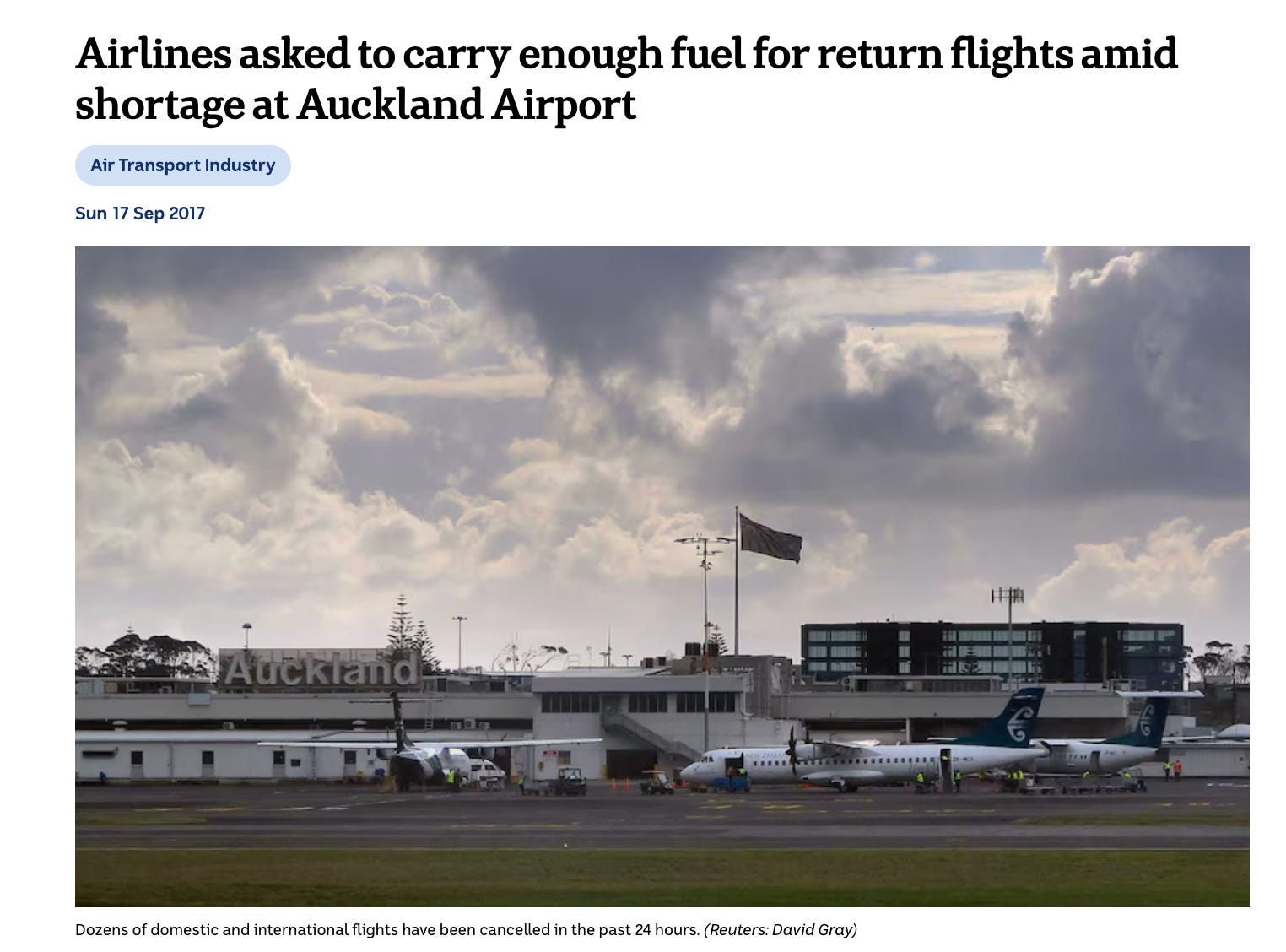
A shortage of aviation fuel has caused dozens of flight cancellations at New Zealand's Auckland Airport, with airlines advised to carry enough fuel for return flights after a digger apparently damaged an oil pipeline while trying to extract kauri logs.
https://www.abc.net.au/news/2017-09-17/fuel-shortage-causes-flight-cancellations-in-auckland/8954788
Iran Conflict: What Next for Marsden Point Ex-Oil Refinery?
Marsden Point stores 300 million litres of imported petrol, diesel and jet fuel and could hold 350 million more if the owning company keeps converting old crude oil tanks. Channel Infrastructure’s CEO takes us inside the ex-refinery as the Middle East conflict raises questions about fuel supply and security.
Guest:
Rob Buchanan, Channel Infrastructure CEO
TIMESTAMPS:
00:00 - Intro
02:25 - Converting crude oil tanks
03:51 - Total fuel stockholdings
06:58 - Climbing a 30 million litre fuel tank
08:00 - Marsden Point’s storage capacity
09:48 - Current customer demand
10:48 - Fuel security
12:29 - Refinery v Storage
12:51 - Does New Zealand need a strategic oil reserve?
13:33 - Other upgrades on site
15:44 - Import arrival schedule
17:56 - International refinery output & exports
20:45 - Rehashing the refinery closure
22:09 - Repurposing the refinery
22:43 - Bitumen terminal build
24:11 - Channel Infrastructure’s Australia expansion
Govt.nz app expands into identity and messaging
New Zealanders will soon be able to store digital identity credentials and receive direct government communications through an expanded Govt.nz app, as the Government pushes further into ‘integrated digital services’.
Digitising Government and Public Service Minister Judith Collins announced a suite of new features set to roll out in the coming months, positioning the app as a central access point for interacting with government systems.
By the end of March users will gain access to a built-in digital wallet capable of storing accredited credentials issued by both government agencies and ‘approved private-sector organisations’. The rollout coincides with the launch of a new Government Credential Issuance Platform, designed to allow agencies to issue digital credentials directly into users’ wallets through a single, standardised system.
The first use case is already in development, with Hospitality New Zealand working alongside the Department of Internal Affairs to introduce a digital version of the Kiwi Access Card. Subject to legislative changes, the credential would allow individuals to verify their age at bars and events using their smartphone, removing the need for physical identification.
Further expansion is planned by mid-2026, when secure in-app messaging will enable government agencies to send notifications directly to users. These could include reminders for vehicle registrations, official updates, or travel advisories, consolidating communication channels into a single digital platform.
Collins said the upgrades are intended to provide New Zealanders with ‘more convenient and secure ways to access public services’, while reducing duplication across government systems and improving efficiency.
The State maintains that its use will remain optional, with traditional service channels continuing to operate alongside the digital platform