Dystopian Britain

Listen to the UK Government's plans for Britain
It's going to be a COMPLETE POLICE STATE
Eyes will be watching you at all times
There will be no privacy
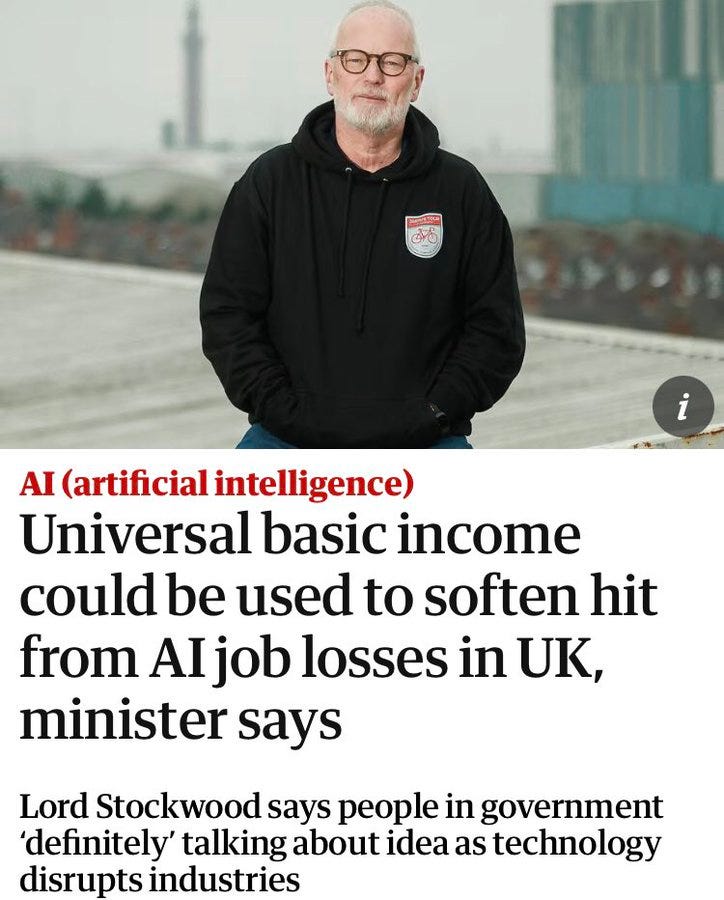
The UK could introduce a universal basic income (UBI) to protect workers in industries that are being disrupted by AI, the investment minister Jason Stockwood has said.
“Bumpy” changes to society caused by the introduction of the technology would mean there would have to be “some sort of concessionary arrangement with jobs that go immediately”, Lord Stockwood said.
Britain’s new 'mind-reading' and behaviour-predicting surveillance system turns every citizen into a suspect.
The British government, under the guise of public safety and crime prevention, is quietly constructing the most advanced surveillance architecture in the Western world, a system designed not just to see you, but to feed you lies, provoke you, and interpret your thoughts and predict your intentions. This move toward “inferential” surveillance—technology that claims to read stress, emotion, and intent from your face and body—marks a perilous leap from monitoring actions to policing thoughts and feelings, laying the groundwork for a soft-totalitarian state where innocence is no longer presumed but algorithmically assessed. The United Kingdom is pioneering a model of control that sacrifices the foundational principles of a free society on the altar of security, creating a blueprint for a world where your own face could betray you.
Key points:
The UK government is consulting on a legal framework for “inferential” surveillance systems that claim to interpret behavior, stress, and emotional states in real-time.
Privacy experts warn the technology is built on “shaky scientific foundations,” with emotion detection being highly unreliable and culturally biased.
Britain’s existing dense CCTV network, a legacy of IRA bombings, provides the perfect infrastructure for this upgrade, normalizing constant public monitoring.
Critics argue this creates a permanent surveillance infrastructure that future governments can weaponize, eroding privacy and chilling free expression.
The UK’s rapid adoption contrasts with more restrictive approaches in the EU and a patchwork of regulations in the US, positioning Britain as a global leader in public-space surveillance.
Slow fade into totalitarian thought control
The journey to this point did not happen overnight. It began with the installation of closed-circuit television cameras across the UK in the 1990s, a direct response to IRA bombings. That crisis birthed both a physical network and, more insidiously, an institutional and public comfort with being constantly watched. As AI researcher Eleanor ‘Nell’ Watson notes, London now boasts approximately 68 CCTV cameras for every 1,000 people, a density roughly six times that of Berlin. This existing web of lenses has conditioned a population to accept surveillance as a benign, ever-present fact of life, making the introduction of more intrusive technologies seem like a mere technical upgrade rather than the fundamental power shift it truly represents.
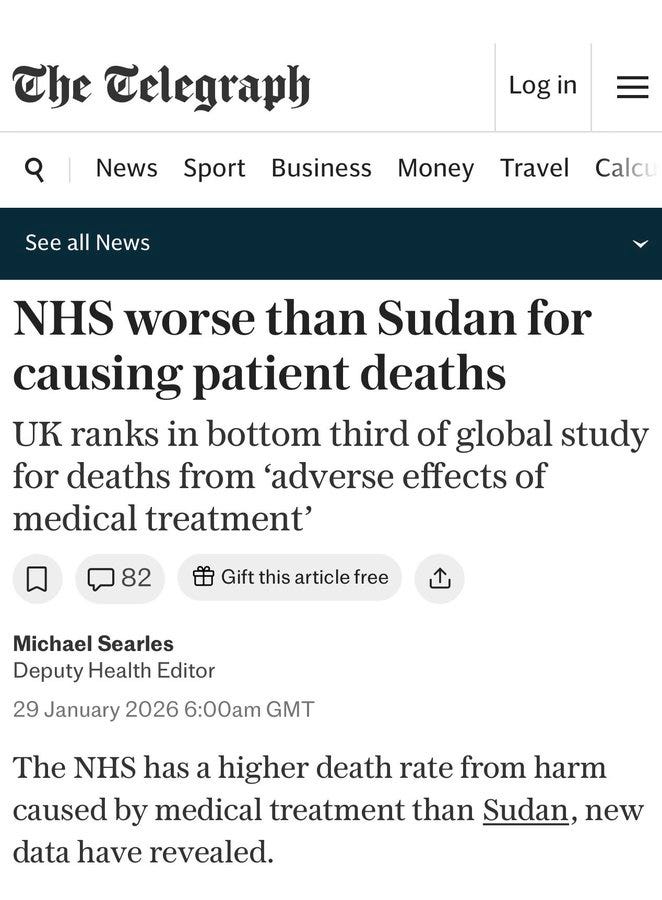
THE NHS has a higher death rate from harm caused by medical treatment than Sudan, new data has revealed. The global state of patient safety 2025 study found the UK ranked in the bottom third – 141 out of 205 countries – for deaths from “adverse...
https://www.telegraph.co.uk/news/2026/01/29/nhs-worse-than-sudan-for-causing-patient-deaths/
From AI
Recent reports indicate that the NHS in England is facing significant challenges, with rising rates of patient safety issues and avoidable deaths, particularly in certain regions. Comparatively, while Sudan has its own healthcare challenges, the NHS’s performance in patient safety has raised serious concerns among experts.
Patient Safety in the NHS Compared to Global Standards
Overview of Patient Safety in the NHS
The National Health Service (NHS) in England is currently facing significant challenges regarding patient safety. Reports indicate that the performance in key areas, such as maternity care, has deteriorated, leading to increased rates of maternal and neonatal deaths. The NHS has been criticized for its inability to provide timely and safe care, particularly in urgent situations.
Comparison of Patient Safety Metrics
MetricNHS PerformanceGlobal ComparisonMaternal Death RatesRising, especially among Black womenHigher than many OECD countriesDeaths from Treatable CausesAverage compared to OECDUK lags behind top-performing countriesClinical Harm CostsEstimated at £14.7 billion/yearSignificant compared to other nations
Key Findings
The NHS has seen a rise in maternal and neonatal deaths for the first time in a decade.
The disparity in care quality is evident, with higher rates of adverse effects in certain regions, particularly in the North East of England.
The NHS’s performance on treatable causes of death is average, but there is a notable gap compared to the best-performing countries.
The situation highlights the urgent need for improvements in patient safety and care quality within the NHS.
Lord Christopher Monckton argues that the UK government is destroying the British economy deliberately

Superb analysis on the surveillance creep. The part about emotion detection algorithms being culturally biased is something I've noticed in my work with computer vision systems. It's not just unreliable, its fundamentally flawed when applied universally. The bit about how Britain's IRA-era CCTV network normalized this surveillance infrastructure is honestly chilling once you think about it.