DYSTOPIA Down-Under

From X
The NZ-India Free Trade Agreement, complete list.
What each country actually gave up.

🇳🇿 WHAT NEW ZEALAND OPENED:
Every category of goods. Food, machinery, chemicals, vehicles, textiles, every line. Tariff goes to zero on day one. No exclusions, no phasing in, no quotas.
• Every service sector. NZ is open to Indian companies by default, apart from a specific list of what stays protected: Air NZ ownership, Chorus ownership, ACC, KiwiSaver, public health and education, fishing access, gambling, tobacco and alcohol retail, Fonterra and Zespri's structures, the Treaty of Waitangi exception (for digital trade only). Notable examples of what NZ did NOT put on the protection list: Spark, 2degrees, One NZ, the banking sector, electricity generation, ports and airports, doctors and dentists, private schools, universities, audit firms, aged care, newspapers, law firms.
• A commitment to push US$20 billion (around NZ$33 billion) of NZ investment into India over 15 years. India has no reciprocal target to invest in NZ. If NZ underdelivers, India alone decides whether NZ has fallen short. India alone decides what "proportionate" tariff claw-back to apply. NZ cannot challenge any of it through any panel. The political pressure to deliver lands on NZ Super Fund, ACC, KiwiSaver providers and large NZ corporates to direct savings to India for treaty-performance reasons rather than commercial return.
• 1,000 Indian working holiday visas a year. Nothing equivalent for young New Zealanders going to India.
• 4,100 visa-holders present at any one time across capped skilled-worker categories (IT, engineering, construction, teachers, nurses, physios, plus 600 reserved spots for chefs, yoga teachers, classical musicians and Ayush practitioners).
• An uncapped channel for Indian companies operating in NZ to bring in their own staff with no cap and labour market tests banned. Much like the controversial US H1B - though it is capped at 85,000 per year, is for any company, and has a $100,000 fee.
• Uncapped Indian international student visas. Extended locked-in 2, 3 and 4 year post-study work visas.
• Legally protect the basmati name for Indian rice growers within 18 months.
• Stop NZ insurers from being told to exclude coverage of homeopathy and traditional Indian medicine.
• Working with India on connecting NZ's payment systems to India's national instant-payment network and building central bank digital currencies (like a digital NZ dollar issued by the Reserve Bank). The Reserve Bank of NZ now has obligations on payments policy that it didn't have before. Future decisions about how NZ's payment systems develop are tied to bilateral commitments with India rather than purely Reserve Bank policy.
• If any future trade deal that NZ signs includes better services terms, it gets automatically extended to India. India made no equivalent commitment to NZ so it can give other countries better terms than it gave NZ.
• NZ taxpayers and industry help commercialise Indian apple, kiwifruit, honey and wine growers to upgrade their orchards and supply chains. The same growers we'd be competing with. India can suspend the small NZ market access quotas if it judges we underdelivered. NZ Crown research institutes (Plant & Food Research, AgResearch, Scion) and industry levy bodies (Zespri, NZ Apples & Pears, Apiculture NZ) must divert research budgets and grower-funded levies to build Indian capacity.
It’s a replacement of Kiwis - Maori and Pakeha and destruction of a way of life





“Shane Jones is next” - NZ Police
The young woman who was targeted by police over a social media post that has gone viral as a golden example of oppressive policing of the internet, freedom of expression and personal opinion spoke to Michael Laws this morning .
New Zealanders paying through the nose for their own butter while American butter is offered up instead

American butter confusion has officially reached the supermarket dairy aisle, where some shoppers are discovering that the butter block they assumed was one of ours is actually American butter packaged in Christchurch and sent out to mingle with the locals.
The brand, Burtfield’s & Co, is being sold in some Pak’nSave stores and is cheaper than New Zealand butter, which means the national butter conversation has now entered the stage where people are squinting at the back of a yellow wrapper like it just lied to them personally.
This is what the cost-of-living era does.
At some point, even the butter stops presenting itself clearly.
https://pavlovapost.co.nz/american-butter-confusion-nz
“Regional councils in New Zealand are gone.”

The government has given councils an ultimatum: come up with amalgamation plans within three months or the government will do it for you.
Local Government Minister Simon Watts and RMA Reform Minister Chris Bishop announced the move on Tuesday afternoon, giving a three-month deadline for reorganisation plans to be delivered.
It followed an announcement in November that groups of city and district mayors - with some government oversight - would be formed to come up with such plans.
But the ministers on Tuesday appeared to do away with that approach, saying if councils failed to make use of the new ‘Head Start’ approach, they would be forced into changes.
Instead, councils would form voluntary groups, and bring their ideas for those to the government about how they wanted to reorganise.
https://www.rnz.co.nz/news/political/594289/government-gives-councils-amalgamation-ultimatum

New Zealand’s (ostensibly non-existent) fuel crisis
From an AUSTRALIAN publication
You will find nothing remotely similar in what goes for NZ mass media!
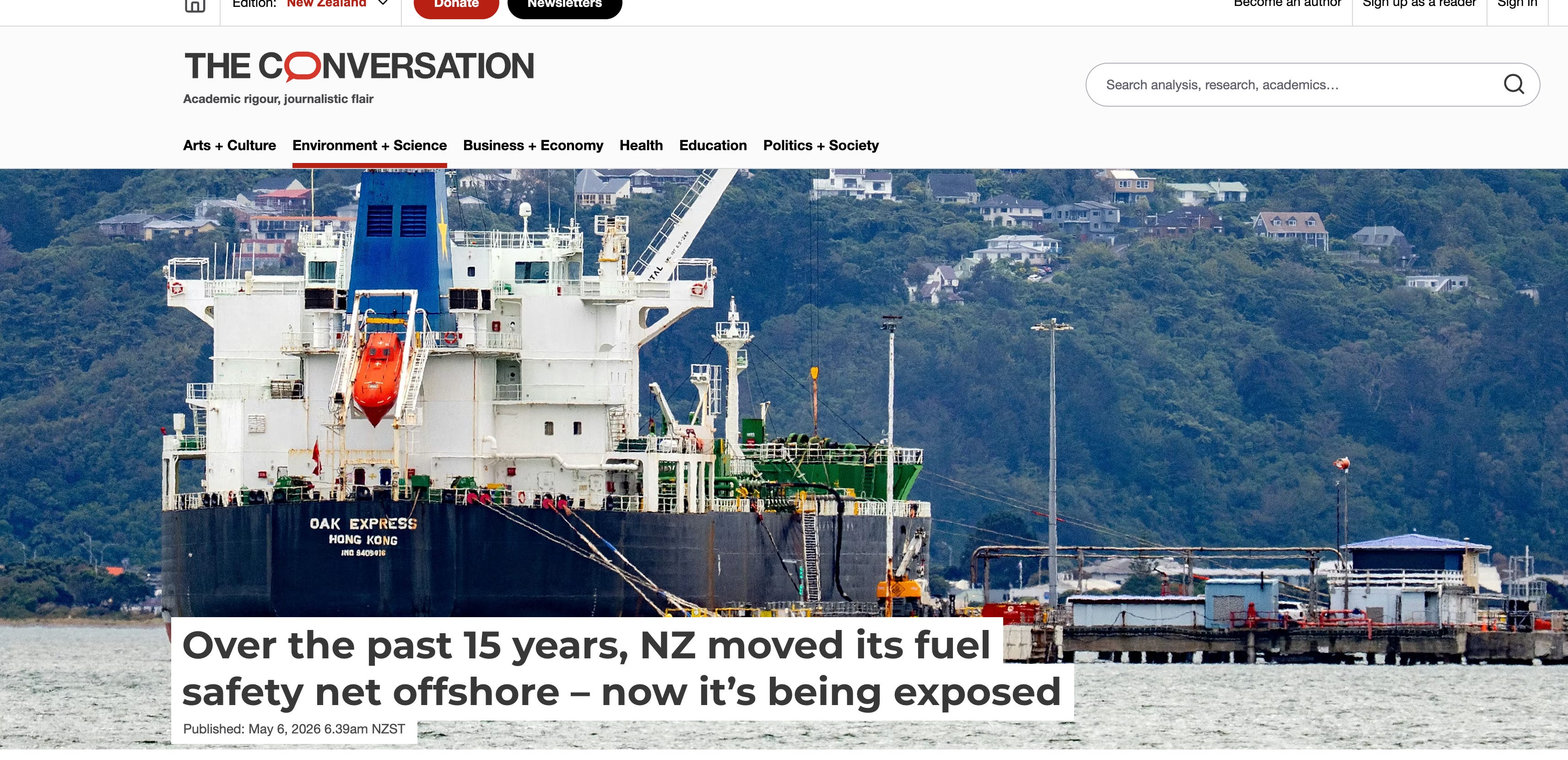
Amid a worsening global energy crisis, New Zealand and Singapore’s freshly struck deal to keep fuel and other essential goods flowing is being touted as a boost to supply chain resilience.
The agreement commits both countries not to impose export restrictions on each other during economic upheaval. But it also highlights an uncomfortable reality facing New Zealand’s energy security, which depends heavily on fuel stored and refined overseas.
Nearly 60% of the country’s petroleum reserves are held offshore in countries such as the United States, Japan and the United Kingdom, and around a third of its fuel is refined in Singapore. As global tensions disrupt oil markets and put pressure on key shipping routes, that model is being tested.
While New Zealand meets international requirements to hold 90 days of net petroleum imports as a member of the International Energy Agency (IEA), much of this is stored thousands of kilometres away.
In emergencies, the IEA can coordinate collective stock releases to stabilise global markets, as occurred in the agency’s release of 400 million barrels of oil in March.
However, a closer look at the data shows New Zealand is a clear outlier in how it meets these obligations.

Ballance Agri Nutrients has increased its prices for fertiliser prices due, it says, to firming global commodity prices.
The lift in global prices has pushed up procurement costs and while some of these has been absorbed, the new prices reflect the increases the fertiliser co-operative is facing, Ballance Agri-nutrients customer manager Jason Minkhorst said in an email to customers.
As of May 5, urea and SustaiN will increase by $100 a tonne to $1175/t and $1224/t respectively. DAP and SOA have both increased by $50/t to $1653/t and $650/t, Sulphurgain 90S will increase by $120/t to $1297/t and Sulphurgain 30S is up $25/t to $703/t.
Rival co-operative Ravensdown’s prices have remained unchanged since April 8.
https://www.farmersweekly.co.nz/markets/ballance-raises-fertilister-prices/#google_vignette
DATA CENTRES
This is an international agenda to replace current infrastructure and take us to an AI dystopia/
How long before they roll out the “free energy” that doesn’t exist?
When they’ve destroyed everthing-that ‘s when.
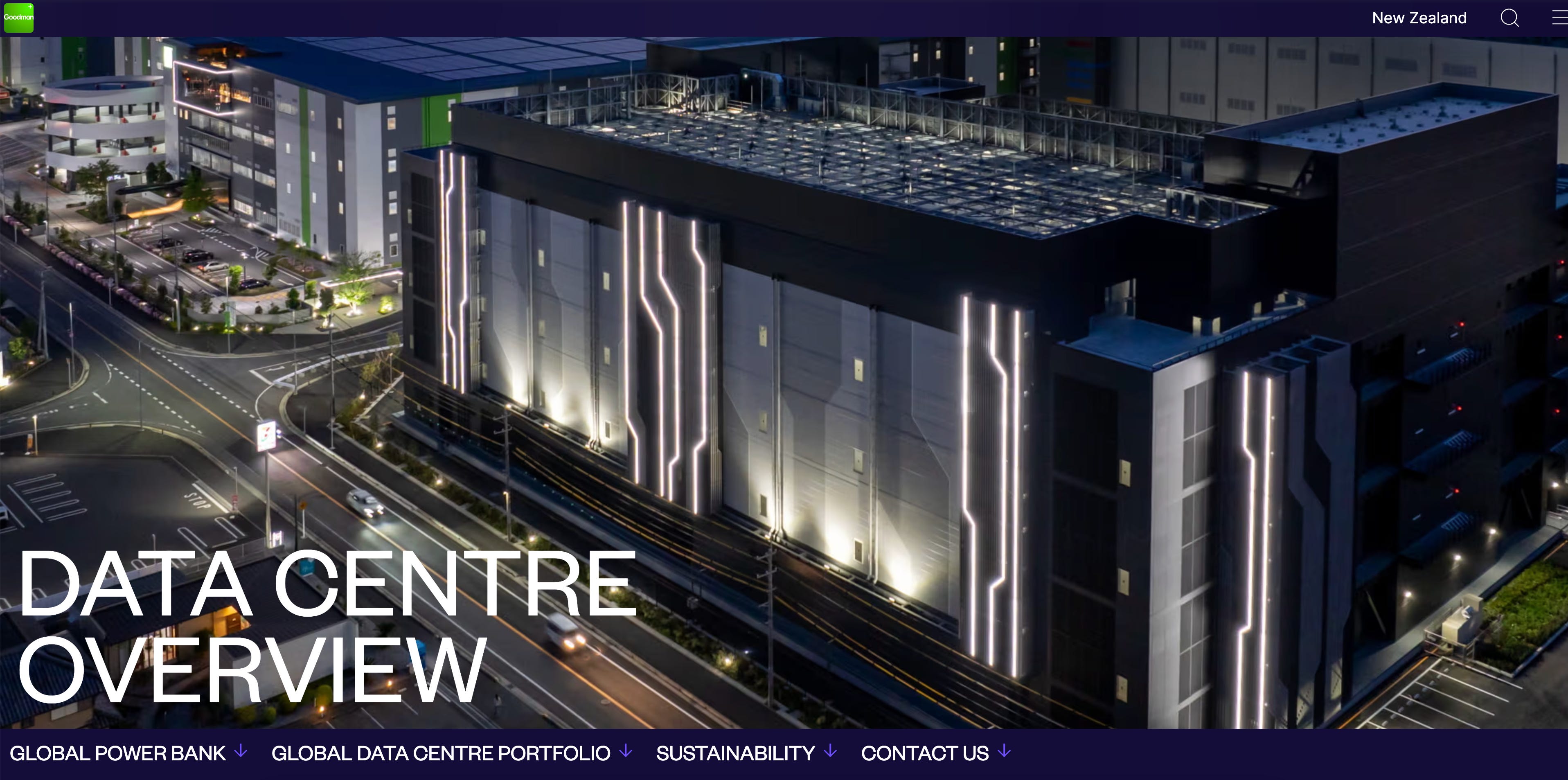
https://nz.goodman.com/our-properties/data-centres?gad_campaignid=22996885122
Amazon takes $45m hit, abandons planned West Auckland data centre
4 May 2026
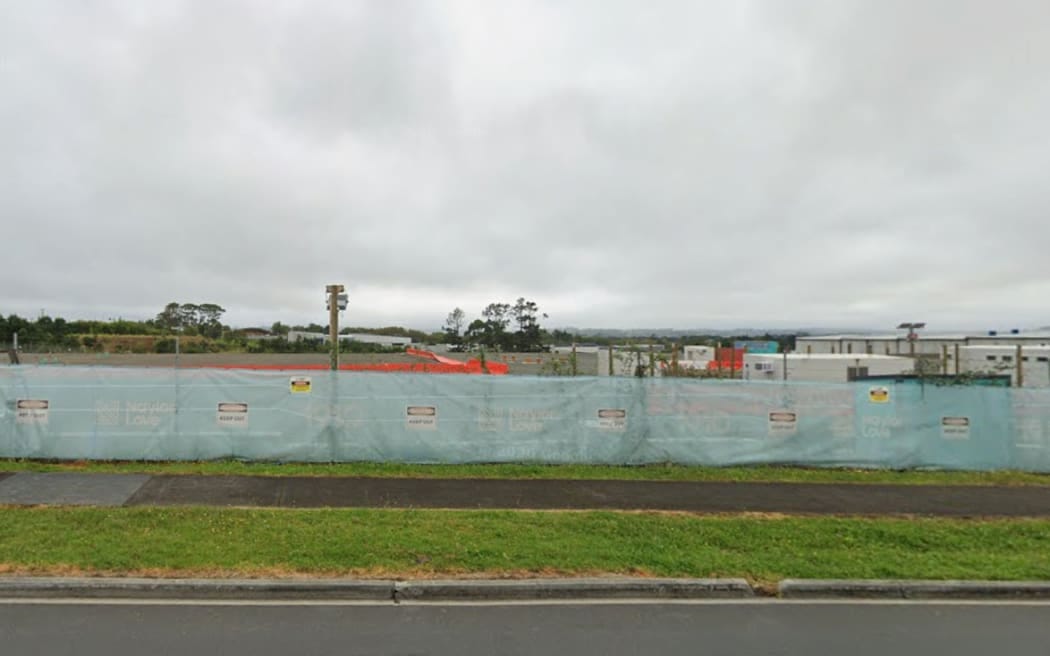
The site which was planned to be used by Amazon in Westgate, Auckland. Photo: Google Maps / Screenshot
Amazon’s New Zealand data centre arm has taken a roughly $45 million hit after shelving a planned West Auckland development, newly filed accounts show.
Financial statements for Amazon Data Services New Zealand Ltd for the year to December 31, 2025, reveal the company booked a $44.9 million impairment in 2025 after deciding “not to continue with the planned development of the site.”
The write-down related to land holdings, which were reduced to a recoverable value of about $62.7 million.
While the filing does not explicitly name the location, Amazon’s only publicly disclosed greenfield development in New Zealand had been a proposed hyperscale data centre in Westgate, Auckland.
The scale of the write-down and the reference to undeveloped land implies the impaired site relates to that project.
The impairment drove the subsidiary to a pre-tax loss of $36 million in 2025, reversing a profit a year earlier. It was recorded within operating expenses and accounted for the bulk of the decline.
Despite the write-down, Amazon appeared to be continuing to invest heavily in its New Zealand footprint, with total assets above $650 million.
Those investments appear to be being redirected into new servers, networking gear and leasing capacity in other data centres, rather than new builds.
Between December 2024 and December 2025, the value of equipment on its books surged to more than $250 million from about $5 million, while lease assets climbed to about $285 million from roughly $244 million, with a further $162 million in future lease commitments yet to begin.
At the same time, assets under construction have dropped to zero.
Rather than building its own sites, it looks like Amazon in New Zealand is shifting to a “lease-and-equip” model - buying capacity and filling it, rather than building from scratch.
In 2021 when Amazon announced the data centre construction plan, it said the investment would create 1000 direct and indirect jobs and claimed it would add about $10.8bn to the local economy over the next 15 years.
Then-Minister for Digital Economy and Communications David Clark said it was a vote of confidence in the country’s economic recovery from the pandemic.
Then-National Party digital economy spokesperson Melissa Lee said the investment would encourage more young people to pursue careers in the tech sector.
A letter from Amazon to then-Prime Minister Jacinda Ardern showed the US tech firm celebrating an “ambitious partnership” with the New Zealand government.
A new Southland datacentre would be the country’s second-largest drain on power
17 March 2026
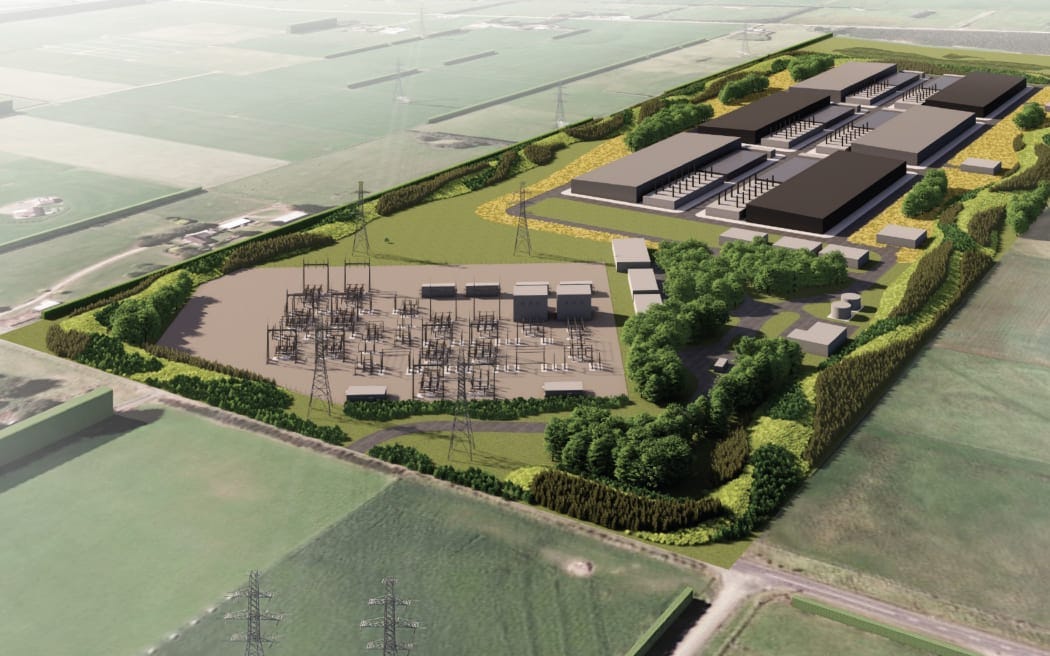
Artist’s impression of how the data centre is to look. Photo: Datagrid
It’s being billed as the data centre that changes everything - but hopefully that doesn’t include the price of your power.
It will be the country’s second biggest user of electricity after the Tiwai Point aluminium smelter.
A $3 billion data centre in Southland that, as the marketing says, “changes everything”....
“...delivering the most significant upgrade to New Zealand’s digital infrastructure in a generation. We’re doubling national data capacity and opening up a high-growth gateway to Asia-Pacific’s booming cloud and AI economy.”
Multiple resource consents have been granted by three local authorities to get Datagrid’s huge AI data storage project in Makarewa off the ground, and to land a high-speed internet cable from Australia coming up at Oreti Beach near Invercargill.
But where will all the power come from? The likely answer is the Manapōuri hydro-electric power plant, which also powers Tiwai.
But if there’s a shortage, say in a drought, what will the data centre’s requirement for constant electricity do to the market - and our power bills?
That’s what niggles Newsroom’s South Island editor, David Williams, who speaks to The Detail today after six years of keeping tabs on the project.
Datagrid has told him it won’t be answering his questions until it issues a news release later on - possibly this week.
For its international clients, the fact that the centre will be using clean energy is a big selling point, but is there enough of that energy to go around?
“It’s not like a data centre can just power down,” says Williams.
“The advantage of Tiwai is that they can say, ‘ok, well, we’re not going to put on this particular potline. We will close down for a while, and that’s part of our contract, and we’ll get paid by the country if you like, to shut down because that’s good for New Zealand Inc.’
“Data centres need continuous power. If they power down... that’s why they have these backup generators... if they power down, it’s actually damaging to their units or their processing centre. It needs to be a constant supply.”
Fast Track approval has just been given for a large Contact Energy wind farm just 50 kilometres away from the centre’s site, so that could be a piece of the puzzle.
Williams says this is “not your usual Southland development, I would have thought”.
“The scale of this is quite something.”
Not only does it involve building six data halls, but it is also flanked by 12-metre-high noise control barriers over 9.5 hectares on a 48-ha property. There will be 84 emergency generators, each with a 10,000 litre diesel tank and a 15m high exhaust stack.
The construction phase will offer the most lucrative economic return to the region, with up to 550 workers expected to be on site, but once it’s finished, it will only require about 50 staff to keep it going.
The main transmission line practically runs over the top of the site, and Datagrid will build its own substation and upgrade the grid exit point.
Williams says the company has done well to consult with neighbours, iwi, and anyone else affected, all of whom seem to be on board with the mitigations it’s planning.
Southland mayor Rob Scott has told him, “these people have done it right”.
“They’ve talked to people, they’ve consulted the community, but more importantly, they’ve listened,” he says.
“They’ve taken account of the things that they’ve said, and they’ve tried to change things.”
Measures included noise mitigation from the 24-hour hum of servers and concerns answered over water, required in great quantities for cooling.
“Most of the people who live around them have given their written approval for what’s going on,” he says.
Williams says given the Amazon data centre debacle in Auckland, where billions of dollar’s worth of building and employment were promised but never eventuated, people are right to be sceptical. But he says this project has emerged differently, starting small and getting bigger.
“But I do note,” he says, “with this particular project, the consent approval announcement was not made by the Prime Minister. So maybe that’s a good sign.”
Connect the dots
Transpower warns of higher blackout risk in winter 2026
16 May 2025
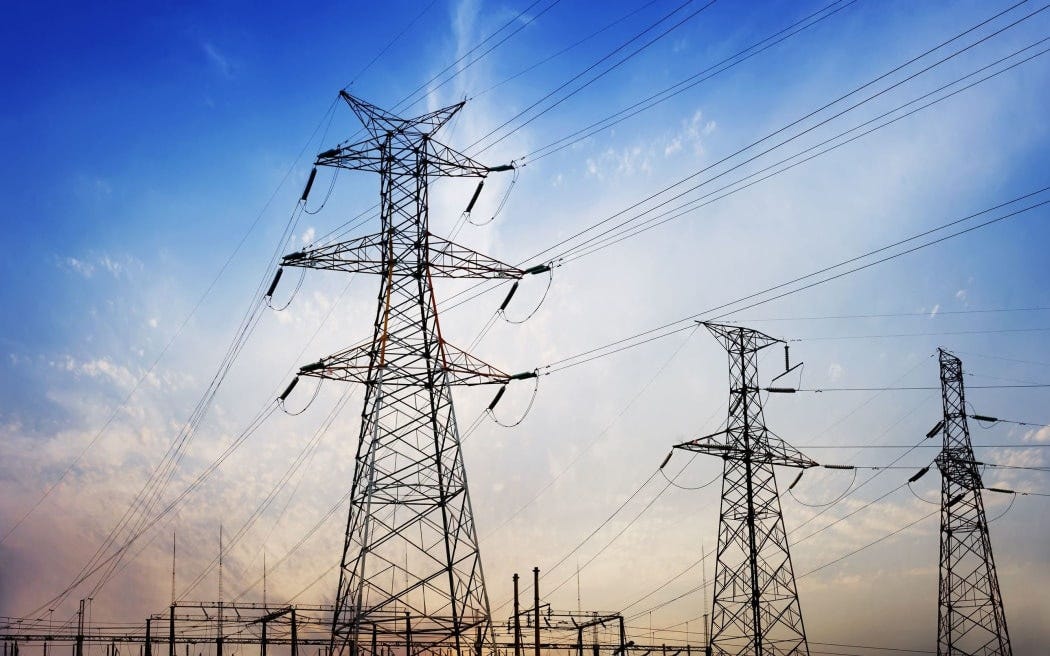
The draft Security of Supply Assessment makes sobering reading for power suppliers. Photo: 123rf.com
Transpower is warning of higher risks of electricity outages starting in winter 2026.
The national grid operator’s draft Security of Supply Assessment predicts an elevated risk of shortages will arrive four years earlier than thought as recently as a year ago.
It found solar, wind and battery storage isn’t coming online fast enough to make up for dwindling supplies in the country’s gas fields.
The assessment found, if every electricity generation project in the pipeline was built, supply would be much more reliable, but Transpower said there was a risk of some proposed solar, wind and battery projects falling over.
Previously, Transpower thought its lower security standard - a measure of the safety margin between expected demand and supply - would be met until 2030. Now, it says that will be breached in 2026, much earlier than expected.
“It doesn’t mean there will actually be outages, but it does signal an increased risk,” said Transpower chief executive James Kilty. “It is telling us things are getting tighter and next year is looking tight.”
He said companies in the electricity market could challenge the draft assessment, which said, if all potential solar, wind and battery projects in the development pipeline were built, the country would be in a much more secure position, but many projects didn’t have consent yet.
The main factor behind the changed outlook was worse-than-expected results from gas producers.
Not only have yields from the country’s gasfields dropped faster than expected, independent experts have also downgraded the size of estimated gas reserves in existing fields since the previous assessment a year ago.
Transpower now expects lower demand from industrial users than previously forecast, with more electricity generation projects committed to being built than a year ago.
Commercial rooftop solar has also helped alleviate some pressure, but while those factors improved the buffer, they weren’t enough, the assessment found.
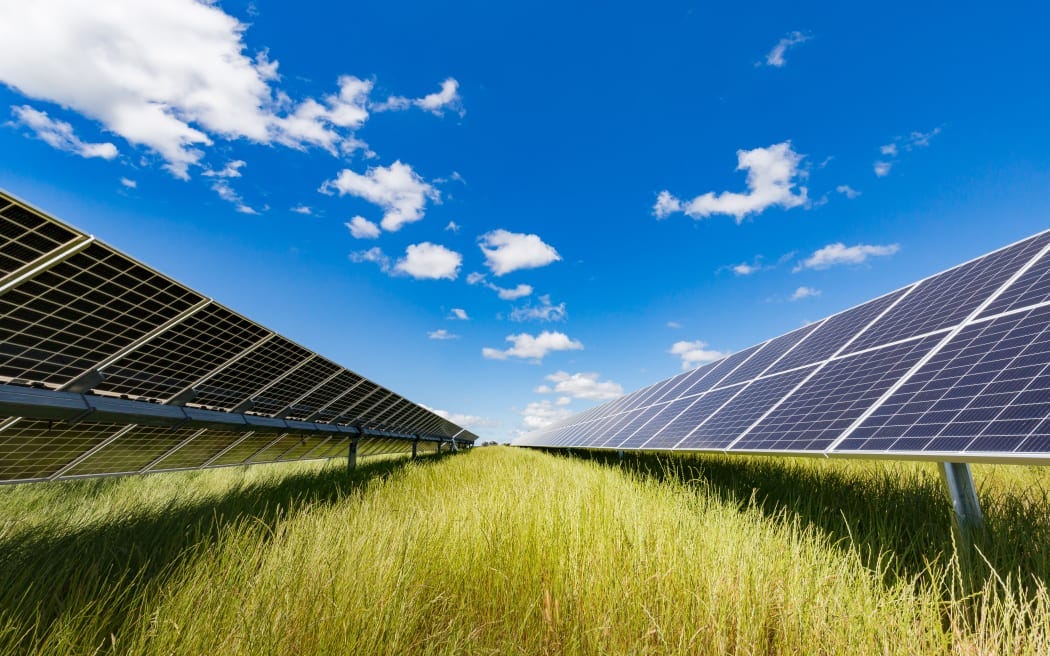
A solar farm. Photo: Supplied / Genesis Energy
Need for certainty for planned projects
Transpower says, to get the reliable supply the country needs, more renewable generation projects need to progress from possible to locked-in.
“The more speculative part of the supply pipeline... has increased,” the assessment says. “However, with so much of the supply pipeline unconsented, there is risk that these projects could be delayed, deferred or dropped.”
The risk of shortfall out to 2034 can’t be met by coal and gas, even at their maximum levels.
“Even with the highest plausible energy contribution from thermal [coal and gas], we require a rapid and sustained build of new generation, exceeding the large amount currently consented, to maintain energy margins above the security standards over the full ten-year horizon,” the assessment said.
Eighty-five percent of planned new generation is solar and wind, with most of the rest battery projects. Batteries can be used to store solar or wind power, and switched on and off to boost supply at stretched times, taking some pressure off the nation’s hydro dams.
Octopus Energy’s Margaret Cooney said the risks could be alleviated before next winter, if the government acted quickly.
“What the report’s saying is actually, yes, that risk of outages is increasing,” she said. “We do have opportunities to take action now that could reduce that, so more batteries more quickly, more demand response - both of those could help solve that situation and avoid the blackouts.”
“We’re not getting enough new generation coming in fast enough to compensate for the fact that we’ve lost the firmness or certainty you’ve had with gas. The government really needs to focus on making sure more supply is coming into the market as soon as possible.”
Cooney said the government could take steps now that would make a difference within a year. One of those was changing the market, so companies could be paid to lower their demand at peak times, helping the country survive the short-term risk of outages.
Octopus’ UK arm made those payments in the United Kingdom and the company also wants to offer it here.
“I’m not talking about shutting down plants for whole seasons, it’s literally just to manage the supply imbalance that happens for a few hours,” Cooney said.
“When you look at markets abroad, they have incentive payments... so in those situations, where you’re approaching peak scenarios, they get called on and if they reduce their usage at that time, they get paid.
“It’s something Fonterra and other major energy users have highlighted they are open to doing, but the current market structure doesn’t support it.
“There is potential to quickly spin up a solution and examples in other markets we could replicate quite quickly.”
Cooney said overall productivity need not be impacted.
“They could time maintenance over the peak period, but ultimately not impact their own production.”
The country’s biggest electricity user, Rio Tinto, has agreed to reduce its electricity use during tight winters, but in that case, the hiatus impacts production of aluminum.
Likewise, the country’s biggest gas user, Methanex, has committed to selling its gas to electricity generators this winter, if needed, to shore up dwindling gas supplies during a potentially dry winter for the hydro power lakes.
Methanex has agreed to forfeit production of methanol for export for the second year in a row, because it was considered more profitable to onsell its gas supply to the likes of Contact and Genesis Energy.
Managing director Stuart McCall told RNZ that its core business remained methanol production and it intended to get back to it.
“Recent gas sales to New Zealand’s electricity sector reflect targeted support during a period of energy supply stress, not a shift away from our core business,” he said.
“Our priority remains manufacturing methanol, a key ingredient in everyday products such as mobile phones, pharmaceuticals, construction materials, wind turbines, solar panels and an increasingly important lower-emissions fuel for the global shipping industry.”
Kilty said the hydro lakes looked a little fuller than feared going into winter 2024, and deals struck with Rio Tinto and Methanex also helped lower the risk of shortages this winter, but the sector needed to respond again to lower the risks in 2026.
The draft assessment looks ahead 10 years and forecasts fossil fuel supplies, new power stations, new build of factories and demand sources, and assesses how much buffer there may be in the electricity supply.
“We need to keep working hard to bring new electricity to market as soon as possible and make sure existing stations are well-fuelled going into next winter,” he said.
And finally…


Dystopia indeed. Thanks for putting all on one page....
Indian in close setup with Israel… indians create caos. Watch CJBs video on India. Cjbbooks on substack.