Dmitry Orlov: Russia Prepares DEVASTATING response After Ukraine’s Drone Attack!

If there is something that comes through all these videos is that public opinion and the government has hardened.
There will be no more negotiations with the Ukrainians. They are seen as a terrorist entity and will be treated as such.
What we are seeing with airstrikes overnight is not the retaliation.
Last night in Kharkov.
And Kiev
Scott Ritter and Diane Sare talk about the Ukrainian drone strikes against Russia
From yesterday
ALERT: Whitehouse IMPLODES, WW3 EXPLODES, Widespread BLACKOUTS in Iran
I thought as much when I heard this after the Istanbul talks

Leaked Ukrainian peace terms differ from version presented to Moscow
Kiev did not reject limitations on its armed forces in the text given to Russia
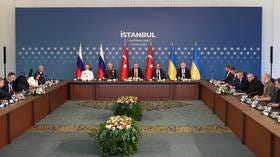
Members of delegations attend a second round of direct talks between Russia and Ukraine at the Ciragan Palace in Istanbul, Turkey on on June 02, 2025. © Sputnik/Alexander Ryumin
The memorandum Ukraine handed to Russia during Monday’s peace talks in Istanbul was not the same as the version leaked to Western media, RT has learned. A key clause rejecting any limits on Ukraine’s armed forces – present in the leaked draft – was missing from the official proposal received by the Russian delegation.
The revelation casts new doubt over Kiev’s public stance and suggests a possible divergence between Ukraine’s media messaging and its negotiating position behind closed doors.
According to a source, who reviewed the Ukrainian memorandum submitted at the Turkish meeting, the document omitted a paragraph found in the version published earlier this week by Reuters. That paragraph explicitly ruled out any restrictions on the size or deployment of Ukraine’s military forces or those of its allies.
The Reuters draft stated: “No restrictions may be imposed on the number, deployment, or other parameters of the Armed Forces of Ukraine, as well as on the deployment of troops of friendly foreign states on the territory of Ukraine.”
That language does not appear in the version reviewed by RT’s source.
The talks in Istanbul marked the second round of direct negotiations between Russia and Ukraine in less than a month. Moscow’s proposal reportedly called on Kiev to recognize the loss of five territories that voted to join Russia in referendums, withdraw Ukrainian forces from those regions, commit to neutrality, and accept limitations on its military capacity.
READ MORE: Fyodor Lukyanov: Kiev’s drone strikes prove Moscow’s point
On Wednesday, Ukraine's Vladimir Zelensky dismissed Moscow’s proposal out of hand, calling it “an ultimatum.”
“This memorandum is a misunderstanding,” he said, adding that the Istanbul process had become “meaningless.”
Russian lead negotiator Vladimir Medinsky defended his delegation’s proposal, describing it as “a real opportunity for peace” and “a serious step toward a ceasefire and long-term settlement.”
The discrepancy between the two versions of Ukraine’s memorandum is likely to raise fresh questions in Moscow about the sincerity of Kiev’s approach to negotiations. No date has been set for a third round of talks.
Ukraine’s most reckless attack: Was NATO behind it?
The logistics, timing, and technology behind the attack raise bigger questions about who was really involved
By Dmitry Kornev, military expert, founder and author of the MilitaryRussia project
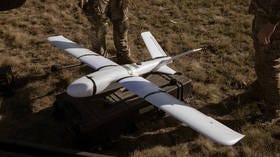
FILE PHOTO. © Andre Luis Alves/Anadolu via Getty Images
While Western headlines celebrated Operation Spider’s Web as a daring feat of Ukrainian ingenuity, a closer look reveals something far more calculated – and far less Ukrainian. This wasn’t just a strike on Russian airfields. It was a test – one that blended high-tech sabotage, covert infiltration, and satellite-guided timing with the kind of precision that only the world’s most advanced intelligence networks can deliver. And it begs the question: who was really pulling the strings?
Let’s be honest. Ukraine’s Main Directorate of Intelligence didn’t act alone. It couldn’t have.
Even if no Western agency was directly involved in the operation itself, the broader picture is clear: Ukraine’s Main Directorate of Intelligence, its military, and even its top political leadership rely heavily on Western intelligence feeds. Ukraine is deeply embedded within NATO’s intelligence-sharing architecture. The idea of a self-contained Ukrainian intel ecosystem is largely a thing of the past. These days, Kiev draws primarily on NATO-provided data, supplementing it with its own domestic sources where it can.
That’s the backdrop – a hybrid model that’s become standard over the past two years. Now, let’s look more closely at Operation Spider’s Web itself. We know the planning took roughly 18 months and involved moving drones covertly into Russian territory, hiding them, and then orchestrating coordinated attacks on key airfields. So how likely is it that Western intelligence agencies had a hand in such a complex operation?
Start with logistics. It’s been reported that 117 drones were prepped for launch inside Russia. Given that numerous private companies in Russia currently manufacture drones for the war effort, it wouldn’t have been difficult to assemble the necessary devices under that cover. That’s almost certainly what happened. Components were likely purchased domestically under the guise of supplying the “Special Military Operation.” Still, it’s hard to believe Ukraine’s Main Directorate of Intelligence could have pulled off this mass procurement and assembly alone. It’s highly likely Western intelligence agencies played a quiet but crucial role – especially in securing specialized components.
Then there’s the explosives. If the operation’s command center was located in the Ural region, as some suggest, it’s plausible that explosives or components were smuggled in via neighboring CIS countries. That kind of border-hopping precision doesn’t happen without outside help. In fact, it mirrors tactics long perfected by intelligence services in both the US and Western Europe.
Because make no mistake: this wasn’t just the CIA’s playground. European services – particularly those in the UK, France, and Germany – possess the same capabilities to execute and conceal such an operation. The NATO intelligence community may have different national flags, but it speaks with one voice in the field.
The real giveaway, however, lies in the timing of the strikes. These weren’t blind attacks on static targets. Russia’s strategic bombers frequently rotate bases. Commercial satellite imagery – updated every few days at best – simply can’t track aircraft on the move. And yet these drones struck with exquisite timing. That points to a steady flow of real-time surveillance, likely derived from signals intelligence, radar tracking, and live satellite feeds – all tools in the Western intelligence toolbox.
Could Ukraine, on its own, have mustered that kind of persistent, multidomain awareness? Not a chance. That level of situational intelligence is the domain of NATO’s most capable agencies – particularly those tasked with monitoring Russian military infrastructure as part of their day job.
For years now, Ukraine has been described in Western media as a plucky underdog using low-cost tactics to take on a larger foe. But beneath the David vs. Goliath narrative lies a more uncomfortable truth: Ukraine’s intelligence ecosystem is now deeply embedded within NATO’s operational architecture. Real-time feeds from US and European satellites, intercepts from British SIGINT stations, operational planning consultations with Western handlers – this is the new normal.
Ukraine still has its own sources, but it’s no longer running a self-contained intelligence operation. That era ended with the first HIMARS launch.
Western officials, of course, deny direct involvement. But Russian investigators are already analyzing mobile traffic around the impact sites. If it turns out that these drones weren’t connected to commercial mobile networks – if, instead, they were guided through encrypted, military-grade links – it will be damning. Not only would that confirm foreign operational input, it would expose the full extent of how Western assets operated inside Russia without detection.
At that point, no amount of plausible deniability will cover the truth. The question will no longer be whether NATO participated – but how deep that participation ran.
Russian military retaliated against Kiev’s ‘terrorism’ – MOD
Targets of overnight strikes included drone assembly sites, training centers, and weapons repair facilities, the Defense Ministry has said
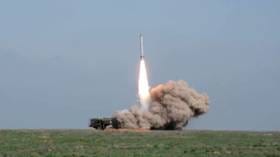
FILE PHOTO: A ballistic missile being launched by a Russian Iskander-M system. © Sputnik / Russian Defence Ministry
The Russian military has said its forces carried out large-scale overnight strikes against Ukrainian defense industry sites, using drones and long-range precision-guided weapons.
Ukrainian officials also reported waves of missile and drone attacks across multiple cities, including the capital Kiev, as well as Lviv and Lutsk on Friday morning.
The barrage, which included air-, sea-, and land-based missiles as well as unmanned aerial vehicles (UAVs), was a response to recent “terrorist acts” carried out by Kiev, Russia’s Defense Ministry said on Friday.
Ukraine blew up railway bridges in Russia last week, derailing civilian and freight trains and killing at least seven and injuring over 120. Kiev also launched a coordinated drone strike on multiple Russian airbases, targeting long-range, nuclear-capable bombers stationed in Russia’s north and far east. Moscow has claimed that most drones were intercepted and the aircraft targeted was damaged by not destroyed.
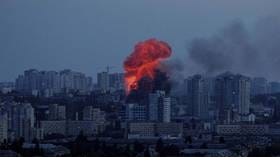
Ukraine reports major Russian strikes overnight (VIDEOS)
The targets of Russia’s overnight strikes included “design bureaus, enterprises involved in production and repair of Ukraine’s weapons and military equipment, workshops for the assembly of attack drones, flight training centers as well as warehouses of weapons and military equipment,” the statement read. “The goal of the strike was achieved. All designated facilities were hit,” the ministry said.
According to Moscow, it was the sixth combined strike against Ukraine’s military-related targets carried out by the Russian forces since May 31.
Over the past week, attacks have hit Kiev’s defense industry enterprises; military airfields; production, storage and launch sites of drones; arms depots as well as deployment points of Ukrainian military units and foreign mercenaries, according to the ministry.
Russian President Vladimir Putin has described the railway sabotage incidents as “undoubtedly a terrorist act” committed by the “illegitimate regime in Kiev,” which, he said, is “gradually turning into a terrorist organization.” Putin told his US counterpart Donald Trump in a phone call on Wednesday that Moscow “will have to respond”