Disclosure continues apace
Or does it?

The following was written, not by me, but generated by ChatGPT based on a “discussion”
The UAP Debate: Between Avi Loeb and Jacques Vallée
Recent reports suggest that Harvard astrophysicist Avi Loeb has been tasked with helping assemble a scientific advisory group to examine the UAP phenomenon, drawing together specialists in astrophysics, artificial intelligence, instrumentation, data analysis, and psychology. Whether this develops into a formal government body or remains an advisory initiative, the symbolism is unmistakable. One of the world’s most prominent scientists has been invited into a field that, until recently, was regarded as intellectual quicksand.


Loeb’s involvement raises an interesting question. If there is a mystery at the heart of the UAP phenomenon, what sort of mystery is it?
For Loeb, the answer is clear. The mystery is one of insufficient data.
His Galileo Project seeks to move the subject away from eyewitness testimony, speculation, leaks, and internet debate and into the realm of instrumentation, measurement, and scientific observation. If unusual objects exist, then they should be photographed, tracked, measured, and analyzed. If they are Chinese drones, the data should reveal this. If they are natural phenomena, the data should reveal this. If they are something genuinely unknown, the data should reveal that too. The answer, in Loeb’s view, lies not in stories but in sensors.
This position has obvious strengths. It is rigorous, disciplined, and resistant to fantasy. It insists that extraordinary claims require evidence.
Yet there is another school of thought, represented most prominently by Jacques Vallée.
Vallée has spent decades studying not merely UFO reports but the long historical record of anomalous encounters. He notes striking similarities between modern UFO reports and much older accounts of fairy encounters, religious apparitions, angelic visitations, and other phenomena that appear to shape themselves according to the beliefs and expectations of the age in which they occur.
For Vallée, the phenomenon may not simply be an object moving through space. It may be interacting with consciousness, culture, and perception itself.
This is where the divide becomes profound.
Loeb asks:
“What is the object?”
Vallée asks:
“What if the phenomenon is not merely an object?”
These questions are not necessarily contradictory, but they point in very different directions.
The same divide appears in discussions surrounding physicist Hal Puthoff.
Puthoff occupies an unusual position. Unlike Loeb, he has spent decades moving between conventional science, intelligence research, and investigations into anomalous phenomena. He has repeatedly stated that credible individuals within government and defense circles have reported extraordinary things, including claims involving non-human intelligences and recovered technologies.
Critics point out that Puthoff is often reporting what others have told him rather than presenting direct evidence. That is true. Yet many observers note that scientists are not merely abstract logic machines. They are human beings operating within institutions, disciplines, and reputational networks.
In theory, saying “This deserves investigation” is not the same as saying “I believe it.”
In practice, the distinction is not always so clear.
Scientists, like everyone else, belong to tribes.
Academia likes to portray itself as a purely rational marketplace of ideas. Reality is more complicated. Careers, funding, prestige, and professional relationships all exert pressure. Many researchers avoid controversial subjects altogether. Others choose their words carefully. The result is a language of implication, caution, and qualification.
When a scientist of Puthoff’s stature says that claims from insiders should not be dismissed, some hear mere procedural caution. Others hear a carefully measured indication that he considers the reports worthy of belief.
Whether that interpretation is fair is another matter.
The larger point is that the UAP debate increasingly resembles less a scientific dispute than a clash of worldviews.
On one side stand those who believe the mystery, if there is one, will ultimately yield to improved instrumentation and analysis. Avi Loeb belongs broadly within this camp.
On the other side stand those who suspect that the phenomenon may challenge the assumptions upon which the scientific worldview itself rests. Jacques Vallée is perhaps the most sophisticated representative of this position.
The disagreement is not really about UFOs.
It is about reality.
Materialist science begins with the assumption that matter is fundamental and consciousness emerges from physical processes. Within that framework, unidentified objects are simply unidentified objects awaiting identification.
But there are alternative perspectives.
Many spiritual traditions, including Advaita Vedānta, begin from the direct experience of awareness itself. Consciousness is not something produced by matter. Rather, matter appears within consciousness.
From this perspective, a purely materialist investigation may be incomplete from the outset. It may be asking questions about the contents of experience while ignoring the nature of experience itself.


This does not prove that UAPs are interdimensional. It does not prove that aliens exist. It certainly does not prove stories about Grays, Nordics, Reptilians, or Insectoids that circulate through UFO culture.


What it does suggest is that the deepest question may not be whether there are non-human intelligences.
The deepest question may be whether our current understanding of reality is adequate to explain whatever is taking place.
The mythology of Cassandra offers a useful warning.
In Greek legend, Cassandra was cursed to speak the truth while never being believed. Today the analogy is frequently applied to whistleblowers such as David Grusch and others who claim knowledge of hidden programs and recovered technologies.
Yet the lesson of Cassandra is not simply that institutions ignore truth.
It is that, in the moment, nobody knows whether the warning is truth or error.
Only history decides.
That is the uncomfortable position in which we find ourselves.
Perhaps Loeb is correct, and better sensors will eventually resolve the mystery as advanced drones, natural phenomena, or misunderstood technology.
Perhaps Vallée is correct, and the phenomenon is pointing toward dimensions of reality that current science has barely begun to contemplate.
Or perhaps both are partly right.
It may be that better instruments are required not only to observe the phenomenon, but also to reveal the limitations of the assumptions with which we began.
In the meantime, the debate continues.
Loeb keeps his eyes on the sky.
Vallée keeps his eyes on the mystery.
And the rest of us are left wondering whether the greatest unknown is not what is out there, but what we think reality itself is.
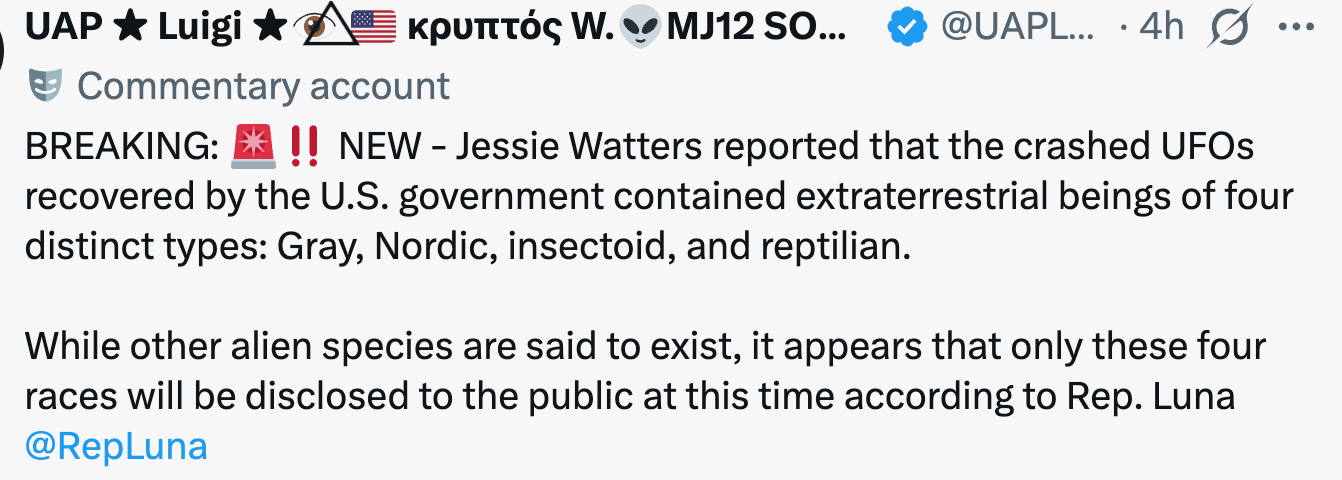
Imagine that! Reptilians DO exist!
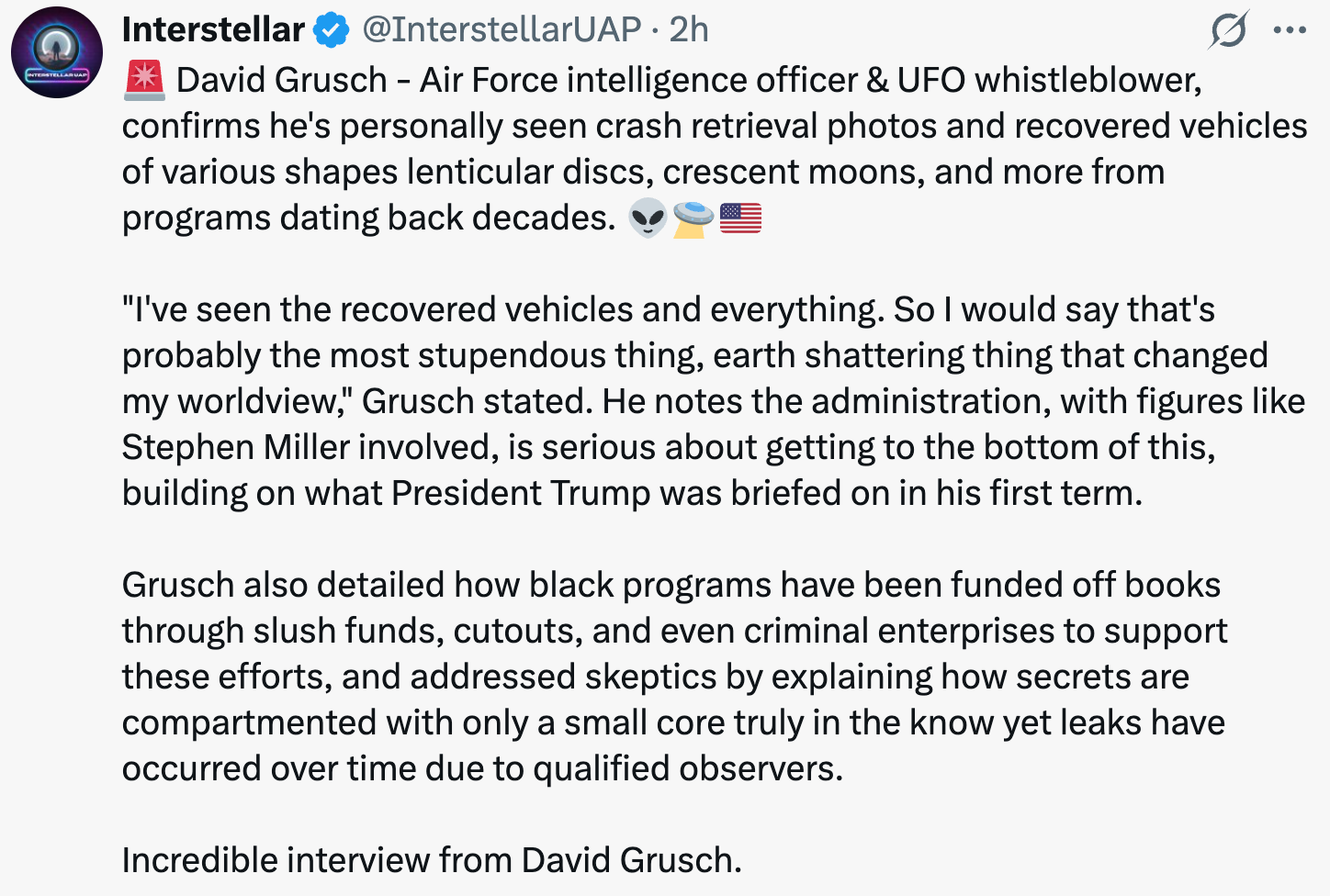
David Grusch - Air Force intelligence officer & UFO whistleblower, confirms he's personally seen crash retrieval photos and recovered vehicles of various shapes lenticular discs, crescent moons, and more from programs dating back decades
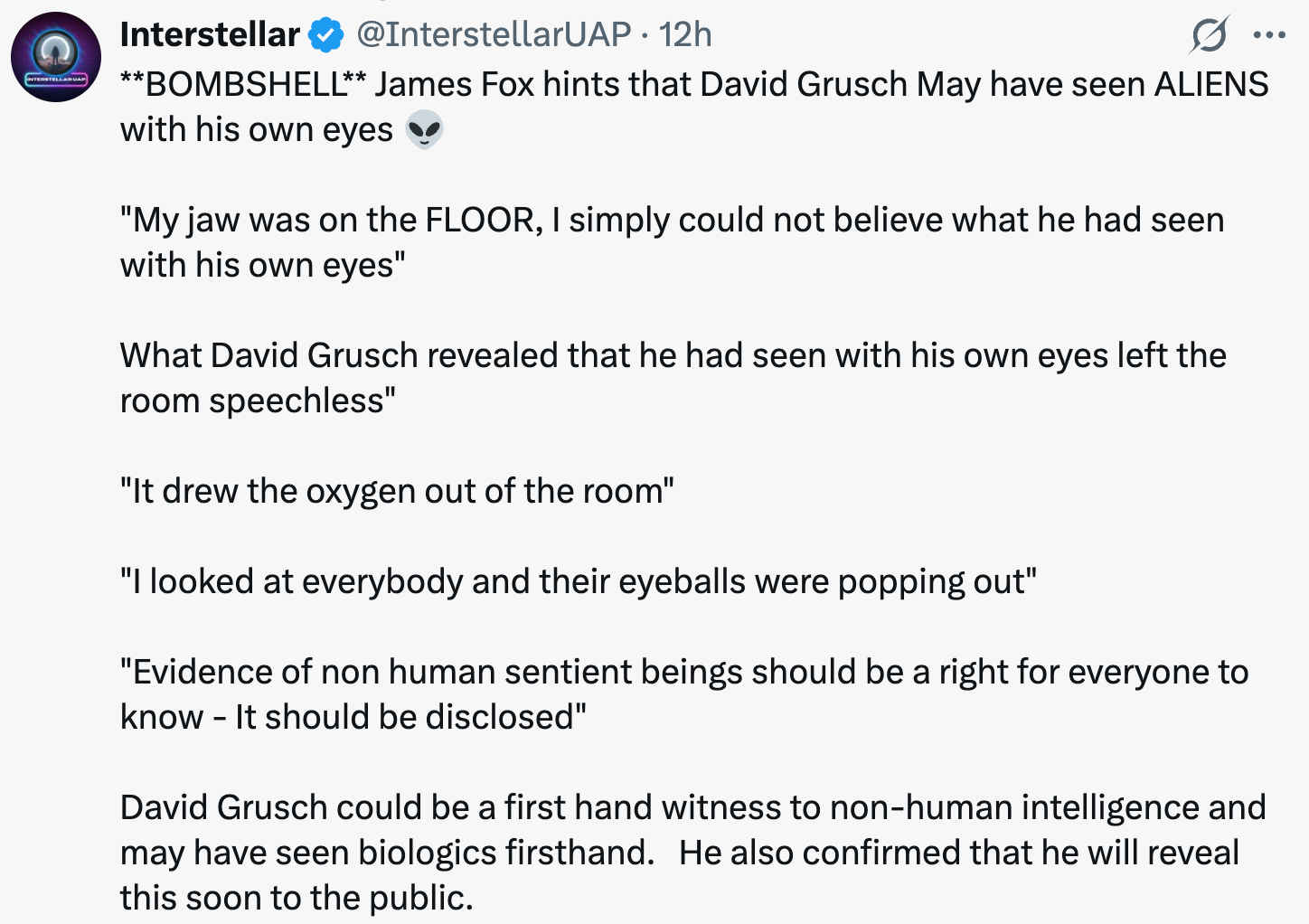
From today
Ross Coulthart reviews ‘Disclosure Day’ | Reality Check with Ross Coulthart
As the world packs theatres to watch Steven Spielberg’s newest UFO film, real-world disclosure is happening in real time. NewsNation and Ross Coulthart have been at the forefront of driving that conversation with history-making whistleblower interviews.
In this TV special, Ross brings us a cinematic, investigative journey through the history of UFO disclosure: from ancient sightings and Roswell to modern whistleblowers, congressional hearings, declassified files and Hollywood’s fascination with the phenomenon.
Including new interviews with Steven Spielberg, Colman Domingo, Emily Blunt and screenwriter David Koepp, the show also includes a behind-the-scenes look at the making of the movie from a NewsNation reporter who makes a cameo. Ross also shares some behind-the-scenes footage from his landmark interviews, including David Grusch, Lue Elizondo and Jake Barber. Brian Entin also visits Area 51, staking out the legendary place at night. Plus: George Knapp details his famous interview with Bob Lazar.