CRASH!!

Dow Jones Industrial Average PLUNGES 2,448 points. . . -6.00%
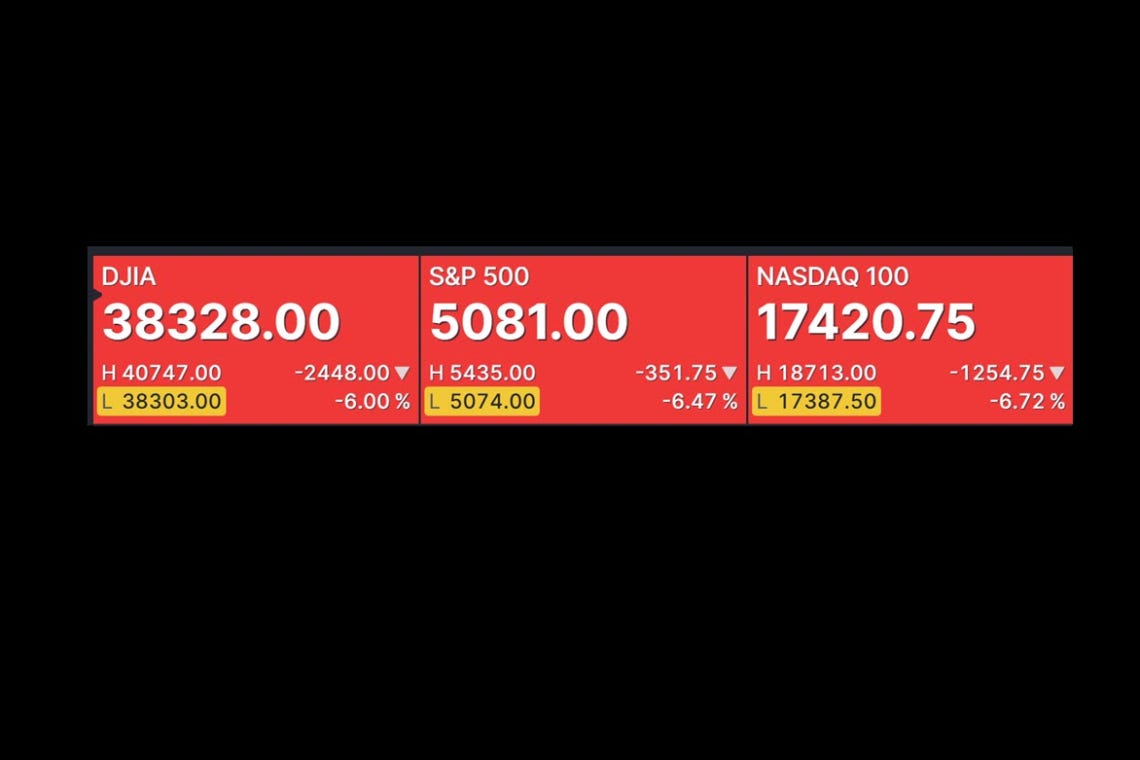
Stock Markets here in the United States have finished trading for the week. The Dow plunged Two-Thousand Four-Hundred Forty-eight (2,448.) points or SIX PERCENT today.
$3.25 trillion wiped out from the US stock market today.
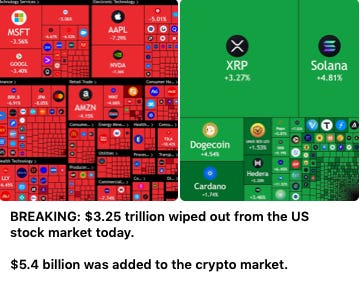
Mid-Day Update: PARIS, FRANKFURT, LONDON, AND ROME STOCK MARKETS ALL DOWN AGAIN . . .
European Stock Markets are finishing-up their trading week. Today has not been a good day over there:
Paris -3.8%
Frankfurt -3.3%
London -3.7%
Rome -7.79
Here in the USA, today alone, some $2.8 TRILLION has been wiped out in market value today alone; but they are still open and can redeem some of those losses.
All of this volatility is being blamed on the Tariffs applied by President Trump against 185 countries, yesterday.
But results from those Tariffs are already yielding positive aspects:
VIETNAM WANTS TO CUT THEIR TARIFFS TO ZERO
President Trump this morning reports “Just had a very productive call with To Lam, General Secretary of the Communist Party of Vietnam, who told me that Vietnam wants to cut their tariffs down to ZERO if they are able to make an agreement with the U.S. I thanked him on behalf of our country and said I look forward to a meeting in the near future.”
THAILAND WANTS TO NEGOTIATE
Thailand to Negotiate With the US on 36% Imposed Tariff, according to their Prime Minister
Next: everyone else
Worrisome: Japan Bank Stocks Plummeting
Get to the bank this morning and get yourself SOME cash money. Not for paying bills; but to survive. Money to pay for food, medicine, and fuel. Bank shares tanked across the globe on Friday as fears of a recession swept through markets in the wake of U.S. President Donald Trump announcing the highest tariff walls in a century. Japan Banks are hit hard.
(Hal Turner Remark: This is the largest decline in 40 years. Shit is hitting the fan. Could have full blown financial crisis by next week.)
Mitsubishi UFJ Financial Group, (MUFG, 8306.T) fell 8.5% on Friday for a weekly loss of 20%
Mizuho Financial Group (MFG, 8411.T) fell 11% on Friday and more than 22% for the week
Sumitomo Mitsui Financial Group (SMFG, 8316.T) slid 8% on the day and more than 20% for the week
European banking stocks had tanked 10% by 1100 GMT and the financials sector was the biggest faller in the STOXX Europe 600.
BIGGESST BANK LOSSES SINCE 2008
In Asia, Japanese megabanks ended the week with the biggest losses since the financial crisis of 2008 in one of the markets' most unsettling signals so far about the consequences of Trump's trade war.
Banks, as barometers of growth, are seeing their shares hammered as the U.S. breaks with the free trade order that it built up over decades. Investors are bracing for falling spending, a sharp decline in loan demand and deal volumes to crater.
"Bank stock valuations tell us investors are leaning toward the bear case for banks becoming a reality," according to Raymond James, pointing to investor expectations for a recession in 2025.
U.S. banks also extended declines in premarket trade, after crumbling to their lowest in months on Thursday. JPMorgan Chase fell 4%. Wall Street powerhouses Goldman Sachs and Morgan Stanley fell 3% and 4%, respectively.
A universal 10% tariff on U.S. imports is set to take effect on April 5, followed by further levies on dozens of countries as Washington erects the steepest trade barriers in more than 100 years.
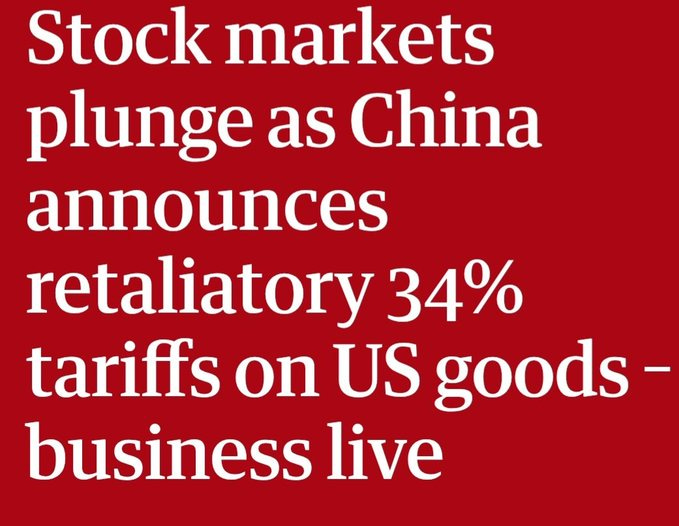
Mounting fears of retaliation, which Trump officials have warned could escalate the dispute further, have also led some to shorten their odds on a recession coming to pass.
China's finance ministry said on Friday it will impose additional tariffs of 34% on all U.S. goods from April 10.
The drop in shares is a sharp reversal for the banking sector, which a few months ago was riding high on post-election optimism. While the tariffs don't hit banks head-on, they may prompt companies to pause M&A plans and erode consumer sentiment, which can ultimately hit investment banking fees and slow loan demand.
Fitch Ratings' head of North American Banks Christopher Wolfe said that banks may have to start setting aside bigger provisions for potential loan defaults, especially if tariffs stay in place for a prolonged period. This is going to start triggering the CDS (Credit Default Swaps), which implicates . . . derivatives!
Starting next week, U.S. banks will offer insights into their strategies for navigating the turmoil, with JPMorgan, Morgan Stanley, Wells Fargo and BNY set to kick-off the earnings season.
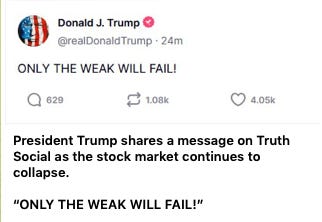
"Trump is purposely crashing the stock market."
Trump posted this video on Truth Social
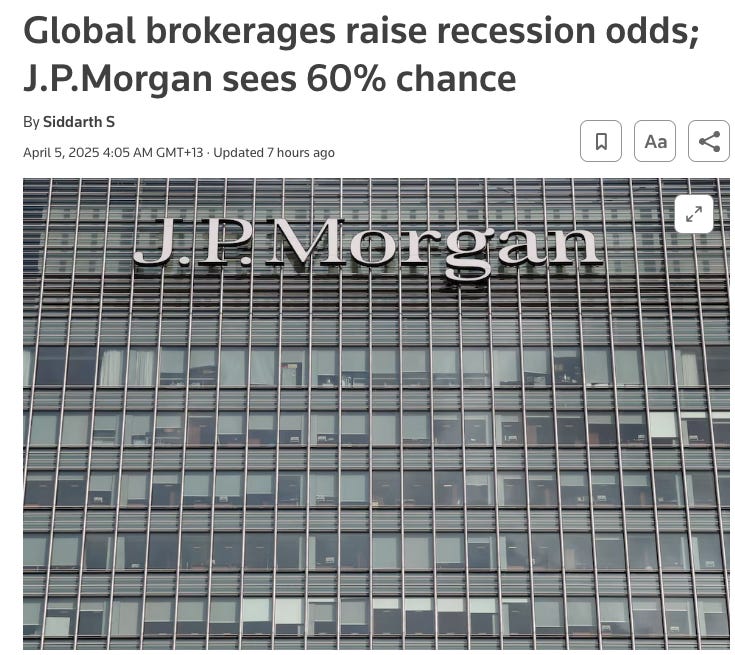
JPM raises recession odds from its previous estimate of 40%
S&P Global, Goldman also hike US recession probability
Barclays, BofA, Deutsche Bank warn of higher recession risks
RBC, UBS cut S&P 500's year-end targets
Brokerages expect more Fed rate cuts if tariffs remain
Tariff countdown triggers shopping spree: Americans rush to buy key goods before Donald Trump’s trade war hits their wallets
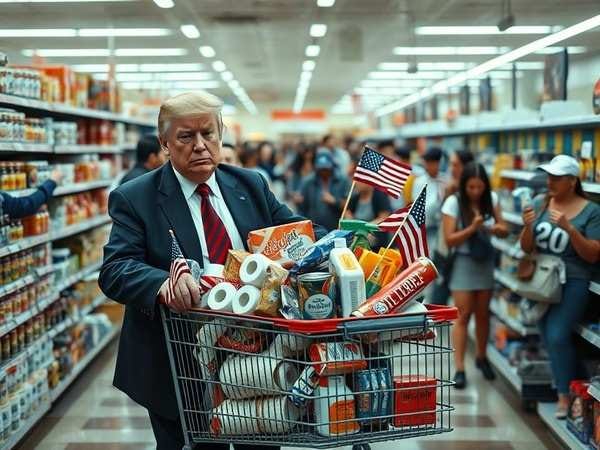
Americans rush to stock up as Trump’s tariffs spark shopping frenzy - A wave of panic buying is sweeping across the United States as President Donald Trump’s global tariff rollout begins to take hold. With prices expected to surge on essential items like shoes, furniture, cars, coffee, and even avocados, Americans are rushing to stores to stock up before the hike hits their wallets.
Leading economists are warning that the brunt of these sweeping tariffs will land squarely on everyday consumers, who are already feeling the squeeze from inflation. From major grocery staples to big-ticket purchases, a wide range of imported goods is expected to become significantly more expensive in just a matter of weeks.
Stock market has seen $9.6 trillion in value erased since President Donald Trump was sworn into office for his second term in January.
U.S. stocks have had a rough go of it since President Donald Trump was sworn into office for his second term in January.
Since Jan. 17, the Friday before Inauguration Day, the U.S. stock market has seen $9.6 trillion in value erased, according to data from FactSet and Dow Jones Market Data. Of those losses, $5 trillion has been erased just over the past two days -- the largest two-day loss on record.
Major equity indexes were seeing their losses deepen in early trading on Friday. The Dow was down by more than 1,200 points in recent trading, bringing its losses since the market opened on Thursday to nearly 3,000 points.
The S&P 500 was down by 3.6%, while the Nasdaq Composite was off by 3.8%, leaving it on the cusp of bear-market territory. The Russell 2000 has fallen by another 4.1% since it became the first major U.S. equity index to enter bear-market territory on Thursday.
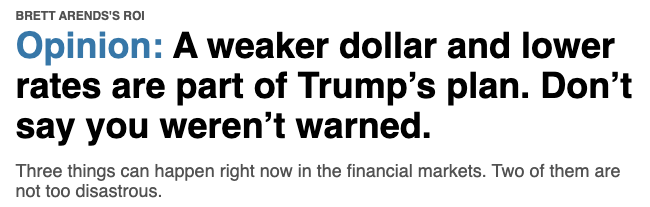
Gerald Celente goes beyond the headlines
EMERGENCY ALERT! The Market Crash is NOW! (the public is about to go nuts!) | Gerald Celente
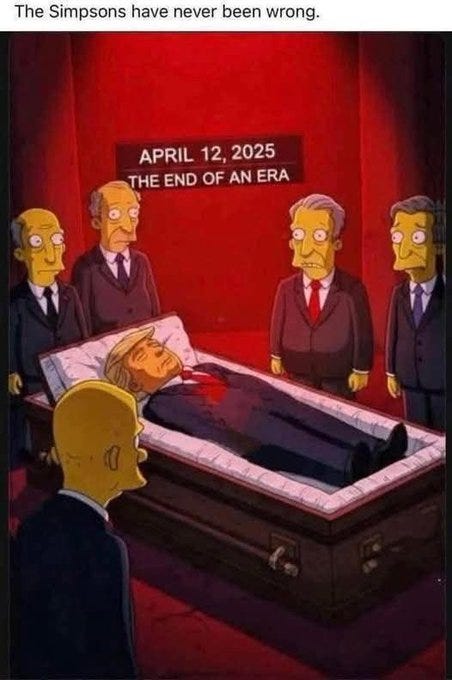
Some people who have no idea of history should contemplate this
The Smoot–Hawley Tariff Act of 1930 was a protectionist trade signed into law in the United States by President Herbert Hoover on June 17, 1930.
The act raised tariffs on over 20,000 imported goods in an effort to shield American industries from foreign competition during the onset of the Great Depression, which had started in October 1929.
The tariffs imposed by the act raised the existing import duties by an average of 20%, to the third highest levels in U.S. history, after the tariffs imposed on the world by President Donald Trump in 2025 and the Tariff of 1828.
In May 1930, Canada, the most loyal trading partner for the U.S., retaliated by imposing new tariffs on 16 products, that accounted altogether for approximately 30% of U.S. exports to Canada. Later, Canada forged closer economic links with the British Empire via the British Empire Economic Conference of 1932. France and Britain protested and developed new trade partners. Germany developed a system of trade via clearing.
U.S. imports decreased 66% from $4.4 billion (1929) to $1.5 billion (1933), and exports decreased 61% from $5.4 billion to $2.1 billion. US gross national product fell from $103.1 billion in 1929 to $75.8 billion in 1931 and bottomed out at $55.6 billion in 1933.[22] Imports from Europe decreased from a 1929 high of $1.3 billion, to $390 million in 1932. U.S. exports to Europe decreased from $2.3 billion in 1929 to $784 million in 1932. Overall, world trade decreased by some 66% between 1929 and 1934.
The economic depression worsened for workers and farmers despite Smoot and Hawley's promises of prosperity from high tariffs.
Keep in mind the element of essentially a complete credit withdrawal from the markets by the central bank and their partner banks on walls street, is what triggered the margin call in 1929. Furthermore, those same banks were quietly going to gold and selling out their stock positions months prior to the crash.
Then the central bank and their partner banks continued to withhold credit from the markets until those with ANY loans against property or fixed assets, were bankrupted and the assets seized by those very same banks. This was done on purpose and they had written many papers about how they were going to do it several years before they executed the crash scenario.
The Great Depression was NOT caused solely by the tariffs that Hoover put into place. Tariffs was how the federal government was funded for more than a century prior to the creation of the federal reserve. Those who do not know the actual history of these parasites from the central bank / crony banks, often make the fatal mistake of blaming the Great Depression on the tariffs alone.
I had expected a deeper analysis and truth on this critical subject.