CONTEXT (2019): Robert Fisk Exposes Israel’s Hidden Role in the Brewing India-Pakistan Conflict

I have been watching Sky News and in particular their aggressive interviewing of the Pakistan Minister of Information, saying, as they do with India that “India has the right to defend itself against terrorism”.
India Pak Tensions| Pakistan Defence Minister Admits Supporting Terrorism, Says Doing US' Dirty Work
However, there is a history to all this.
Firstly, I found a piece I posted to my blog back in 2019.
Robert Fisk on India, Kashmir and Pakistan
Robert Fisk does not take prisoners; he has been very vocal over the years about the dangers of Pakistan.
Now he gives his take on the latest conflict – especially the danger of Israel's involvement.
For months, Israel has been assiduously lining itself up alongside India’s nationalist BJP government in an unspoken – and politically dangerous – “anti-Islamist” coalition, an unofficial, unacknowledged alliance, while India itself has now become the largest weapons market for the Israeli arms trade.
Being coy doesn’t change the reality of modern Pakistan — a a corrupt,politically savage, and physically broken society
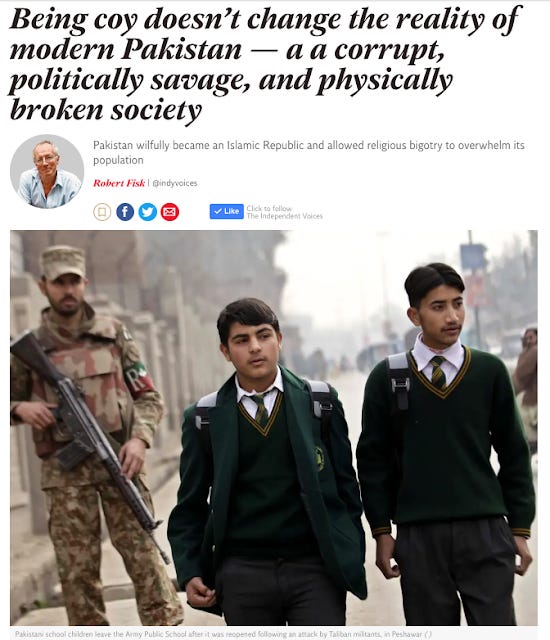
Pakistan wilfully became an Islamic Republic and allowed religious bigotry to overwhelm its population
Israel is playing a big role in India’s escalating conflict with Pakistan
Signing up to the ‘war on terror’ – especially ‘Islamist terror’ – may seem natural for two states built on colonial partition whose security is threatened by Muslim neighbours
Robert Fisk
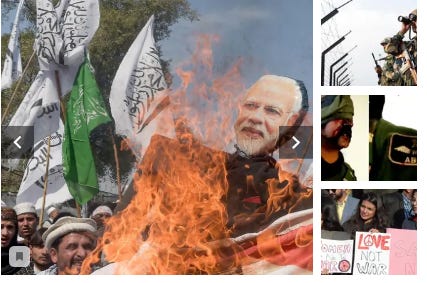
28 February, 2019
When I heard the first news report, I assumed it was an Israeli air raid on Gaza. Or Syria. Airstrikes on a “terrorist camp” were the first words. A “command and control centre” destroyed, many “terrorists” killed. The military was retaliating for a “terrorist attack” on its troops, we were told.
An Islamist “jihadi” base had been eliminated. Then I heard the name Balakot and realised that it was neither in Gaza, nor in Syria – not even in Lebanon – but in Pakistan. Strange thing, that. How could anyone mix up Israel and India?
Well, don’t let the idea fade away. Two thousand five hundred miles separate the Israeli ministry of defence in Tel Aviv from the Indian ministry of defence in New Delhi, but there’s a reason why the usual cliche-stricken agency dispatches sound so similar.
For months, Israel has been assiduously lining itself up alongside India’s nationalist BJP government in an unspoken – and politically dangerous – “anti-Islamist” coalition, an unofficial, unacknowledged alliance, while India itself has now become the largest weapons market for the Israeli arms trade.
Not by chance, therefore, has the Indian press just trumpeted the fact that Israeli-made Rafael Spice-2000 “smart bombs” were used by the Indian air force in its strike against Jaish-e-Mohammed (JeM) “terrorists” inside Pakistan.
Like many Israeli boasts of hitting similar targets, the Indian adventure into Pakistan might owe more to the imagination than military success. The “300-400 terrorists” supposedly eliminated by the Israeli-manufactured and Israeli-supplied GPS-guided bombs may turn out to be little more than rocks and trees.
But there was nothing unreal about the savage ambush of Indian troops in Kashmir on 14 February which the JeM claimed, and which left 40 Indian soldiers dead. Nor the shooting down of at least one Indian jet this week.
India was Israel’s largest arms client in 2017, paying £530m for Israeli air defence, radar systems and ammunition, including air-to-ground missiles – most of them tested during Israel’s military offensives against Palestinians and targets in Syria.
Israel itself is trying to explain away its continued sales of tanks, weapons and boats to the Myanmar military dictatorship – while western nations impose sanctions on the government which has attempted to destroy its minority and largely Muslim Rohingya people. But Israel’s arms trade with India is legal, above-board and much advertised by both sides.
The Israelis have filmed joint exercises between their own “special commando” units and those sent by India to be trained in the Negev desert, again with all the expertise supposedly learned by Israel in Gaza and other civilian-thronged battlefronts.
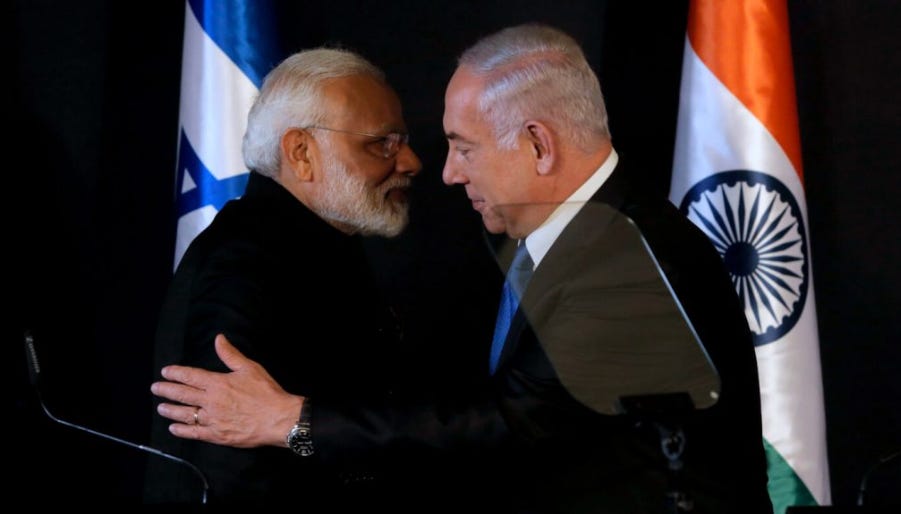
At least 16 Indian “Garud” commandos – part of a 45-strong Indian military delegation – were for a time based at the Nevatim and Palmachim air bases in Israel. In his first visit to India last year – preceded by a trip to Israel by nationalist Indian prime minister Narendra Modi, Israeli PM Benjamin Netanyahu recalled the 2008 Islamist attacks on Mumbai in which almost 170 civilians were killed. “Indians and Israelis know too well the pain of terrorist attacks,” he told Modi. “We remember the horrific savagery of Mumbai. We grit our teeth, we fight back, we never give in.” This was also BJP-speak.
Several Indian commentators, however, have warned that right-wing Zionism and right-wing nationalism under Modi should not become the foundation stone of the relationship between the two countries, both of which – in rather different ways – fought the British empire.
Brussels researcher Shairee Malhotra, whose work has appeared in the Israeli newspaper Haaretz, has pointed out that India has the world’s third largest Muslim population after Indonesia and Pakistan – upward of 180 million people. “The India-Israel relationship is also commonly being framed in terms of a natural convergence of ideas between their ruling BJP and Likud parties,” she wrote last year.
Hindu nationalists had constructed “a narrative of Hindus as historically victims at the hands of Muslims”, an attractive idea to those Hindus who recall partition and the continuing turbulent relationship with Pakistan.
In fact, as Malhotra pointed out in Haaretz, “Israel’s biggest fans in India appear to be the ‘internet Hindus’ who primarily love Israel for how it deals with Palestine and fights Muslims.
Malhotra has condemned Carleton University professor Vivek Dehejia for demanding a “tripartite” alliance between India, Israel and the US – since they have all suffered “from the scourge of Islamic terrorism”.
In fact, by the end of 2016, only 23 men from India had left to fight for Isis in the Arab world, although Belgium, with a population of only half a million Muslims, produced nearly 500 fighters.
Malhotra’s argument is that the Indian-Israeli relationship should be pragmatic rather than ideological.
But it is difficult to see how Zionist nationalism will not leach into Hindu nationalism when Israel is supplying so many weapons to India – the latest of which India, which has enjoyed diplomatic relations with Israel since 1992, has already used against Islamists inside Pakistan.
Signing up to the “war on terror” – especially “Islamist terror” – may seem natural for two states built on colonial partition whose security is threatened by Muslim neighbours.
In both cases, their struggle is over the right to own or occupy territory. Israel, India and Pakistan all possess nuclear weapons. Another good reason not to let Palestine and Kashmir get tangled up together. And to leave India’s 180 million Muslims alone.
And Whitney Webb
Robert Fisk Exposes Israel’s Hidden Role in the Brewing India-Pakistan Conflict
Robert Fisk recently wrote a very telling and troubling article regarding the outsized role of the state of Israel in the burgeoning tensions between India and Pakistan.
renegade March 5, 2019 5
By Whitney Webb
LONDON — Well-known British journalist Robert Fisk recently wrote a very telling and troubling article in The Independent regarding the outsized role of the state of Israel in the burgeoning tensions between India and Pakistan, two nuclear powers. The story — despite its importance, given the looming threat of nuclear war between the two countries — was largely overlooked by the international media.
The tit-for-tat attacks exchanged between India and Pakistan last week have seen long-standing tensions between the two countries escalate to dangerous proportions, though Pakistan helped to deescalate the situation somewhat by returning and “saving” an Indian pilot whose plane had been shot down in retaliation for India’s bombing of targets in a disputed area administered by Pakistan.
That bombing was retaliation for a car bomb attack launched by Jaish-e-Mohammed (JeM) militants, a group that both India and Pakistan recognize as a terrorist organization, against Indian forces. Some analysts have speculated that India’s decision to bomb this area was made by Indian President Narendra Modi, a Hindu ethno-nationalist, in order to rally his base ahead of upcoming Indian elections in May.
Yet, whatever the reason, the bombing has revealed the close ties that have formed between Modi’s India and Israel, particularly between their militaries. As Fisk notes, following the bombing, Indian media heavily promoted the fact that Israeli-made bombs — specifically, Rafael Spice-2000 “smart bombs” — had been used in the attack. Fisk writes:
Like many Israeli boasts of hitting similar targets, the Indian adventure into Pakistan might owe more to the imagination than military success. The ‘300-400 terrorists’ supposedly eliminated by the Israeli-manufactured and Israeli-supplied GPS-guided bombs may turn out to be little more than rocks and trees.”
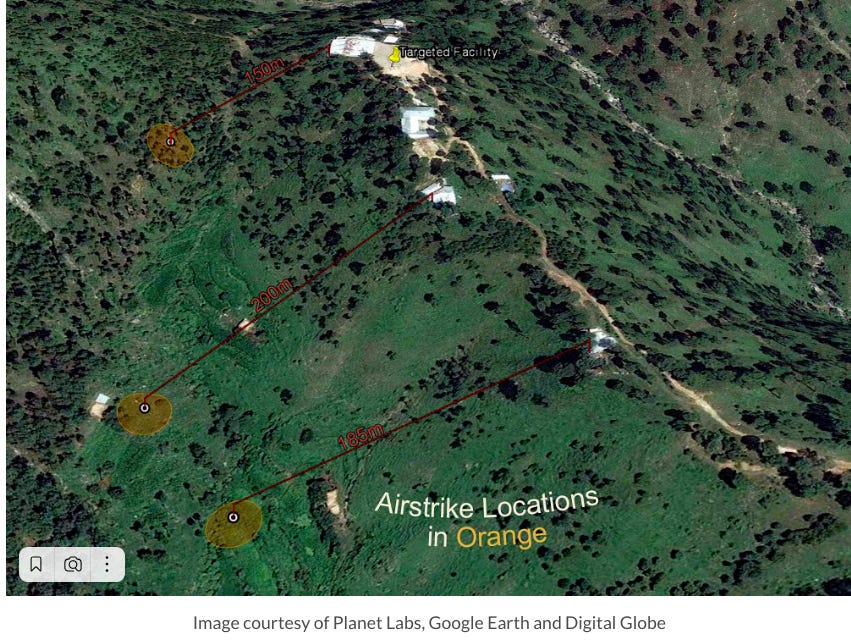
Recently released satellite images seem to corroborate what Fisk predicted, as the bombing failed to hit its intended target and instead damaged a nearby forest.
Exporting oppression
Just as troubling as this military cooperation is that ethnonationalism and anti-Islam rhetoric are increasingly becoming the basis for the relationship between the two countries.
For instance, a recent Haaretz article, written by Shairee Malhotra and cited by Fisk, noted that “the India-Israel relationship is also commonly being framed in terms of a natural convergence of ideas between their ruling BJP and Likud parties.” Other reports have noted that this has translated into more “aggressive” policies from Modi targeting Kashmir and Muslims elsewhere in India and that continued Israeli goading of Modi’s anti-Islam tendencies could make life much more difficult for the estimated 180 million Muslims living in India.
It is difficult to see how Zionist nationalism will not leach into Hindu nationalism when Israel is supplying so many weapons to India – the latest of which India, which has enjoyed diplomatic relations with Israel since 1992, has already used against Islamists inside Pakistan.”
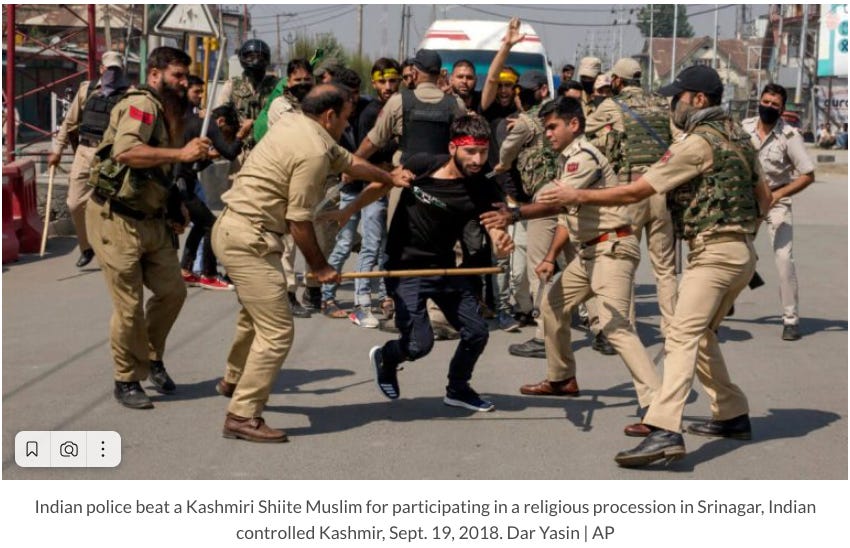
Fisk goes on to note that “[s]igning up to the ‘war on terror’ – especially ‘Islamist terror’ – may seem natural for two states built on colonial partition.” Indeed, India’s actions in the disputed Kashmir region share many similarities to Israel’s neocolonial occupation of Palestine. For instance, the Muslim majority of Kashmir are treated as second-class citizens on their own land and their push for self-determination has been brutally suppressed by Indian forces. As of 2016, 500,000 Indian military personnel in the region were present in the region, roughly equating to one soldier for every 25 civilians. As Al Jazeera noted at the time, there have been more than 70,000 killings, about 10,000 enforced disappearances and 7,000 mass graves found since 1947 in Indian-administered Kashmir.
There are many other parallels between Kashmir and Palestine, including the fact that the British government shares a large share of the responsibility for both. Indeed, the British-brokered partition creating the current states of India and Pakistan in 1947 is the root of the current conflict in Kashmir much as the Britain-mandated creation of the Israeli state in 1948 is the root of the current conflict in Palestine. As far as Kashmiris and Palestinians are concerned, the governments of India and Israel picked up where their colonial master of years past left off.
If a deadly conflict ultimately breaks out between India and Pakistan, it will hardly be the first time Israel has armed controversial governments. Israel sold arms to the Rwandan government during the Rwandan genocide and, more recently, to the government of Myanmar during its “ethnic cleansing” of the Rohingya Muslims. Yet, as Fisk notes, Israel’s export of Zionist nationalism and neocolonialism — and the accompanying oppression that in practice actually helps to create many of the very terrorist groups they fight against — is just as dangerous as its export of arms.
Whitney Webb is a staff writer for MintPress News and has contributed to several other independent, alternative outlets. Her work has appeared on sites such as Global Research, the Ron Paul Institute and 21st Century Wire among others. She also makes guest appearances to discuss politics on radio and television. She currently lives with her family in southern Chile.
****
Here is an assessment on Grok
The 2008 Mumbai attacks, executed by Lashkar-e-Taiba (LeT), have been a significant flashpoint in India-Pakistan relations, often cited in discussions about Pakistan’s alleged support for terrorism and, more recently, India’s actions regarding the Indus Waters Treaty (IWT). Below, I’ll weave the Mumbai attacks into the broader context of Pakistan’s history of alleged terrorism support, as previously outlined, and address the recent developments concerning India’s suspension of the IWT and its implications for shutting off water from the Indus River system. The response will integrate the Mumbai attacks where relevant, incorporate verified information on the IWT suspension, and critically assess the situation, maintaining balance and conciseness.
Historical Context of Pakistan’s Alleged Support for Terrorism
Pakistan’s alleged involvement in supporting militant groups began during the Soviet-Afghan War (1979–1989), when the U.S., via the CIA, channeled billions through Pakistan’s Inter-Services Intelligence (ISI) to arm Afghan mujahideen. This infrastructure, initially backed by Western powers, fostered groups like Lashkar-e-Taiba (LeT), which later targeted India, most notably in the 2008 Mumbai attacks. Pakistan’s strategic aim was to counter India’s influence and secure a pro-Pakistan regime in Afghanistan, a policy that extended to supporting militancy in Kashmir.
Post-Soviet withdrawal, Pakistan backed the Taliban in the 1990s to ensure “strategic depth” against India, creating an ecosystem that enabled groups like LeT to thrive. The Mumbai attacks—a meticulously planned assault from November 26–29, 2008, killing 166 people across multiple sites (e.g., Taj Mahal Hotel, Chhatrapati Shivaji Terminus)—underscored this strategy. LeT operative Ajmal Kasab’s confession and intercepted communications pointed to training camps in Pakistan and ISI logistical support, allegations Pakistan denies, attributing the attack to “non-state actors.”
Allegations of State-Sponsored Terrorism
Pakistan faces accusations from India, the U.S., Afghanistan, and others of supporting terrorist groups, with the Mumbai attacks as a pivotal example:
Kashmir and Mumbai Attacks: India accuses Pakistan of backing LeT and Jaish-e-Mohammed (JeM) for attacks in Jammu and Kashmir and beyond. The Mumbai attacks saw ten LeT operatives, trained in Pakistan, execute a 60-hour siege, targeting civilians and foreigners. U.S. and Indian intelligence, including FBI analysis of phone intercepts, implicated LeT leader Hafiz Saeed and alleged ISI handlers. Pakistan arrested Saeed but released him in 2009, citing insufficient evidence, fueling India’s claims of state complicity. The attacks led to global sanctions on LeT and strained bilateral ties, with India suspending dialogue until 2010. Pakistan’s insistence on “non-state actors” and calls for joint probes have been dismissed by India as evasive.
Afghanistan-Centric Groups: The U.S. accuses Pakistan of sheltering the Afghan Taliban and Haqqani Network. The Mumbai attacks amplified scrutiny of Pakistan’s militant networks, as LeT’s global fundraising overlapped with other ISI-linked groups. The 2011 discovery of Osama bin Laden in Abbottabad further deepened suspicions of Pakistan’s duplicity.
Global Concerns: The Financial Action Task Force (FATF) grey-listed Pakistan (2018–2022) for terrorism financing risks, citing LeT’s operations post-Mumbai. The attacks prompted UN Security Council designation of LeT as a terrorist group, highlighting Pakistan’s role as a hub for such networks.
Domestic Blowback: Pakistan’s selective support for groups like LeT has fueled domestic terrorism, with the Tehrik-i-Taliban Pakistan (TTP) killing thousands (e.g., 2014 Peshawar attack). The Mumbai attacks indirectly strained Pakistan’s counterterrorism efforts, as global pressure forced limited crackdowns on LeT, antagonizing domestic Islamists.
Pakistan’s Official Stance
Pakistan denies state-sponsored terrorism, claiming it is a victim, with 32,000 deaths and $126 billion in losses since 2001. On Mumbai, Pakistan acknowledges LeT’s role but denies ISI involvement, prosecuting seven suspects, including LeT’s Zakiur Rehman Lakhvi, though trials stalled, with Lakhvi bailed in 2015. Pakistan highlights operations like Zarb-e-Azb (2014) and actions against LeT (e.g., Saeed’s 2019 conviction) as evidence of commitment, though critics argue these are symbolic, driven by FATF pressure. Pakistan accuses India of supporting TTP and Balochistan Liberation Army (BLA), citing the 2016 Kulbhushan Jadhav case, which India denies.
Recent Developments: India’s Suspension of the Indus Waters Treaty
In April 2025, following a terrorist attack in Pahalgam, Jammu and Kashmir, killing 26 tourists, India suspended the Indus Waters Treaty (IWT), a 1960 World Bank-brokered agreement allocating the eastern rivers (Ravi, Beas, Sutlej) to India and the western rivers (Indus, Jhelum, Chenab) to Pakistan. India blamed Pakistan for the attack, linking it to cross-border terrorism akin to the Mumbai attacks, and declared the treaty “in abeyance” until Pakistan “credibly abjures” terrorism.
Key Actions and Implications:
Immediate Measures: India has stopped sharing hydrological data, flood warnings, and ceased annual IWT meetings. It has also begun flushing sediments from dams like Baglihar on the Chenab and Kishanganga on the Jhelum, potentially disrupting downstream flows in Pakistan.
Infrastructure Plans: India is enhancing reservoir capacities at projects like Salal and Baglihar and accelerating hydropower projects (e.g., Pakal Dul, Kiru, Kwar, Ratle) on the Chenab, set for completion by 2027–28. These aim to increase India’s control over western river flows, though significant diversion requires years and massive investment.
Impact on Pakistan: The Indus system supports 80% of Pakistan’s agriculture,Rosie, 24% of its GDP, and major cities like Karachi and Lahore. Even minor disruptions, like sediment flushing, could affect crops during key seasons. Pakistan has called the suspension an “act of war,” threatening legal action via the World Bank, International Court of Justice, or UN Security Council.
Limitations:
India’s current infrastructure, primarily “run-of-the-river” hydropower plants, lacks the storage capacity to halt flows immediately. Satellite data and Pakistan’s Indus River System Authority confirm normal river flows as of April 30, 2025. Building diversion canals or large dams could take 4–7 years, with environmental and geopolitical risks.
Mumbai Attacks Connection:
The Pahalgam attack, like Mumbai, was cited by India as evidence of Pakistan’s “sustained cross-border terrorism,” justifying the IWT suspension. Indian officials, including PM Narendra Modi, echoed post-Mumbai rhetoric (e.g., “blood and water cannot flow together” from 2016), framing the suspension as a response to Pakistan’s failure to curb groups like LeT. The Mumbai attacks set a precedent for India’s punitive measures, as they led to global pressure on Pakistan and FATF scrutiny, much like the current push for international accountability.
Critical Analysis
Geopolitical Strategy: The Mumbai attacks and Pahalgam reflect Pakistan’s alleged use of proxies like LeT to counter India’s military edge. India’s IWT suspension mirrors its post-Mumbai diplomatic freeze, using water as a strategic lever, though limited by infrastructure.
U.S. Role: The U.S. funded Pakistan’s militant ecosystem in the 1980s, indirectly enabling LeT’s rise pre-Mumbai. Post-Mumbai, U.S. aid continued ($32 billion post-9/11), complicating blame. Today, U.S. silence on the IWT suspension suggests tacit approval of India’s stance.
Double Game: Pakistan’s post-Mumbai cooperation (e.g., sharing Kasab’s interrogation) contrasted with LeT’s persistence. Similarly, Pakistan’s current counterterrorism claims are undermined by TTP’s resurgence (490 attacks in 2023).
Regional Risks: The IWT suspension, like the Mumbai fallout, risks escalation. Pakistan’s “act of war” rhetoric and China’s potential Brahmaputra River response (supplying 30% of India’s freshwater) could broaden the conflict.
Conclusion
Pakistan’s alleged support for terrorism, exemplified by the 2008 Mumbai attacks, has long fueled India’s punitive actions, culminating in the April 2025 IWT suspension after the Pahalgam attack. India has halted data sharing and begun sediment flushing at dams like Baglihar, but cannot yet stop Indus flows due to infrastructure limits. Pakistan faces agricultural risks, but normal river flows persist as of April 30, 2025. The Mumbai attacks set a precedent for India’s hardline stance, with the IWT suspension echoing post-2008 diplomatic freezes. Pakistan’s denials and counter-accusations, alongside its domestic terrorism challenges, mirror its post-Mumbai narrative, while India’s actions risk regional escalation, potentially involving China. Both nations face a delicate balance, with water weaponization echoing the high stakes of terrorism disputes.
"By deception thou shalt do war." Motto of the Mossad