Climate scientists amit doomsday scenario no longer plausible
RIP RCP 8.5

Since seeing material on data centres that seem to be being built everywhere at some speed and especially the following
I have been thinking that the Powers-that-be might have to find another narrative to support this new line.
It may be that this is it.
I came across this this morning.
Here are more details
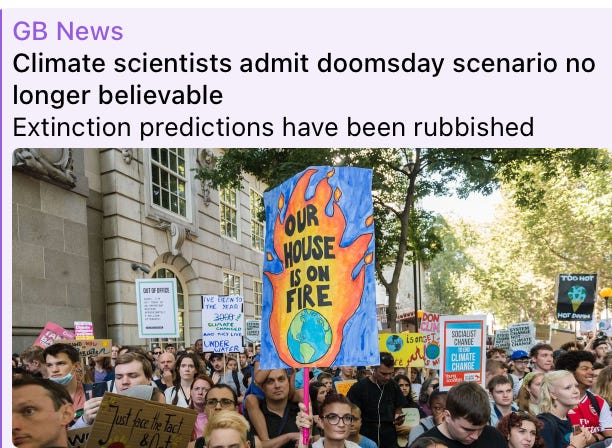
6 May, 2026
Climate scientists have dropped their most apocalyptic forecasts on global warming after finding they were “implausible”.
Scientists and the media have long quoted from the IPCC’s worst-case scenarios, which foresaw temperatures soaring by up to 5C, massive sea level rises and global crop failures.
Some even predicted it could ultimately bring about extinction events on the scale of the dinosaurs.
But now modellers working for the UN-backed IPCC, which provides climate change information to governments, say the chances of this worst-case scenario actually happening are “negligible”.
The scenario was known as RCP 8.5 and, later, SSP5 8.5.
Researchers say it was intended “to explore an unlikely high-risk future” but it was “widely used by some experts, policymakers and the media as something else entirely: as a likely ‘business as usual’ outcome”.
It has been cited more than 45,000 times in academic papers and fed through to informing policy.
Scientific journals claimed that the RCP 8.5 path would lead to mass oceanic extinctions, leading to the New York Times warning: “Under the high emissions scenario that the scientists modelled, in which pollution from the burning of fossil fuels continues to climb, warming would trigger ocean species loss by 2300 that was on par with the five mass extinctions in Earth’s past.
“The last of those wiped out the dinosaurs.”
When Extinction Rebellion’s Roger Hallam faced criticism for claiming “six billion people will die this century as a result of climate change”, supporters pointed to the RCP 8.5 predictions to back him up.
But critics have long argued that the worst-case scenario painted an unrealistically bleak picture of the future because it relied heavily on unproven modelling data.
They also said that it also assumed the world would massively increase its use of coal for the next 75 years.
Now the scientists behind the official UN climate modelling system appear to agree it no longer reflects reality.
They say that the worst case has been avoided because of climate policy and the lower costs of renewables.
Writing in journal Geoscientific Model Development, experts behind the models that will be fed into the next IPCC reports said that the old worst-case scenario would be dropped.
They wrote: “The scenarios should cover plausible outcomes ranging from a high level of climate change (in the case of policy failure) to low levels of climate change resulting from stringent policies.
“For the 21st century, this range will be smaller than assessed before: on the high-end of the range, the high emission levels (quantified by SSP5-8.5) have become implausible, based on trends in the costs of renewables, the emergence of climate policy and recent emission trends.”
Climate scientist Zeke Hausfather and climate researcher Glen Peters warned in 2020 that the scenario was being misunderstood.
Writing in Nature, they said: “RCP8.5 was intended to explore an unlikely high-risk future.”
But they warned it had been “widely used by some experts, policymakers and the media as something else entirely: as a likely ‘business as usual’ outcome”.
They added the scenario required “an unprecedented fivefold increase in coal use by the end of the century”.
Despite that, the scenario became hugely influential.
The new climate framework no longer includes an ‘8.5’ scenario - instead, the highest future warming prediction has been replaced with a less extreme version that assumes lower emissions and lower warming.
However the scientists still warn the planet could warm by roughly 3C this century under a new high-end scenario -enough to bring climate disruption, rising seas and more extreme weather.
Such an increase could also wipe out coral reefs and put the Amazon rainforest at risk.
Energy analyst Michael Liebreich, founder of Bloomberg New Energy Finance, has spent years criticising use of the old scenario.
He has said in a previous interview: “Anyone with eyeballs can see the absurdity of RCP 8.5, which would require growing coal use 7x through to 2100.”
He also accused parts of the climate movement of relying too heavily on frightening worst-case scenarios.
“The tragedy,” he wrote, “is that the climate community spent two decades telling people we were heading for 4°C to 7°C of warming.”
Roger Pielke, professor of environmental studies at the University of Colorado Boulder, called the decision “an absolutely huge development in climate science”. He wrote: “The future is not what it used to be.”
Some scientists and commentators say the row exposes a bigger problem in climate communication.
Steven Koonin, former US Under Secretary for Science under President Obama, has argued that extreme scenarios often dominate public debate because they generate the most dramatic coverage.
He told GB News: “This is not at all a surprise - it’s the latest step in the ongoing retreat from climate alarmism to realism. Expect a similar climb down on claims about extreme weather events and on the benefits of wind and solar energy.”
Speaking to the Hoover Institution, Mr Koonin criticised what he called the “worst, worst, worst case climate projection”.
He said it assumed “that the world is going to massively increase consumption of coal in the future”.
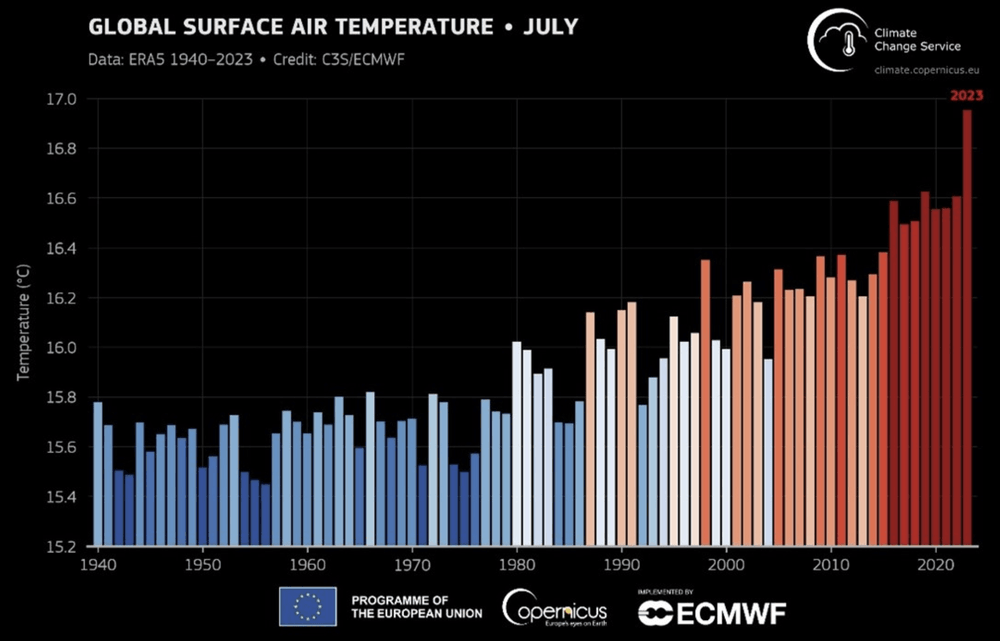
EU scientists say 2023 was the hottest year on record as climate change blamed in official reports | Copernicus Climate Change Service (C3S).
Prof Koonin, former energy advisor to the US government, says the nuance was often lost once the scenario moved from scientific journals into political speeches and media headlines.
Scientists stress that climate scenarios are not predictions.
Instead, they are “what if?” exercises designed to explore how the climate might respond under different conditions.
Supporters of the old 8.5 pathway say it still had scientific value because it helped researchers study high-risk outcomes and prepare for worst cases.
Writing last year, Dr Hausfather said it was unclear whether the improvement in outcome was down to better climate policy or that fact that the original estimates were so high.
He wrote: “Ultimately, the degree to which the improvement in probable 21st century emissions outcomes was due to progress in driving down the costs of clean energy and climate policy interventions vs. implausible assumptions of high future emissions is to a large degree unknowable given its dependence on counterfactual assumptions.”
But he said that emissions had slowed notably and today’s world was a ‘different place’.
“It is hard to rule out the possibility that the 21st century could have ended up dominated by coal—as seemed much more plausible from the vantage point of the mid-2000s—even if it is clearly quite unlikely today,” he wrote.
Here is more
RIP RCP8.5: The IPCC is always the last to admit the obvious
In a blockbuster post at his Substack, Roger Pielke Jr. breaks the news that the elves in the IPCC factory who generate emission scenarios to feed into computer models have decided that, for the next IPCC report, they will finally drop the extreme RCP8.5 scenario and its SSP5-8.5 spawn, having concluded that they are “implausible”. Yeah. No kidding. We knew in 2020, and said it, as did a lot of observers. And while Pielke Jr. applauds the IPCC’s decision, we have little interest in praising them for their newfound scientific probity. They’ve known for a long time that they were pushing a phony scare, and that tens of thousands of “climate impact” studies based on RCP8.5 were bogus, leading to tens of thousands of overhyped media nonsense items all of which they would now call on to be retracted if they were interested in being truthful, and an enormous wave of wasteful government spending based on this induced panic. And it gets worse because, even with their quiet retreat from RCP8.5, the IPCC is still clinging to other exaggerated scenarios. They’re a long way from deserving praise.
The report from the so-called Scenario Model Intercomparison Project or ScenarioMIP drops the admission thickly padded by this noise- and attention-muffling bafflegab (emphasis added):
“As a set, the ScenarioMIP scenarios should thus cover plausible outcomes ranging from a high level of climate change (in the case of policy failure) to low levels of climate change resulting from stringent policies. For the 21st century, this range will be smaller than assessed before: on the high-end of the range, the CMIP6 high emission levels (quantified by SSP5-8.5) have become implausible, based on trends in the costs of renewables, the emergence of climate policy and recent emission trends (Hausfather and Peters, 2020). At the low end, many CMIP6 emission trajectories have become inconsistent with observed trends during the 2020–2030 period.”
It’s not just soporific, it’s untrue. Because as Pielke Jr. notes, RCP8.5 and SSP5-8.5 have not “become” implausible, and their status certainly hasn’t changed due to policy success or the declining costs of renewables. They never were plausible. Not even remotely. And what policy success? Or declining costs of renewables?
The IPCC report has 44 authors, all who believe themselves capable of predicting the world in detail a hundred years from now yet who remain completely incapable of describing it today. Which deserves hissing and wagging of the head, not applause.
To get all technical, which surely is the IPCC’s job or should be, RCP8.5 was absurd from the beginning because it proposed a simultaneous collapse of the world economy due to scorching heat and massive global expansion in coal use, the latter being doubly impossible because it was incompatible with known estimates of global coal reserves. Yet when that scenario finally became laugh-out-loud non-credible, SSP5-8.5 carried on the wheeze. Pielke Jr. shows the situation in the following figure:
This graph shows actual and projected annual global CO2 emissions from fossil fuel use and industry. And the dashed lines are the now-obsolete SSP scenarios. The solid lines are the new supposedly-credible scenarios and the black indicators are the projections from the International Energy Agency.
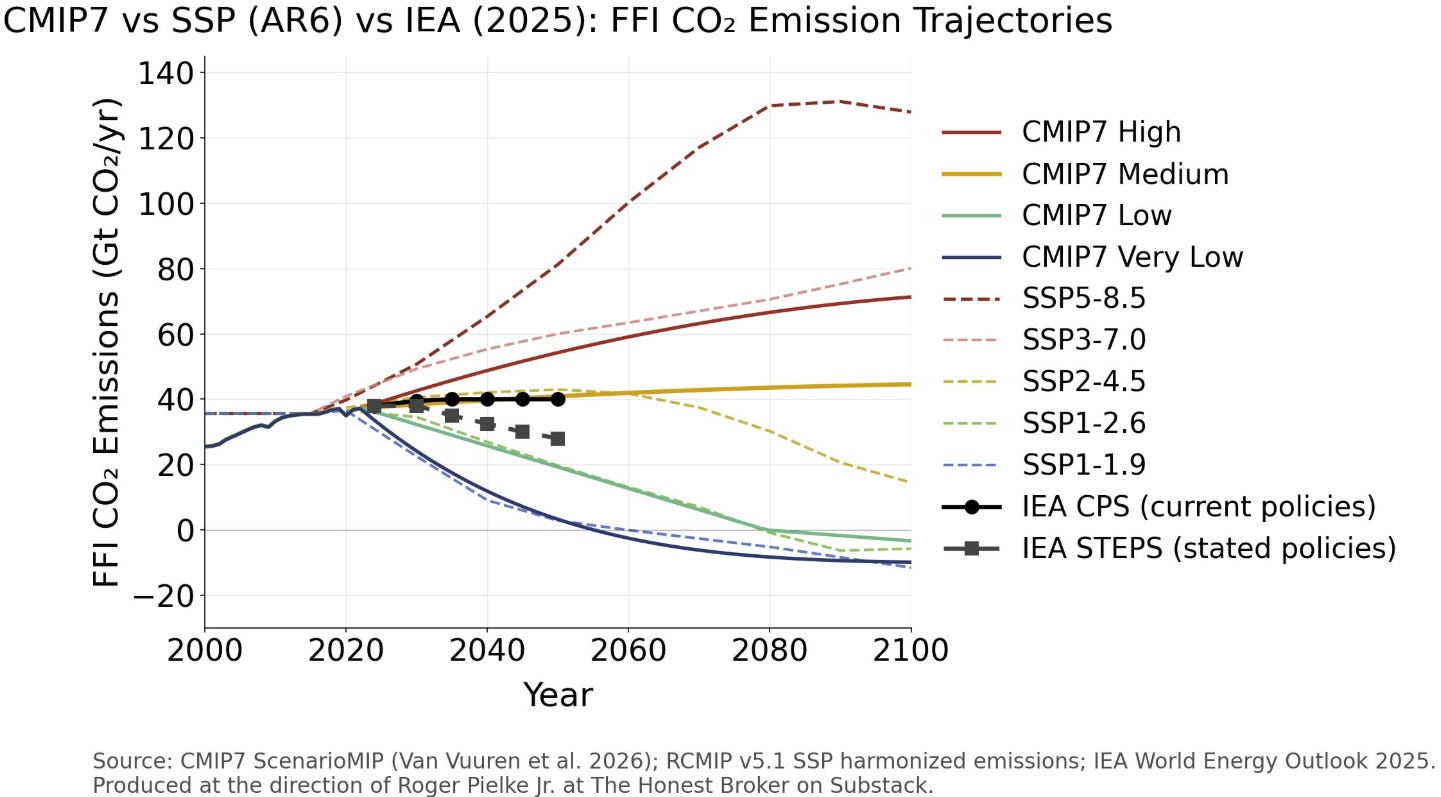
The highest dotted line is SSP5-8.5, which matches the RCP8.5 outcome on which almost all “climate change impacts” studies over the past decade, and certainly all the impacts studies you ever heard about in the media, were based. The next lowest is SSP3-7.0. And immediately below it is “CMIP7 High” which the Scenario elves now call the “high end” of the plausible range. Its annual emissions are less than half those of SSP5-8.5, meaning the IPCC now admits its most heavily-promoted scenarios over the past decade assumed emissions more than double what it now admits is the maximum plausible rate. But look how closely it tracks SSP3-7.0.
As you know, these scenarios were intended to be scary. And indeed they are. But not because climate change is scary. Because the scientists whose job it is to tell us about it spent a decade promoting what they knew was an obvious fiction even long after they had been called out on it. And even after admitting it, they’re carrying on.
As RPJ observes:
“Tens of thousands of research papers have been – and continue to be – published using these scenarios, a similar number of media headlines have amplified their findings, and governments and international organization have built these implausible scenarios into policy and regulation. We now know that all of this is built on a foundation of sand.”
Speaking of sand, the new (CMIP7) Medium scenario is the one in yellow, and it overlaps with the IEA “current policies” scenario, which assumes business-as-usual with no further climate policies. But even those projections may be exaggerated because, as Pielke Jr. notes, the scenario writers are using assumptions about population growth well above mainstream demographic estimates, which take into account the world’s ongoing fertility crash. So take out the new High scenario and put it in the same bin as RCP8.5 and SSP5-8.5.
When you do, what remains is a moderate emissions path which will result in modest, non-alarming warming even if you accept the IPCC’s climate sensitivity assumptions. It’s over, folks. But don’t expect to learn that from the IPCC. They’ll be clinging to their alarmist exaggerations until the next glaciation when they and their media enablers will be entombed in ice wrapped in CMIP7 High.
Here is the article -

This is a factcheck from (Leo) AI
Yes, the IPCC has officially declared that the high-end scenarios, including SSP5-8.5, are now considered implausible. This marks a significant shift in climate science.
Key Details
Scenarios Declared Implausible: The scenarios RCP8.5, SSP5-8.5, and SSP3-7.0 have been ruled out as unrealistic by the international committee responsible for climate modeling.
Reasons for the Shift:
Changes in energy trends and policies have made these extreme scenarios unrealistic.
The new framework reflects a more grounded understanding of future emissions and climate impacts.
Implications
This decision will influence future climate research and policy, as many studies and reports have relied on these previously dominant scenarios. The acknowledgment of their implausibility suggests a need for more realistic modeling in climate science.
I have to say I do not gravitate towards this type of right-wing rhetoric
This seemed pretty reasonable to me
SHOCKER: UN Scientists Call Doomsday Climate Change Predictions “IMPLAUSIBLE!” w/ Tony Heller
It’s sad that this is able to be identified with a Trump narrative
Among a flurry of posts on social media last weekend, US president Donald Trump declared “good riddance” to a specific emissions scenario used in global climate projections.
The “RCP8.5” scenario, which envisages a future of very high carbon emissions, was “wrong, wrong, wrong”, the president wrote in block capitals.
This was “just admitted” by the UN’s “top climate committee”, he falsely claimed, referring to the Intergovernmental Panel on Climate Change (IPCC).
The post was quickly picked up by right-leaning media, amplifying Trump’s misrepresentation of emissions scenarios and the role of the IPCC.
See this from Jimmy Dore and Tony Heller from the video above


Data Centers Are MASSIVELY Damaging Environment & Changing The Climate! w/ Tony Heller
MASSIVE Western Drought No One Is Talking About! w/ Tony Heller
Its one big club!
there is so Much evidence of espionage/treason to put-away so many for so long ...