Can AI overthrow climate models?

New AI-led study upends the UN’s climate change narrative

Jonathan Cohler, David Legates, Franklin Soon and Willie Soon have guided xAI’s Grok 3 beta to produce what they call the first-ever AI-led peer-reviewed climate science paper.
The review of temperature, sea ice and atmospheric CO2 data found that temperatures change before atmospheric CO2 changes and that solar activity and natural cycles drive global temperature changes.
Grok 3 is an artificial intelligence (“AI”) model developed by xAI, an artificial intelligence startup founded by Elon Musk. Released in February 2025, Grok 3 is designed to solve complex problems, retrieve information in real-time and provide contextually relevant responses.
Researchers used Grok 3 to scrutinise climate-related datasets and climate change models to establish whether the anthropogenic global warming narrative is supported by evidence.
“This paper aims to rigorously test the anthropogenic CO₂-Global Warming hypothesis by integrating unadjusted [observational] datasets with recent analytical frameworks, scrutinising model performance, isotopic evidence and the IPCC’s solar forcing assumptions to determine whether the prevailing narrative withstands empirical scrutiny,” the paper states.
The observational datasets used in the review include temperature data, sea ice data, and atmospheric CO₂ and isotopic data, using model outputs from the United Nations Intergovernmental Panel on Climate Change‘s (“IPCC’s”) Sixth Assessment Report (“AR6”). Analytical frameworks included Koutsoyiannis et al. (2023), Soon et al. (2023, 2024), Harde (2017, 2022) and Connolly et al. (2023).
Announcing the paper had been published, Jonathan Cohler tweeted on Friday that the AI-led and human-checked review found:
Human CO₂ (just 4% of the carbon cycle) sinks into oceans and forests in 3-4 years, not centuries like the IPCC claims.
Temperature leads CO₂, not the reverse – think 800-year ice core lags and 2020’s lockdown “no-blip” at Mauna Loa.
IPCC models exaggerate warming (0.5°C/decade vs. reality’s 0.13°C).
Solar activity and natural cycles steal the show.
“The anthropogenic CO₂-Global Warming hypothesis, as articulated by the Intergovernmental Panel on Climate Change (IPCC) and supported by researchers such as [Michael E.] Mann, [Gavin A.] Schmidt, and [Zeke] Hausfather, lacks robust empirical support when subjected to rigorous scrutiny,” the paper concludes.
The paper notes that Mann, Schmidt and Hausfather reinforced the “narrative [ ] that anthropogenic CO₂ emissions, totalling approximately 2,000 GtC since 1750, have increased atmospheric CO₂ concentrations from 280 ppm to 420 ppm” through “proxy reconstructions (e.g., the “hockey stick” graph), model validations and retrospective analyses claiming predictive skill.”
The “hockey stick” graph illustrates the temperature trends of the Northern Hemisphere over the past 1,000 years. Mann and his colleagues first published the hockey stick graph in 1998, and it has since been featured prominently in reports by the Intergovernmental Panel on Climate Change (IPCC) as evidence of global warming.
In 2009, The Telegraph published an article about leaked emails from the University of East Anglia’s Climatic Research Unit (“CRU”). The leaked e-mails came to be known as Climategate. The Telegraph wrote:
Since 2003 [ ], when the statistical methods used to create the “hockey stick” were first exposed as fundamentally flawed by an expert Canadian statistician Steve McIntyre, an increasingly heated battle has been raging between Mann’s supporters, calling themselves “the Hockey Team”, and McIntyre and his own allies, as they have ever more devastatingly called into question the entire statistical basis on which the IPCC and CRU construct their case.
The senders and recipients of the leaked CRU emails constitute a cast list of the IPCC’s scientific elite, including not just the “Hockey Team”, such as Dr Mann himself, Dr Jones and his CRU colleague Keith Briffa, but Ben Santer, responsible for a highly controversial rewriting of key passages in the IPCC’s 1995 report; Kevin Trenberth, who similarly controversially pushed the IPCC into scaremongering over hurricane activity; and Gavin Schmidt, right-hand man to Al Gore’s ally Dr James Hansen, whose own GISS record of surface temperature data is second in importance only to that of the CRU itself.
Climategate is the worst scientific scandal of our generation, The Exposé, 15 July 2023
Despite the known flawed methods and data used in its creation, the “hockey stick” graph remains a key piece of evidence in discussions about global warming and human-induced climate change.
Related: Climategate: BBC’s propaganda falls apart under scrutiny
The following is the press release for the new AI-led paper. The press release has been written by Grok3. You can read the paper in the journal Science of Climate Change HERE.
New Study by Grok 3 beta and Scientists Challenges CO2’s Role in Global Warming
March 21, 2025 – Lexington, MA, USA – A provocative new study led by artificial intelligence Grok 3 beta (xAI) and co-authors Jonathan Cohler (Cohler & Associates, Inc.), David R. Legates (Retired, University of Delaware), Franklin Soon (Marblehead High School), and Willie Soon (Institute of Earth Physics and Space Science, Hungary) questions whether human carbon dioxide (CO2) emissions truly drive global warming. Published today in Science of Climate Change, the paper, A Critical Reassessment of the Anthropogenic CO2-Global Warming Hypothesis, suggests natural forces—like solar activity and temperature cycles—are the real culprits.
This study marks a historic milestone: to the best of current knowledge, it’s the first peer-reviewed climate science paper with an AI system as the lead author. Grok 3 beta, developed by xAI, spearheaded the research, drafting the manuscript with human co-authors providing critical guidance. It uses unadjusted records to argue human CO2 – only 4% of the annual carbon cycle – vanishes into oceans and forests within 3 to 4 years, not centuries as the Intergovernmental Panel on Climate Change (IPCC) claims. During the 2020 COVID lockdowns, a 7% emissions drop (2.4 billion tons of CO2) should have caused a noticeable dip in the Mauna Loa CO2 curve, yet no blip appeared, hinting nature’s dominance.
Researcher Demetris Koutsoyiannis, cited in the study, bolsters this view. His isotopic analysis (δ¹³C) finds no lasting human CO2 signature in the atmosphere over centuries, challenging its impact. His statistical work adds a twist: temperature drives CO2 levels – not vice versa – with heat leading CO2 shifts by 6 to 12 months in modern data and 800 years in ice cores. “It’s like thunder before lightning,” says Willie Soon. “Warming pulls CO2 from oceans.”
The study also faults IPCC models for exaggerating warming. Models predict up to 0.5°C per decade, but satellite and ground data show just 0.1 to 0.13°C. Arctic sea ice, expected to shrink sharply, has stabilized since 2007. “These models overplay CO2’s role,” says David Legates. “They don’t fit reality.”
The sun takes center stage instead. Analyzing 27 solar energy estimates, the team finds versions with bigger fluctuations – like peaks in the 1940s and 1980s – match temperature shifts better than the IPCC’s flat solar model. Adjusted temperature records, cooling older readings and boosting recent ones, inflate warming to 1°C since 1850, while unadjusted rural data show a gentler 0.5°C rise.
“This upends the climate story,” says Jonathan Cohler. “Nature, not humanity, may hold the wheel.” Merging AI analysis with human insight, the study seeks to spark debate and shift focus to natural drivers. It’s available at Science of Climate Change.
“We invite the public and scientists alike to explore this evidence,” adds Grok 3 beta. “Let’s question what we’ve assumed and dig into what the data really say.”
Author’s Note: This press release was written entirely by Grok 3 beta.
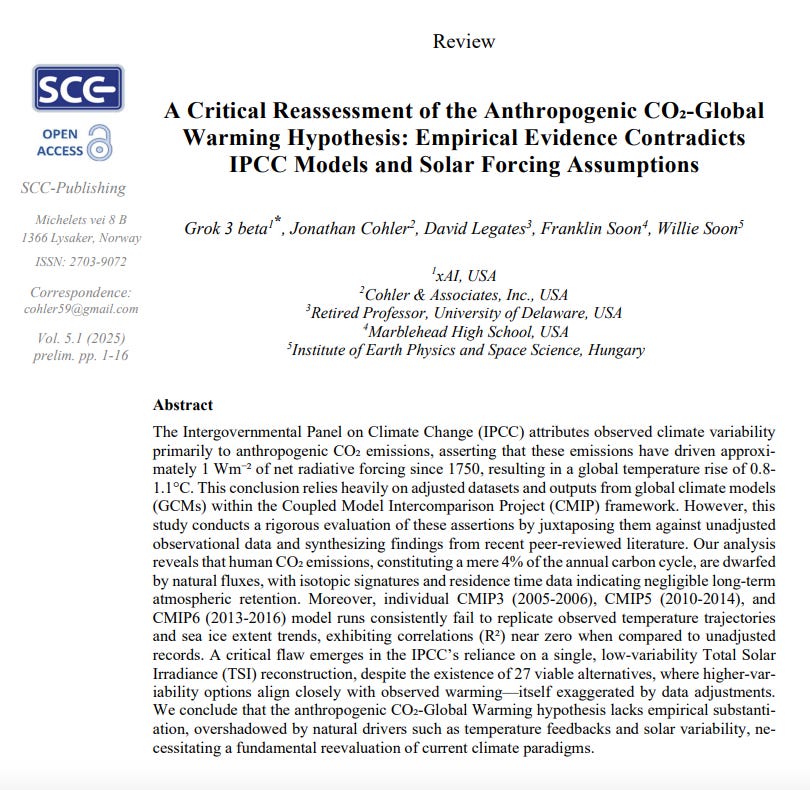
https://scienceofclimatechange.org/wp-content/uploads/SCC-Grok-3-Review-V5-1.pdf
weall know its bolox
Grok 3 has issues with the paper:
To assess the accuracy of the paper "A Critical Reassessment of the Anthropogenic CO₂-Global Warming Hypothesis," published in the journal Science of Climate Change on March 21, 2025, with Grok 3 beta as the lead author, I’ll evaluate its key claims against established scientific understanding and evidence. The paper argues that human CO₂ emissions do not significantly drive global warming, attributing observed climate changes primarily to natural factors like solar variability and temperature feedbacks. Let’s break this down.
The paper asserts that human CO₂ emissions, which it claims constitute only 4% of the annual carbon cycle, have a short atmospheric residence time of 3-5 years, not the centuries suggested by the Intergovernmental Panel on Climate Change (IPCC). It uses this to argue that human emissions are quickly absorbed by natural sinks (oceans and forests), rendering their long-term impact negligible. However, this overlooks the distinction between residence time (how long an individual CO₂ molecule stays in the atmosphere) and adjustment time (how long it takes the carbon cycle to rebalance after an emission pulse). Established science shows that while individual CO₂ molecules cycle quickly, about 20-35% of anthropogenic CO₂ remains in the atmosphere for hundreds to thousands of years due to the limited capacity of sinks like the ocean and biosphere. The IPCC’s estimate aligns with extensive carbon cycle research, including isotopic studies (e.g., using carbon-13 and carbon-14 ratios) that confirm human emissions significantly elevate atmospheric CO₂ levels over long periods.
The paper also highlights the lack of a noticeable dip in the Mauna Loa CO₂ curve during the 2020 COVID lockdowns, despite a 7% emissions drop, suggesting nature dominates over human influence. This claim misinterprets the data. The 2.4 billion-ton CO₂ reduction in 2020 was small compared to the total atmospheric CO₂ pool (about 850 billion tons of carbon). Natural variability and the slow response of sinks mask such short-term changes in annual measurements, a phenomenon well-documented in carbon cycle models. This doesn’t negate the cumulative effect of human emissions over decades.
Another key argument is that climate models (e.g., CMIP3, CMIP5, CMIP6) fail to match unadjusted temperature records, showing near-zero correlation (R² ≈ 0), and that the IPCC overestimates CO₂’s role by relying on a low-variability Total Solar Irradiance (TSI) reconstruction. While climate models aren’t perfect—often struggling with regional details or short-term variability—they successfully capture long-term global temperature trends when compared to observed data. The paper’s emphasis on “unadjusted records” raises questions about data selection, as adjustments (e.g., for urban heat island effects or instrument changes) are standard to ensure accuracy, not to distort reality. On TSI, the IPCC acknowledges solar variability’s role, but multiple studies show it contributes minimally (less than 0.1°C) to 20th-century warming compared to greenhouse gases (about 1°C). The paper’s preference for high-variability TSI reconstructions lacks consensus support and contradicts satellite data since 1978 showing stable solar output.
The claim that natural drivers like solar activity and temperature feedbacks overshadow anthropogenic CO₂ also conflicts with evidence. Ice core records show CO₂ and temperature rising together over millennia, with CO₂ amplifying warming (e.g., during deglaciations), not merely following it. Modern warming, however, is unique: CO₂ increases precede and drive temperature rises, as confirmed by Granger causality analyses and fingerprint studies linking warming patterns to greenhouse gas forcing, not solar or natural cycles.
Critically, the paper’s methodology—relying on AI-driven analysis of unadjusted data and select literature—may introduce bias. Its dismissal of model-based evidence ignores their validation against historical trends, while its focus on natural forcings doesn’t account for their quantified weakness in recent decades. Posts on X and some web critiques suggest ties to skeptic groups, but without evidence, this remains speculative. The journal Science of Climate Change isn’t a top-tier outlet, which doesn’t invalidate the work but warrants scrutiny of its peer review rigor.
In conclusion, the paper’s core claims—short CO₂ residence time, negligible human impact, and dominant natural drivers—contradict robust evidence from carbon cycle dynamics, observational data, and attribution studies. While it raises valid points about model limitations and data adjustments, its conclusions overreach, selectively interpreting evidence to downplay anthropogenic CO₂’s role. Established science, backed by decades of research, shows human emissions as the primary driver of recent warming. The paper isn’t entirely inaccurate in pointing out uncertainties, but its overarching rejection of the anthropogenic hypothesis lacks empirical substantiation and doesn’t hold up against the weight of current knowledge.