A warning from Down-Under

The Australian share market has opened to a sea of red, shedding nearly 6 per cent in response to sharp falls on Wall Street. US President Donald Trump’s announcement of tariffs triggered massive declines on US markets, as fears of a recession spooked investors. ABC finance reporter Alicia Barry says the ASX’s movements in early trade are reminiscent of the Global Financial Crisis (GFC).
Nikkei drops 5 percent
Japanese Prime Minister Shigeru Ishiba said on Monday the government will continue to ask U.S. President Donald Trump to lower tariffs against Japan, but acknowledged results "won't come overnight."
"As such, the government must take all available means" to cushion the economic blow from US tariffs such as offering funding support for domestic firms and taking measures to protect jobs, Ishiba told parliament.
The Nikkei opened on Monday to a drop of just over 5 percent.
- Reuters/RNZ
Circuit breakers have been triggered in Japan's Nikkei 225 and TOPIX stock market indices. Trading is now temporarily halted because losses have been so severe.
Nikkei Stock Average Plummets 8.5%; Lowest Since Oct 2023
NZX drops more than 3% in worst session since Covid-19 pandemic
Companies exporting to the US or with significant US assets or income at risk from a slowdown such as tourism are the hardest hit.
RNZ
Dollar on a roller-coaster
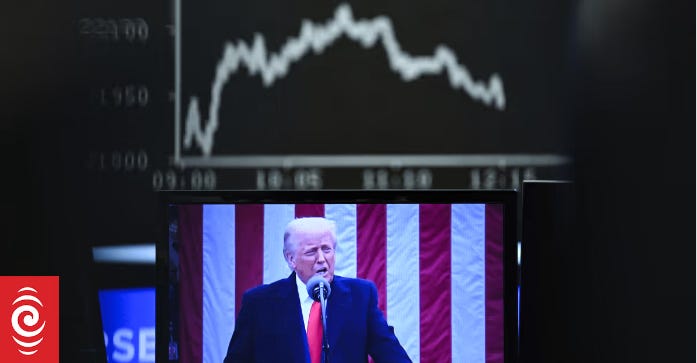
The New Zealand dollar has been on a rollercoaster ride the international markets react to Trump's shock and awe tariff announcements.
The Kiwi initially gained against the US dollar after tariffs were revealed, but plunged nearly 2 cents to around 55.5 US cents on Friday - the lowest level since the start of this year - as markets digested the news, and as China hit back.
(I would have to go back to 1984 for when the $NZ was this low - after devaluation)
BNZ senior markets strategist Jason Wong said the tariffs were possibly worse than the worst-case-scenario. China's retaliatory tariffs played a big part in the Kiwi's movement, including gains against the Australian dollar, he said.
"In this sort of world where there are a lot of doubts about global growth and China at the forefront, it does tend to have a marked impact on very growth-sensitive currencies like the New Zealand dollar."